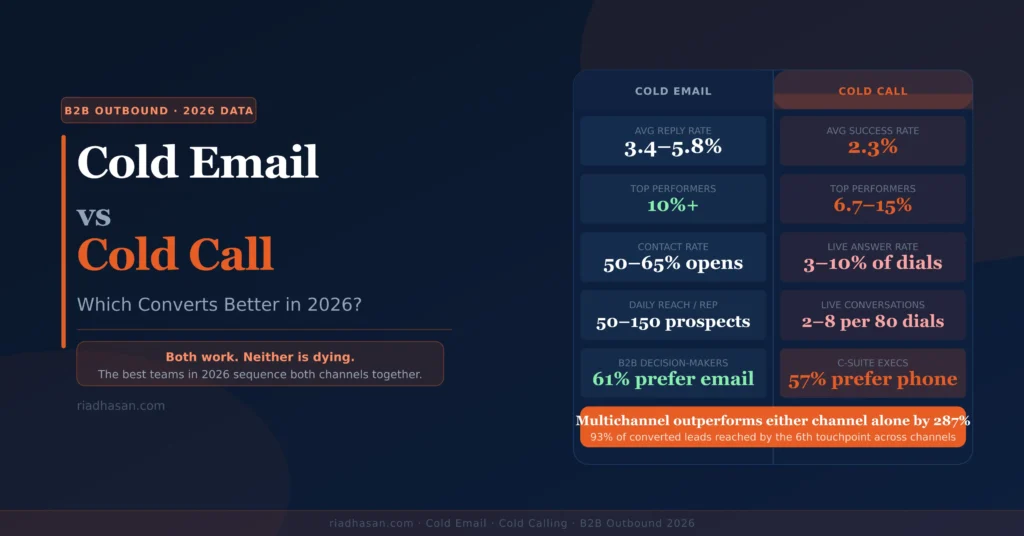
Choosing between cold email vs cold call is one of the first decisions B2B teams face when building outbound. Cold email averages a 3.43–5.8% reply rate in 2026. Cold calling averages a 2.3% success rate and you only reach a live person on 3–10% of your dials. Neither number sounds impressive on its own. But the question of which channel converts better is the wrong question. The right one is which channel fits the situation you’re in.
This guide compares cold email and cold calling across every dimension that matters for a B2B revenue decision: conversion rates, cost, scalability, channel preference by buyer type and when to use each. It also covers email marketing and how it differs from both, plus how to structure a cold call follow-up email when you’ve already had someone on the phone.
Cold Email vs Cold Call: The Data Side by Side
| Metric | Cold Email | Cold Calling |
|---|---|---|
| Average reply/success rate | 3.43–5.8% reply rate | 2.3% success rate (down from 4.82% in 2024) |
| Top performer rate | 10%+ reply rate (tight targeting) | 6.7–15% (precision + multichannel) |
| Contact rate | 50–65% open rate (warmed inbox) | 3–10% of calls reach a live person |
| Daily reach per rep | 50–150 prospects | 50–80 dials, 2–8 conversations |
| Cost per conversation | Low (~$0.10–0.50 per prospect reached) | Higher ($2–$10+ per live conversation) |
| Best send/call time | Tue–Thu, 8–11 AM recipient timezone | 4–5 PM prospect timezone (47% higher connect rate) |
| Buyer preference | 61% of B2B decision-makers prefer email | 57% of C-suite prefer phone |
| Scales without headcount | Yes — automation handles volume | No — every dial needs a human |
These numbers are from 2026 primary research — Cognism’s analysis of 200,000+ calls, Prospeo’s dataset of billions of cold emails and Cleverly’s B2B cold outreach benchmarking study. They tell a clear story: neither channel dominates outright. The gap between average and top-performer rates is wider in cold calling than in cold email. Execution matters more in calling. Infrastructure matters more in email.
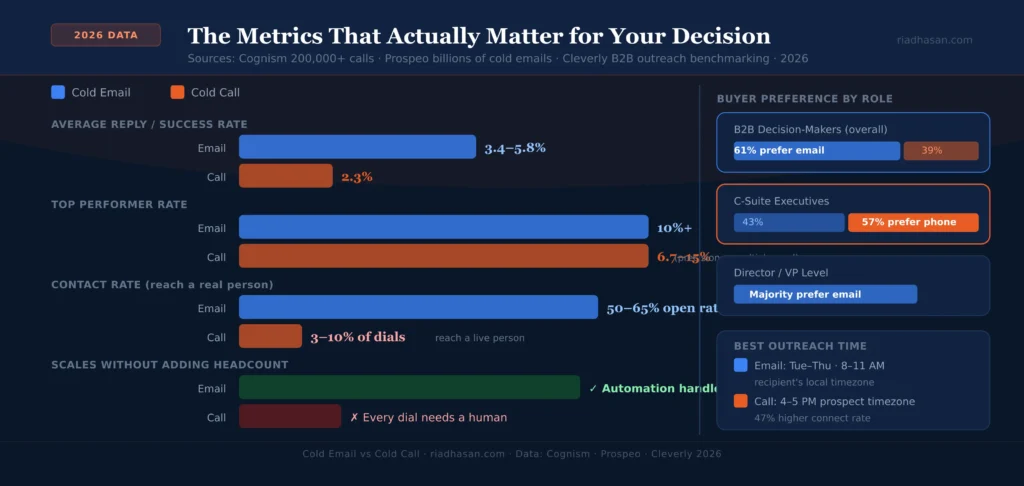
Two numbers stand out from this table. First: 57% of C-suite executives prefer phone, meaning for enterprise decision-makers, cold calling has a structural advantage. Second: 61% of B2B decision-makers overall prefer cold email, meaning for the broader market, email wins by channel preference. The right channel depends on who you’re targeting, not which channel you personally prefer.
The Case for Cold Email
Scale without proportional cost
Cold email’s single biggest operational advantage over cold calling is that it scales without adding headcount. This distinction shapes everything else about when to choose each channel — budget, team size, ICP and deal value all flow from it.
Cold email’s primary structural advantage is that it scales without adding headcount. A single sender can reach 50–150 prospects per day with personalised messages. A cold caller reaches 2–8 live conversations from 50–80 daily dials. To reach 500 prospects in a day via cold calling requires a team. Cold email requires an inbox and a good list.
This is why cold email is the default outreach channel for early-stage companies, agencies and solo operators. The economics work before you have a sales team.
Asynchronous delivery
Cold email arrives when you send it and gets read when the prospect is ready. That asynchronous nature is both a weakness (no immediate conversation) and a strength: the prospect has time to think, research your company and reply on their own schedule. Deals that require deliberation benefit from a channel that allows deliberation.
A written record the prospect keeps
A cold email that doesn’t generate an immediate reply isn’t necessarily dead. Prospects forward emails internally, search for them weeks later when a problem becomes urgent and use them as reference points when evaluating vendors. A cold call that doesn’t convert leaves no trace.
Written proof that persists
A cold email that doesn’t generate an immediate reply isn’t necessarily dead. Prospects forward interesting emails internally, search for them weeks later when a problem becomes urgent and reference them when evaluating vendors. A cold call that doesn’t convert leaves no trace in the prospect’s inbox or memory. The email’s persistence is a long-tail advantage that calling can’t replicate.
Measurable, testable, iteratable
Cold email produces data at every stage: open rate, reply rate, positive reply rate, meeting booked rate. You can A/B test subject lines, opening lines and CTAs across hundreds of prospects simultaneously. Cold calling produces qualitative feedback from individual conversations: valuable, but harder to aggregate into systematic improvement.
The Case for Cold Calling
Real-time conversation
The single biggest advantage of cold calling is immediacy. When a prospect picks up, you can qualify them, handle objections, adjust your pitch in real time and book a meeting before the call ends. A cold email that gets a positive reply still requires a back-and-forth before a meeting lands on the calendar. A cold call can compress that entire cycle into five minutes.
C-suite preference
57% of C-level executives prefer phone as their primary communication channel. For enterprise outreach targeting CEOs, CFOs and boards, cold calling reaches the right preference mode. These are people who make decisions quickly, don’t read long emails carefully and respond to direct conversations. Cold email to a C-suite executive often gets delegated to an EA or ignored entirely.
No inbox competition
A senior executive might receive 140+ emails per day. Their phone rings far less often. A well-timed cold call doesn’t compete with 139 other messages. It competes with silence. The 4–5 PM window in the prospect’s timezone delivers 47% higher connect rates precisely because the executive day has wound down enough that an interruption is less unwelcome.
Speed with time-sensitive triggers
When a trigger event demands speed (a leadership change, a contract expiry window, a company announcement), a cold call can capitalise on it within hours. An email might sit unread for three days. For trigger-driven prospecting where timing is the edge, calling beats emailing.
Cold Email vs Cold Calling: When to Use Each
| Use cold email when… | Use cold calling when… |
|---|---|
| You need volume — targeting 100+ prospects simultaneously | You’re targeting C-suite at enterprise accounts |
| Your offer needs explanation or a written value proposition | Speed matters — a trigger event creates a narrow window |
| You’re targeting director/VP level and below | Deal size justifies higher cost-per-conversation |
| You don’t yet have a sales team | Your ICP responds poorly to email (regulated industries, some GovCon) |
| You want to test messaging before committing rep time | You need immediate feedback on your pitch or offer |
| The buying decision is deliberative and benefits from async communication | You’re following up on a warm email reply to accelerate the meeting |
The Multichannel Answer: Why the Best Teams Use Both
The most common conclusion across every 2026 analysis of cold email vs cold calling is the same: the question itself is wrong. The highest-performing outbound teams don’t choose one channel. They sequence both.
Multichannel outreach combining email, LinkedIn and calls outperforms email-only sequences by up to 287%. 93% of converted leads were reached by the sixth touchpoint. When those touchpoints span multiple channels (an email on day one, a LinkedIn connection on day three, a call on day seven), the conversion rate climbs because the prospect encounters your outreach in the context where they’re most receptive at that moment.
Why the multichannel answer makes sense
93% of converted leads require at least six touchpoints. Most single-channel campaigns top out at four. The gap between what it takes to convert a prospect and what most teams actually deliver is exactly where pipeline gets left on the table. Multichannel fills that gap without requiring six cold emails to the same person — it spreads the touchpoints across channels so each one feels appropriate rather than repetitive.
A practical multichannel sequence
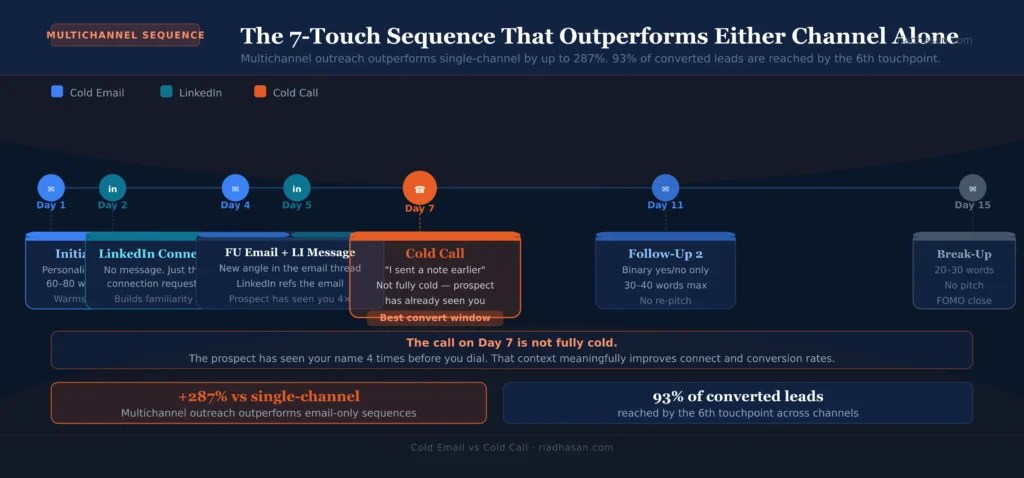
- Day 1: Cold email (initial outreach — personalised, specific, 60–80 words)
- Day 2: LinkedIn connection request (no message — just the connection)
- Day 4: Cold email follow-up (new angle, same thread)
- Day 5: LinkedIn message (short, references the email)
- Day 7: Cold call (cites the email: “I sent you a note earlier this week…”)
- Day 11: Cold email follow-up 2 (binary question)
- Day 15: Break-up email
This cadence covers all three channels, creates familiarity before the call and gives the prospect multiple context windows to engage. The call on day seven lands after the prospect has seen your name twice, making the interruption feel less cold than a standalone dial.
Cold Email vs Email Marketing: What’s the Difference?
Cold email and email marketing are frequently conflated. They serve different purposes, use different platforms and operate under different legal frameworks.
| Cold Email | Email Marketing | |
|---|---|---|
| Audience | Non-subscribers — no prior opt-in | Opted-in subscribers |
| Goal | Start a new conversation | Nurture an existing relationship |
| Platform | Instantly, Smartlead, ReachInbox | Mailchimp, Klaviyo, HubSpot |
| Legal basis | Legitimate interest (GDPR) / CAN-SPAM compliance | Express consent required |
| Metric | Reply rate | Open rate, click-through rate |
| Infrastructure | Secondary sending domains, warm-up, deliverability monitoring | Primary domain, ESP with list management |
The practical confusion arises because both use email. The purpose, the audience, the platform and the compliance requirements are all different. Sending a marketing campaign to an opted-in list from Mailchimp is email marketing. Sending a personalised outreach sequence to cold prospects from Instantly is cold email. Never mix the two on the same domain or platform — the infrastructure requirements are incompatible and the legal basis differs by audience type.
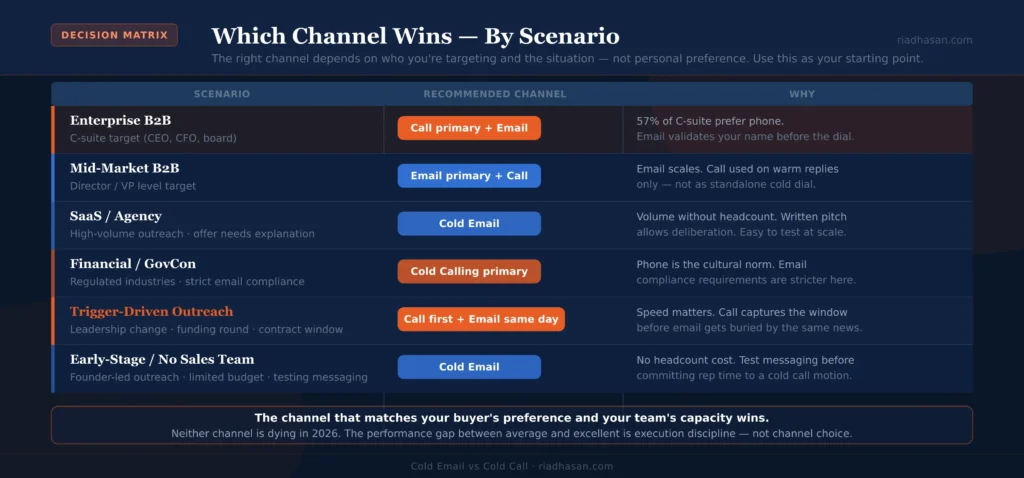
Which Channel Works Best by Industry and Deal Type
| Scenario | Recommended channel | Reason |
|---|---|---|
| Enterprise B2B, C-suite target | Cold calling (primary) + email | 57% of C-suite prefer phone; email validates before the call |
| Mid-market, director/VP target | Cold email (primary) + call | Email scales; call used for warm follow-up on interested replies |
| SaaS / agency, high volume | Cold email | Volume without headcount; offer is well-explained in writing |
| Financial services / GovCon | Cold calling (primary) | Phone is the cultural norm; email compliance requirements stricter |
| Trigger-driven outreach (leadership change, funding) | Cold call first, email same day | Speed matters; call captures the window before email gets buried |
| Early-stage / no sales team | Cold email | No headcount cost; test messaging before hiring callers |
How to Write a Cold Call Follow-Up Email
A cold call follow-up email serves a different purpose than a cold email sequence. You’ve already had a conversation. The prospect knows who you are. The email’s job is to confirm next steps, summarise what was agreed and give the prospect a written reference for the conversation.
The best cold call follow-up emails do three things:
- Reference the call specifically — not just “following up from our call” but “following up on what we discussed about [specific topic from the call].” This proves you were listening.
- Confirm one clear next step — a meeting time, a resource you said you’d send, a question you agreed to answer. One item, not a recap of the entire conversation.
- Keep it under 100 words — the prospect just spoke to you. They don’t need a re-pitch. They need a quick reference that confirms what happens next.
Cold call follow-up email template
Subject: Following up from our call — [First Name]

Hi [First Name],

Good talking earlier. As promised, [the resource/info you said you'd send / the next step you agreed on].

[If relevant: A quick note on what we discussed around [specific topic] — [one sentence summary or link to resource].]

[Meeting booking link or proposed times] still works for [the day/time you discussed]?

[Name]
One tactical note: send from the same email address the prospect has already seen in your cold email sequence if you’ve been running one. The name recognition from previous outreach makes the follow-up land faster. If this is the first email after a fully cold call, the same principles apply — reference the call, confirm next steps, stay under 100 words.
Send this within an hour of the call. Response rates for follow-up emails sent within one hour are significantly higher than emails sent the next day. The conversation is fresh. The prospect’s intent is at its peak. A delayed follow-up risks the momentum from the call dissipating entirely.
Frequently Asked Questions
Is cold email or cold calling more effective in 2026?
Neither channel is categorically more effective. Both depend on targeting quality, execution and the buyer type being reached. Cold email achieves a 3.43–5.8% average reply rate with top performers clearing 10%+. Cold calling achieves a 2.3% average success rate (Cognism 2026) with top performers hitting 6.7–15% using precision targeting. 57% of C-suite executives prefer phone; 61% of B2B decision-makers overall prefer email. The channel that matches your buyer’s preference and your team’s capacity produces the best results.
What is the difference between cold email and cold calling?
Cold email is an asynchronous written outreach to a prospect with no prior relationship: they read it when ready, reply on their schedule and you reach them without direct interruption. Cold calling is a synchronous phone outreach: you interrupt the prospect in real time, which allows immediate conversation and objection handling but requires them to be available and willing to engage at that exact moment. Cold email scales without headcount. Cold calling doesn’t. Email produces data easily and enables systematic testing. Calling produces qualitative feedback from live conversations.
What is the difference between cold email and email marketing?
Cold email targets people who have not opted in. It’s personalised 1-to-1 outreach to a researched prospect. Email marketing targets people who have voluntarily subscribed to your list: it’s 1-to-many communication to an engaged audience. They use different platforms, require different legal compliance (CAN-SPAM vs express consent), measure success differently (reply rate vs click-through rate) and should never share the same sending domain.
What is cold calling vs cold emailing — which has a higher ROI?
Cold email typically produces higher ROI per dollar spent because the cost to reach each prospect is dramatically lower than cold calling. Reaching 500 prospects via email costs a fraction of what it costs to make 500 dials (in rep time, calling tools and list costs). Cold calling produces higher ROI per conversation when it works, because a live conversation can close a meeting in minutes. Early-stage teams without a sales team get better ROI from cold email. For enterprise sales targeting C-suite accounts, cold calling’s higher CPL is often justified by deal size.
How do I write a cold call follow-up email?
Reference the call specifically, confirm one clear next step and keep it under 100 words. Send it within an hour of the call, response rates drop significantly with delay. The subject line should reference the call directly: “Following up from our call” or “As promised, [First Name].” Don’t re-pitch. The prospect just heard your pitch on the phone. The email confirms what happens next, nothing more.
Should I use cold email or cold calling for B2B sales?
Use both, sequenced together. Multichannel outreach combining email, LinkedIn and calls outperforms single-channel by up to 287%, and 93% of converted leads are reached by the sixth touchpoint across channels. Start with cold email to warm the name, use LinkedIn to establish a connection and introduce cold calls after the prospect has already seen your outreach. A call that follows two emails isn’t fully cold — it arrives with context, which meaningfully improves connect and conversion rates.
Choose the Channel That Fits the Situation
The data in this guide supports a clear conclusion: both channels work, neither is dying and the performance gap between average and excellent has more to do with targeting quality and execution discipline than with which channel you pick. Teams that pick a side and ignore the other are leaving pipeline on the table. Teams that sequence both intelligently produce the best results.
Cold email and cold calling aren’t competitors. They’re tools in the same outbound toolkit, each suited to different moments in the prospecting cycle and different buyer profiles. The teams producing the most consistent B2B pipeline in 2026 aren’t the ones who’ve mastered one channel. They deploy both at the right point in a coordinated sequence.
- Cold Email Best Practices 2026 — the full system for making cold email produce pipeline
- Cold Email Sequences — how to structure a multi-touch campaign that captures all available replies
- Cold Email Personalization — the opening line quality that determines whether any channel converts
- Cold Email Infrastructure Setup — the foundation every cold email campaign runs on
If you want cold email campaigns built and managed for your specific ICP and market, you can work with me directly at riadhasan.com.