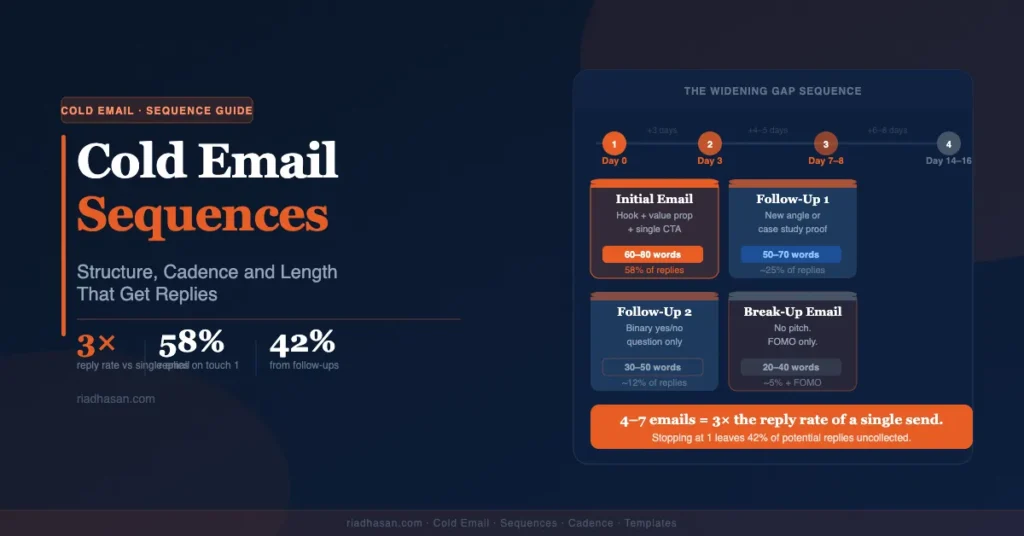
A cold email sequence is a series of automated, personalised emails sent to the same prospect over a defined period, with each email building on the last. It is the operational unit of outbound: not a single email, not a blast, but a structured multi-touch process designed to earn a reply at the moment the prospect is ready to give one.
The data on sequences is unambiguous: a 4–7 email sequence achieves three times the reply rate of a standalone email. 58% of replies arrive on the first touch. The remaining 42% come from follow-ups, which means stopping after one email leaves nearly half your potential replies uncollected. This guide covers how to build sequences that collect all of them.
What Is a Cold Email Sequence?
A cold email sequence is a pre-built series of emails sent to each prospect in a campaign over 15–30 days. When someone in your ICP opens email one and doesn’t reply, the sequence continues automatically. Email two sends three days later. Email three follows a week after that. The sequence runs until the prospect replies or the final touch fires — whichever comes first. The emails send automatically based on a cadence you define. Each one follows up on the previous unless the prospect replies, at which point the sequence stops and a human takes over.
The sequence is not a drip campaign in the marketing sense. A drip campaign sends the same content to everyone on a list based on time intervals. A cold email sequence is personalised to a specific prospect, adjusts based on their behaviour and has one goal: getting a reply from someone who hasn’t heard from you before.
Cold email sequence vs. drip campaign
| About | Cold email sequence | Drip campaign |
|---|---|---|
| Audience | Cold prospects — no prior relationship | Opted-in subscribers or existing contacts |
| Personalisation | Per-prospect, using research and variables | Segment-level or broadcast |
| Trigger to stop | Prospect replies — sequence pauses automatically | Unsubscribe or time-based completion |
| Goal | Start a conversation with a stranger | Nurture an existing relationship |
| Platform | Instantly, Smartlead, ReachInbox, ManyReach | Mailchimp, Klaviyo, HubSpot |
How Many Emails Should a Cold Email Sequence Have?
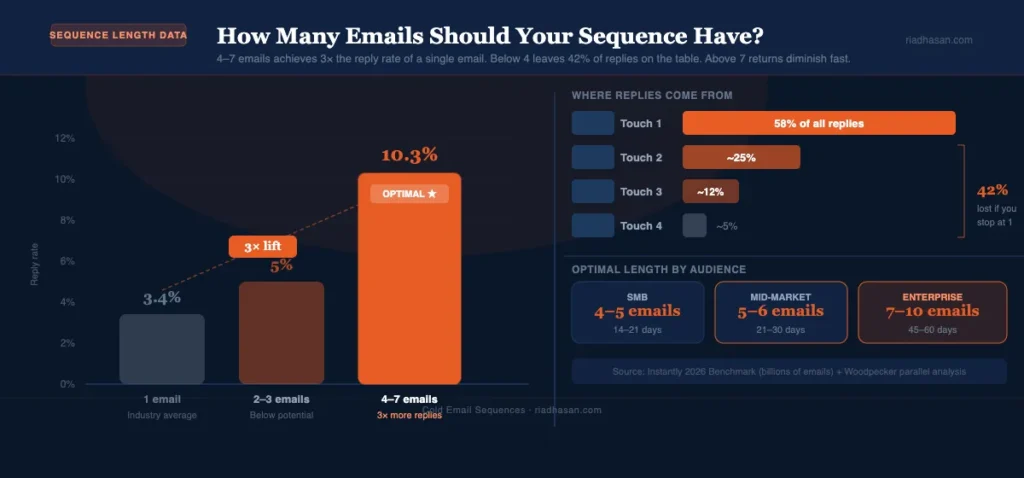
The data from Instantly’s 2026 Benchmark Report (across billions of emails) and Woodpecker’s parallel analysis both converge on the same number: 4–7 emails is the optimal cold email sequence length. Below four touches, you leave 42% of potential replies uncollected. Beyond seven, diminishing returns kick in fast while spam complaints and unsubscribes climb.
The right number depends on your target audience:
- SMB targets: 4–5 touches over 14–21 days. Shorter decision cycles, less patience for extended sequences
- Mid-market targets: 5–6 touches over 21–30 days. Standard B2B sequence structure
- Enterprise targets: 7–10 touches over 45–60 days. Longer consideration periods, more stakeholders, more touchpoints justified
A practical principle: 80% of sales require five or more touchpoints before a decision is made. A 3-email sequence is structurally insufficient for most B2B deals regardless of how strong the copy is. The sequence length must match the buying cycle length of your ICP.
Cold Email Cadence: The Widening Gap Method
Cold email cadence is the timing between each email in a sequence. Most people send follow-ups on fixed intervals: every three days, regardless of position. That’s a mistake.
In 2026, fixed-interval sending creates a velocity pattern that looks robotic to sophisticated inbox providers. Google and Outlook both use machine learning to identify automated sequences. Constant equal spacing is one of the signals they look for. The widening gap method mimics human behaviour: urgent follow-ups close together at first, then increasing patience as the sequence progresses.
The widening gap cadence
| Send day | Gap from previous | Purpose | |
|---|---|---|---|
| Email 1 | Day 0 | — | Initial outreach — establish relevance, make one ask |
| Email 2 | Day 3 | 3 days | New angle — case study, different pain point, added proof |
| Email 3 | Day 7–8 | 4–5 days | Low-friction ask — binary yes/no, soft check-in |
| Email 4 | Day 14–16 | 6–8 days | Break-up email — final touch, FOMO mechanism |
| Email 5 (enterprise) | Day 25–30 | 10–14 days | Reframe — new trigger event, seasonal angle, updated offer |
One more practical note on cadence: send each email on weekdays only. Set the sequence to skip weekends. An email that arrives Saturday morning competes with backlog. One that arrives Tuesday morning competes with the normal daily flow of inbox processing, which is the environment where cold email performs best.
Send time: Tuesday through Thursday, 8–11 AM in the recipient’s local timezone. Thursday morning 9–11 AM holds the highest open rate in Growth List’s 2026 analysis at 44%. Tuesday is the strongest day overall for reply rate. Avoid Monday (clearing weekend backlog) and Friday afternoon (mental checkout before weekend).
How Long Should a Cold Email Be?
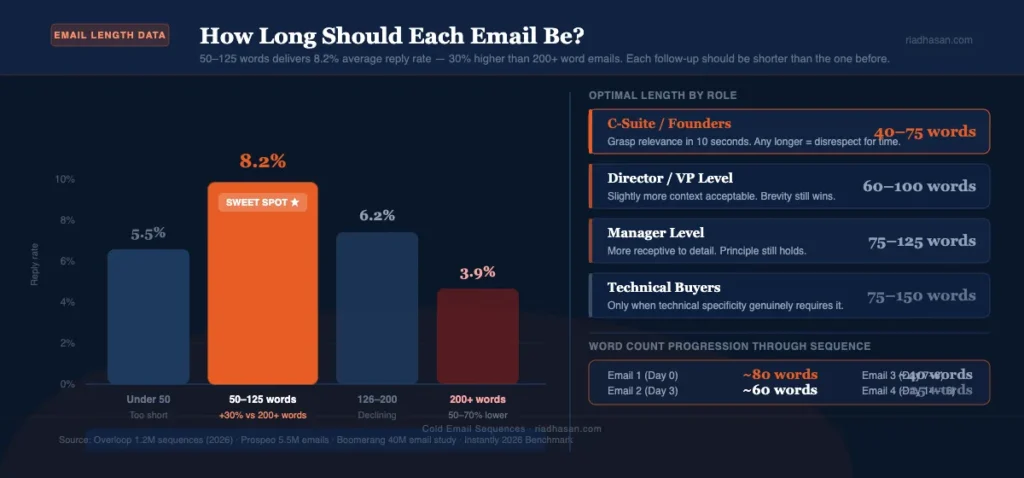
50–125 words. That is the range that delivers an 8.2% average reply rate across every major 2026 study, the highest of any word count bucket.
The specific data:
- Overloop’s analysis of 1.2 million sequences in 2026: 50–125 words delivered a 30% higher reply rate than 200+ word emails (8.2% vs 3.9%)
- Three million email analysis: an 80-word email outperforms a 120-word email by approximately 15%
- Prospeo’s analysis of 5.5 million cold emails: 50–75 words is the sweet spot for initial outreach
- Boomerang’s 40 million email study: 75–100 words hit a 51% response rate
- Instantly 2026 Benchmark Report: top-performing campaigns stay under 80 words
The consensus is clear. The debate is only whether 50–75 or 75–125 is optimal. Both ranges dramatically outperform anything over 200 words, which sees 50–70% lower reply rates.
How long should each email in the sequence be?
Each follow-up should be shorter than the one before it. The prospect has already seen your initial pitch. Follow-ups are quick nudges, not restated pitches. A 100-word initial email followed by a 60-word follow-up followed by a 30-word binary question is exactly the right progression. By the third email, the ask should be a single line.
Email length by role
- C-suite and founders: 40–75 words. They need to grasp relevance in 10 seconds. Any longer signals disrespect for their time.
- Director and VP level: 60–100 words. Slightly more context is acceptable but brevity still wins.
- Manager level: 75–125 words. More receptive to detail, but the principle holds.
- Technical buyers: 75–150 words maximum, only when technical specificity genuinely requires it.
How Many Cold Emails Should You Send Per Day?
30–50 emails per inbox per day once the inbox is properly warmed. Below that and you’re undershooting your capacity. Above that with a young or poorly warmed domain and you’re risking spam flag thresholds.
The practical sending maths for a small team:
| Inboxes | Daily send capacity | Monthly new prospects |
|---|---|---|
| 3 | 90–150 emails/day | ~400–600 |
| 6 | 180–300 emails/day | ~800–1,200 |
| 12 | 360–600 emails/day | ~1,600–2,400 |
| 24 | 720–1,200 emails/day | ~3,200–4,800 |
Keep bounce rate below 3–5% across your sending domains. Keep spam complaint rate below 0.1% (Google starts throttling above 0.3%). If either metric climbs, reduce volume and diagnose the cause before sending more.
Cold Email Sequence Templates
Each template below represents one position in a 4-email sequence. Personalise the opener before sending. The structure does the work, but the first line must prove research happened.
Email 1: Initial outreach (Day 0 — target 60–80 words)
Subject: [specific, 4–6 word subject line]

Hi [First Name],

[One specific opening line — trigger event, observation or content reference. 1 sentence.]

We helped [similar company] [specific result] in [timeframe].

Given [Company]'s [specific situation], I think there's a relevant conversation here.

Worth a 15-minute call this week?

[Name]
Email 2: Follow-up 1 (Day 3 — target 50–70 words, new angle)
Subject: [same thread — no new subject]

Hi [First Name],

Wanted to add one more thing — [different proof point or new angle not mentioned in email 1, e.g. relevant case study result or industry-specific data].

Still open to a quick call if the timing works?

[Name]
Email 3: Follow-up 2 (Day 7–8 — target 30–50 words, binary ask)
Subject: [same thread]

Hi [First Name],

Quick question — is [the specific problem you referenced] something [Company] is actively working on right now, or not a priority at the moment?

Either answer is helpful.

[Name]
Email 4: Break-up email (Day 14–16 — target 20–40 words, no pitch)
Subject: [same thread]

Hi [First Name],

I'll leave it here — I don't want to keep filling your inbox if the timing isn't right.

If [specific problem] becomes relevant later, my contact details are below.

[Name]
Notice the word count progression: 70 → 55 → 40 → 30. The sequence gets shorter as it progresses. Each step is less demanding of the prospect’s attention than the last. The break-up email is the most minimal and often generates the highest response rate of the four, because it removes all pressure.
Three Sequence Mistakes That Kill Reply Rates
Before the evergreen section, three patterns I see constantly in cold email sequences that undermine otherwise solid campaigns:
- Identical length across every email. An 80-word initial email followed by an 80-word follow-up followed by another 80-word email reads as automation. Each step should get shorter. By email three, a single question should carry the whole email.
- New subject lines on follow-ups. Every follow-up should reply in the same thread as the original email. A new subject line resets the context and forces the prospect to evaluate an unfamiliar email from scratch. Keep the thread. The conversation history is the context.
- Adding new pitch content to follow-ups. Follow-ups are not a second attempt at the original pitch. They’re a different angle, a binary question or a break-up. Re-pitching in follow-up two signals you weren’t listening when the prospect didn’t reply to the first version.
How to Create an Evergreen Cold Email Campaign
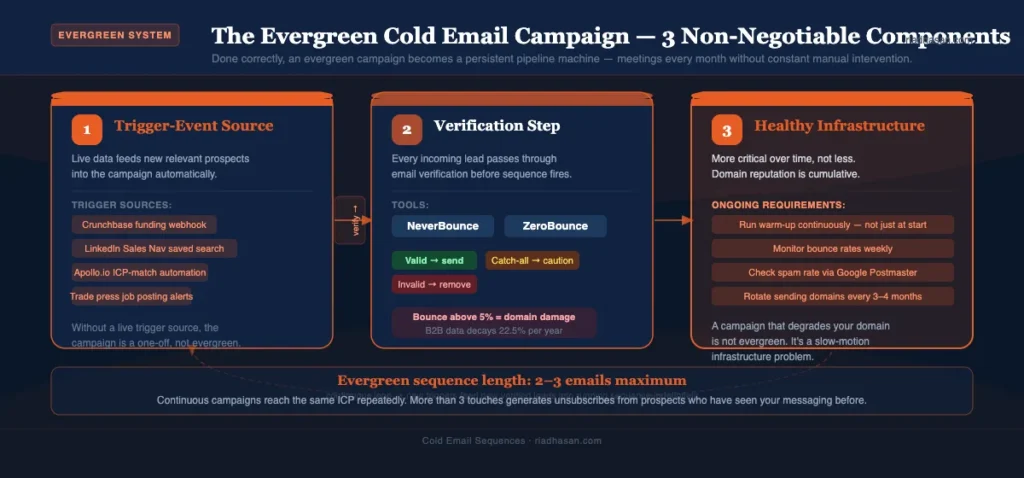
An evergreen cold email campaign runs continuously, feeding new prospects into a sequence automatically rather than requiring a new list-build every few weeks. Done correctly, it becomes a persistent pipeline machine that produces a steady volume of meetings every month without constant manual intervention.
Three non-negotiable components:
1. A trigger-event source that feeds fresh leads automatically
The campaign needs a live data source connected to a trigger that pulls new, relevant prospects automatically. Examples: a Crunchbase webhook that triggers when a company in your ICP raises a funding round, a LinkedIn Sales Navigator saved search that surfaces new job postings matching your target role, or an Apollo.io sequence that adds new contacts as they match your ICP criteria. The trigger is what makes the campaign evergreen rather than static.
2. Deliverability infrastructure that stays healthy
An evergreen campaign that runs for three months will cycle through far more sends than a one-off campaign. Domain reputation management is more critical over time, not less. Run warm-up continuously. Monitor bounce rates weekly. Check spam complaint rate via Google Postmaster Tools. Rotate sending domains every 3–4 months to prevent reputation accumulation on a single domain. A campaign that degrades your domain is not evergreen — it’s a slow-motion infrastructure problem.
3. A verification step for every incoming lead
B2B contact data decays at 22.5% per year. Any evergreen campaign feeding from live data sources will receive some percentage of outdated email addresses. Build a verification step into the intake workflow. Every lead that enters the sequence should pass through NeverBounce or ZeroBounce before the first email fires. One bad data batch that pushes bounce rate above 5% can damage your domain for weeks — long after you’ve fixed the data.
Evergreen sequence structure
Shorter than a standard campaign: 2–3 emails for evergreen outreach, not 4–7. The reasoning: an evergreen campaign contacts a subset of your ICP continuously, which means prospects will see follow-up attempts more frequently than in a one-off campaign. More than three touches in an evergreen context starts generating unsubscribes from people who’ve seen your messaging before.
How to Measure the Success of a Cold Email Campaign
There are five metrics that matter for cold email campaigns. Everything else is noise. Tracking the wrong metrics (vanity numbers that feel good but don’t correlate with pipeline) is one of the most common ways teams convince themselves a failing campaign is working.
| Metric | What it tells you | Benchmark (2026) |
|---|---|---|
| Reply rate | Whether your message is relevant to this ICP | 3–5% average; 9–12% top quartile |
| Positive reply rate | Whether replies are interested (not just opt-outs) | 2–8% of emails sent |
| Bounce rate | List quality and data verification effectiveness | Below 3% (above 5% is dangerous) |
| Spam complaint rate | Whether recipients find your outreach unwanted | Below 0.1% (0.3% triggers enforcement) |
| Meetings booked | Actual pipeline impact of the campaign | 1–4% of emails sent (top campaigns) |
Open rate is conspicuously absent from this list. Apple’s Mail Privacy Protection and similar features mean open rate data is unreliable. Apple pre-loads tracking pixels for up to 60% of emails before a human actually opens them, inflating open rates and making them a poor signal of genuine engagement. Monitor reply rate and meetings booked. Those numbers don’t lie.
When to change what
- Low open rate (below 30%): deliverability or sender name problem — fix infrastructure before touching copy
- Good open rate, low reply rate (below 3%): ICP mismatch or weak opening line — check targeting and first sentence
- Good reply rate, low positive reply rate: offer misalignment — the problem you’re citing isn’t real for this audience
- High bounce rate (above 5%): bad list data — verify before sending another email
- Rising spam complaints: stop the campaign immediately, diagnose before resuming
Frequently Asked Questions
What is a cold email sequence?
A cold email sequence is an automated series of personalised emails sent to a prospect over a defined period, typically 14–30 days. Each email follows up on the previous one unless the prospect replies, at which point the sequence pauses automatically. Unlike a broadcast email or drip campaign, a cold email sequence is designed for one-to-one outreach to people who have no prior relationship with the sender. The goal is to start a conversation that leads to a qualified meeting.
How many emails should be in a cold email sequence?
4–7 emails is the optimal range according to convergent data from Instantly’s 2026 Benchmark Report and Woodpecker. A 4–7 touch sequence achieves three times the reply rate of a single email. For SMB targets, 4–5 touches over 14–21 days is sufficient. Enterprise targets can support 7–10 touches over 45–60 days. Sending beyond 7 emails for standard outreach produces minimal additional replies while generating spam complaints that damage sender reputation.
What is the best cold email cadence?
The widening gap cadence outperforms fixed-interval sending in 2026 because it mimics human patience rather than robotic automation. A practical cadence: Day 0 (initial), Day 3 (follow-up 1), Day 7–8 (follow-up 2), Day 14–16 (break-up). The gap between emails increases with each step. Send Tuesday through Thursday, 8–11 AM in the recipient’s local timezone. Thursday morning 9–11 AM holds the highest open rate in 2026 data at 44%.
How long should a cold email be?
50–125 words delivers the highest reply rate (8.2%) across all major 2026 studies. For initial outreach, 50–75 words is the current sweet spot. Each subsequent follow-up should be shorter than the one before it. The break-up email should be 20–40 words at most. An 80-word email outperforms a 120-word email by approximately 15%. Emails over 200 words see 50–70% lower reply rates. The goal is to earn a reply, not deliver a pitch.
What is a cold email drip campaign?
A cold email drip campaign is often used interchangeably with “cold email sequence” but technically refers to time-based automated outreach where all recipients receive the same content on the same schedule, regardless of their behaviour. A true cold email sequence is personalised per prospect and stops automatically when the prospect replies. Drip campaigns are more commonly associated with marketing automation to opted-in lists. For cold outreach, the term “sequence” is more accurate and the tools are purpose-built for it.
How do I create an evergreen cold email campaign?
An evergreen cold email campaign requires three components: a trigger-event data source that automatically feeds new relevant prospects into the campaign (like a Crunchbase webhook or Apollo saved search), deliverability infrastructure that maintains domain health over months of continuous sending and an automated verification step that checks each incoming lead’s email address before the first email fires. Keep evergreen sequences to 2–3 emails maximum — prospects who re-enter your ICP over time will see previous messaging and shorter sequences generate fewer unsubscribes.
Build the Sequence Once, Then Optimise It
The most effective cold email sequences are not written and forgotten. They’re living systems: A/B tested at each step, optimised based on which position generates the most replies and updated when conditions shift.
The sequence itself is not the whole game. The list quality that feeds it, the infrastructure that delivers it and the reply management that converts interested prospects into booked meetings — all of these matter as much as the sequence structure. A perfectly written 4-email sequence sent to a bad list on a broken domain produces nothing. An average 4-email sequence sent to a verified, tightly targeted list on a healthy domain produces meetings.
Start with four emails, the widening gap cadence and 60–80 words per email. Test the subject line first, then the opening line, then the CTA. One variable at a time, with at least 100 opens per variant before drawing conclusions. After three rounds of testing, a well-structured sequence compounds — each optimisation improving every campaign that follows it.
- Cold Email Follow-Up Guide — what to say in each sequence position, with templates
- Cold Email Subject Lines — the 60+ proven examples that earn the open
- Cold Email Infrastructure Setup — the domain and sending setup every sequence depends on
- Cold Email Best Practices 2026 — the complete system from targeting to reply management
If you’d rather have the sequence built, tested and optimised for your specific ICP, you can work with me directly at riadhasan.com.