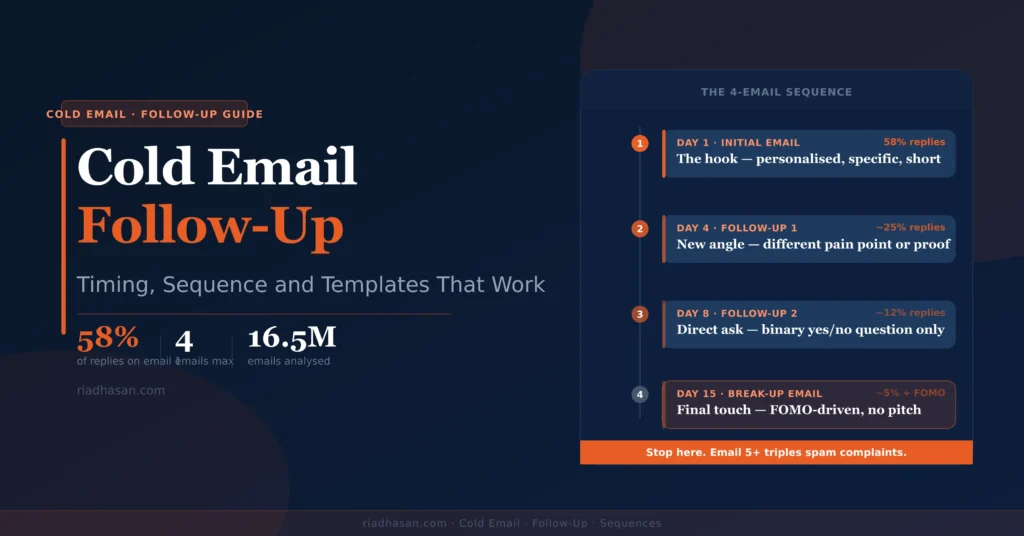
Most cold email guides tell you to follow up five, seven, even twelve times. Getting cold email follow-up right is one of the most impactful improvements you can make to any outreach campaign. The data says something different. Analysis of 16.5 million cold emails across 93 business domains shows the highest reply rate comes from the first email, at 8.4%. Every additional touch pulls that number down.
That doesn’t mean follow-up is pointless. 58% of replies arrive on the first email in a sequence, with steps two through four contributing the remaining 42%. So follow-ups matter. But only if you’re disciplined about how many you send, what you say in each one and when to stop.
This guide covers all of it: the data on sequence length, the timing that works, what each email in a sequence should actually say, real templates for every position and how to re-engage leads who’ve gone completely cold.
Why Most Follow-Ups Don’t Work
The problem isn’t that people follow up. The problem is how they do it.
The two most common failure patterns:
- Sending too many. Sending four or more emails in a total sequence more than triples spam complaints and unsubscribes. Each additional email past the third doesn’t just underperform — it actively damages your sender reputation for every campaign that follows.
- Saying nothing new. “Just checking in,” “bumping this up your inbox” and “I never heard back from you” are the three most common follow-up openers. They add no value, create no reason to reply and research shows phrases like “I never heard back” reduce meeting booking rates by 12%.
A follow-up that says nothing new is worse than no follow-up. The prospect who was on the fence about your first email now has additional evidence that you have nothing interesting to say.
How Many Follow-Ups to Send
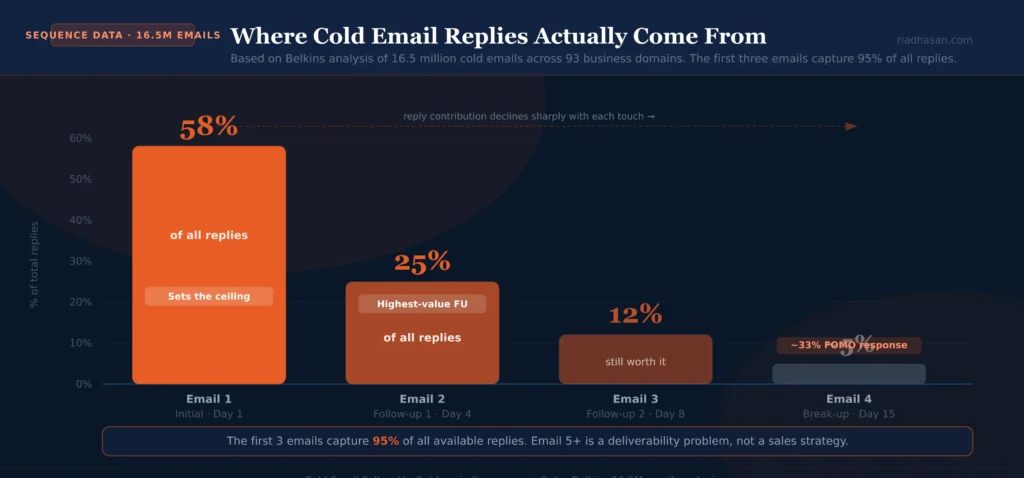
Two to three follow-ups is the working consensus across current benchmark data. That’s a total sequence of three to four emails: one initial email plus two or three follow-ups.
Here’s the reply rate decay curve based on Belkins’ 16.5 million email dataset:
| Email position | Contribution to total replies | What happens here |
|---|---|---|
| Email 1 (initial) | 58% of all replies | Sets the ceiling for the whole sequence |
| Email 2 (follow-up 1) | ~25% of all replies | Highest-value follow-up; catches missed first email |
| Email 3 (follow-up 2) | ~12% of all replies | Diminishing returns begin; still worth sending |
| Email 4 (break-up) | ~5% of all replies | FOMO-driven; high response rate relative to volume sent |
| Email 5+ | Marginal or negative | Spam complaints and unsubscribes start outweighing replies |
The math is clear: the first three emails capture over 90% of available replies. Anything beyond that is diminishing returns at the cost of deliverability. Stop at four total touches unless you have a compelling reason to continue.
One caveat from my own campaigns: a tightly targeted, high-value list (think enterprise accounts or accounts with a clear trigger event) can support a fifth touch if each email adds genuine value. For broad outreach campaigns, four is the hard limit.
The Right Timing Between Emails
The optimal cold email sequence cadence is Day 1 for the initial email, Day 4 for the first follow-up, Day 8 for the second follow-up and Day 15 for the final break-up email. This pattern consistently outperforms compressed timelines where emails arrive too quickly.
The reasoning behind the spacing:
- Day 4 (first follow-up): enough time for a genuine miss — the prospect may have been in meetings, travelling or simply buried. Not so long that your previous email is forgotten.
- Day 8 (second follow-up): by now, anyone who missed both emails has had a full working week. This catches people who process email in batches.
- Day 15 (break-up): two weeks is a respectful gap before the final touch. It signals patience, not desperation.
Best days and times to send
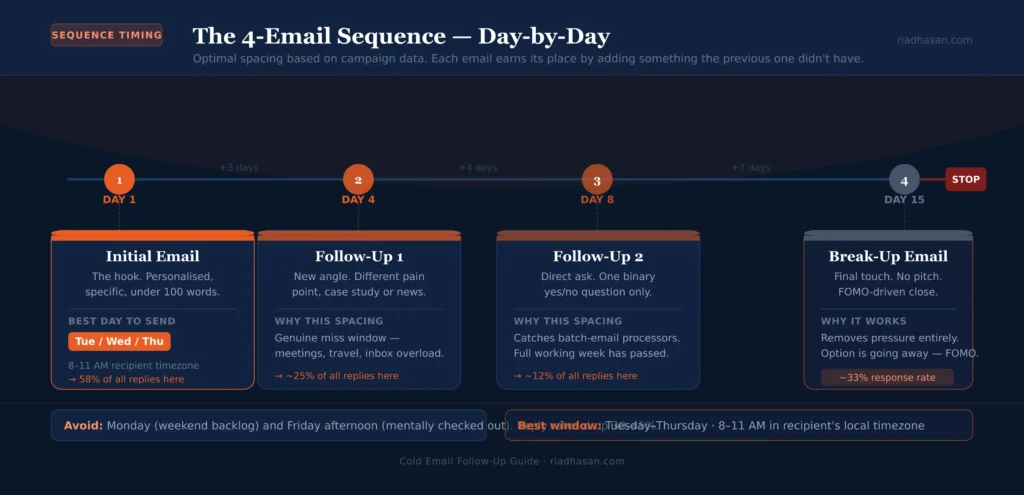
Tuesday is the best day for B2B cold email reply rates in 2026, followed by Wednesday and Thursday, with reply rates 30–45% higher than Monday or Friday sends. Send in the recipient’s local timezone, targeting the 8–11 AM window when professionals are processing their inbox at the start of the day before it fills with meetings.
Avoid Mondays entirely. Inboxes are clearing weekend backlog and your email competes with everything that arrived over the weekend. Friday afternoons have the same problem in reverse: people are mentally checking out and replies drop sharply.
What Each Follow-Up Should Say
The rule is simple: every follow-up must earn its place by adding something the previous email didn’t have. A different angle, a relevant proof point, a new question. If you can’t articulate what’s new in this email compared to the last, don’t send it.
Follow-up 1: A different angle
The most common reason a prospect doesn’t reply to your first email isn’t disinterest. It’s timing. They were busy, distracted or the first email didn’t connect with what’s top of mind for them right now. Follow-up one is your chance to come at the same problem from a different direction.
Options for follow-up one:
- A relevant case study or result you didn’t mention in the first email
- A different pain point the prospect likely experiences (not the same one you led with)
- A new piece of context — a recent news item about their company or industry
- Social proof from a similar company in their space
Keep it short. Under 80 words is the benchmark across current campaign data. Follow-ups that go longer perform worse, not better.
Follow-up 2: A direct, low-friction ask
By the second follow-up, the prospect has seen your message twice. They know who you are. This isn’t the time for another pitch. It’s the time to make the smallest possible ask and see if there’s any signal of interest.
The most effective second follow-up is a single question. Not “can we schedule a call” but something even lower friction: “Is this on your radar at all?” or “Worth a quick conversation, or should I leave you alone?” The binary framing gives the prospect an easy yes or no, which removes the friction of formulating a reply from scratch.
Research from RankWizards’ rebuild campaign showed that simple, direct questions in follow-up two often outperform elaborate pitch emails precisely because they don’t ask for much. The reply “not right now, try me in Q3” is a valuable outcome. It gives you a reason to follow up later without damaging the relationship.
Follow-up 3: The break-up email
The break-up email is the most counterintuitive tool in cold email. Its premise: tell the prospect this is your last message and you won’t follow up again unless they ask you to. Break-up emails generate approximately a 33% response rate due to FOMO. The prospect who wasn’t ready to engage is suddenly aware that the option is going away.
The break-up email works because it does something the previous emails didn’t: it removes pressure entirely. There’s nothing to decide, no commitment to make. The prospect just has to decide whether to let the conversation die permanently or give you a signal. Many people who would never reply to a sales pitch will reply to a break-up email.
What makes a break-up email land:
- It’s genuinely the last email — don’t send a “final follow-up” and then send three more
- It’s short, direct and contains no pitch whatsoever
- It gives the prospect a clear, low-friction way to re-engage if they want to
- It doesn’t sound passive-aggressive or manipulative — just honest
Cold Email Follow-Up Templates
These templates are starting points, not finished copy. Every opener should be personalised to the specific prospect before it sends.
Template: Follow-up 1 (Day 4) — new angle
Subject: [same thread — no new subject line]

Hey [First Name],

Wanted to share something relevant — [similar company in their space] was dealing with [specific problem] and [one-sentence result we helped them get].

Thought it might be worth a quick conversation given what [Company] is doing with [specific thing you noticed].

Still open to a 15-minute call this week?

[Name]
Template: Follow-up 2 (Day 8) — direct ask
Subject: [same thread]

Hi [First Name],

Quick question — is [the problem I mentioned] something you're actively working on right now, or is it not a priority at the moment?

Either answer is helpful. No pressure either way.

[Name]
Template: Follow-up 3 (Day 15) — break-up
Subject: [same thread]

Hi [First Name],

I'll leave it here — I don't want to keep filling your inbox if the timing isn't right.

If [the specific problem] becomes relevant later, my contact details are below. Happy to pick this up whenever.

[Name]
Three things to notice across all these templates: they’re all in the same thread as the original email, they’re all under 80 words and none of them contain “just checking in” or “I never heard back.”
Keep follow-ups in the same thread
Always send follow-ups as replies to the original email thread rather than new emails with new subject lines. A new subject line looks like a fresh cold email and the prospect has to start the mental process of evaluating it from scratch. A reply in the same thread gives them the context of the previous email immediately, reduces cognitive load and feels more like a natural continuation of a conversation.
How to Re-Engage Cold Leads
A cold lead is someone who has gone silent after showing some initial interest: they opened multiple times, replied once and then stopped responding, or were warm at some point and then went dark.
Re-engagement is different from a normal follow-up sequence. The prospect knows you exist. They’ve seen your offer. Something changed (budget, priorities, timing, internal politics) and the conversation stalled. Your job in a re-engagement email isn’t to re-pitch. It’s to acknowledge the gap and give them a reason to re-open the conversation.
The re-engagement framework
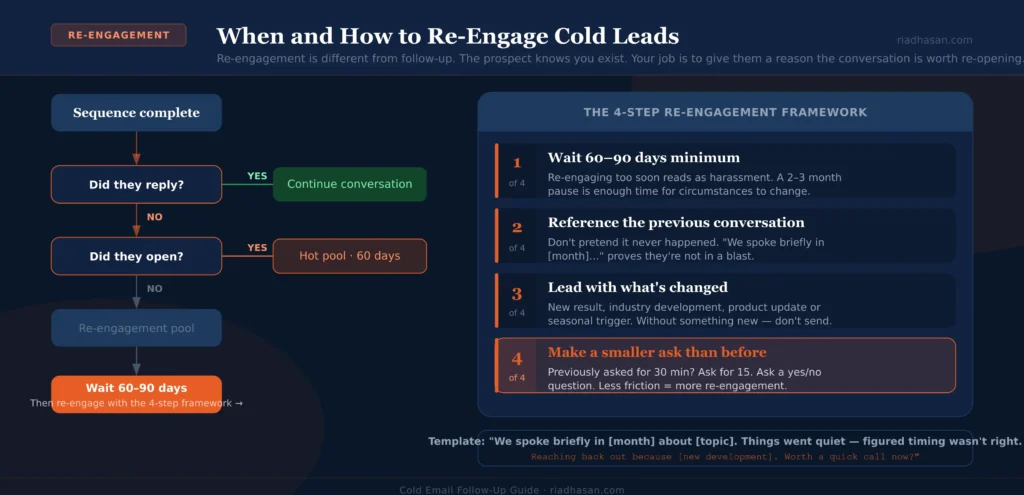
- Wait at least 60–90 days. Re-engaging too soon after going silent reads as harassment, not persistence. A 2–3 month pause is enough time for circumstances to change.
- Reference the previous conversation. Don’t pretend it never happened. “We spoke briefly in [month] about [topic]” establishes continuity and shows the prospect they’re not in a cold email blast.
- Lead with what’s changed. A new result, a relevant industry development, a product update or a seasonal trigger gives the prospect a reason to re-engage that wasn’t there before. Without something new, there’s no reason for them to respond differently than they did last time.
- Make the ask smaller than before. If you previously asked for a 30-minute call, ask for 15. Ask a yes/no question instead of an open request. Reduce the commitment required and you reduce the friction to re-engaging.
Template: Re-engagement after 90 days
Subject: Checking back in — [First Name]

Hi [First Name],

We spoke briefly back in [month] about [specific topic]. Things went quiet and I figured the timing wasn't right.

Reaching back out because [new development — result for similar company, relevant industry change, or updated offer].

Would a quick call make sense now, or still not the right moment?

[Name]
What Kills Follow-Up Performance
Sending follow-ups before verifying your list
A sequence that fires against unverified data will have high bounce rates from the start. High bounces on a sequence damage your sender reputation for every subsequent touch, meaning follow-up two and three are already arriving with a worse deliverability score than the first email had. Verify your list before the initial email sends, not after problems appear.
Tight clustering of emails
Sending follow-ups two days apart feels responsive. To email providers, it looks like aggressive sending behaviour. Tight spacing increases spam flag risk and compresses the window in which the prospect might have naturally replied. The 3–4 day minimum gap between touches isn’t just about not annoying the prospect — it’s about protecting your sender reputation.
Changing the subject line on follow-ups
A new subject line breaks the thread and forces the prospect to evaluate an unfamiliar email from scratch. Keep follow-ups in the same thread with the original subject line. The visual continuity of a reply chain is itself a signal that this isn’t another cold blast.
Continuing after the sequence ends
If someone hasn’t replied after four emails, continuing to contact them generates unsubscribes and spam complaints at a rate that outweighs any marginal replies. Stop. Add them to a re-engagement pool for 90 days and move on to the rest of the list. Persistence past four touches isn’t tenacity. It’s a deliverability problem in progress.
Frequently Asked Questions
How many follow-up emails should I send for cold email?
Two to three follow-ups is the data-backed standard for 2026, giving you a total sequence of three to four emails including the initial send. Sending four or more emails total more than triples spam complaints and unsubscribes, according to analysis of 16.5 million cold emails. The first email captures 58% of all replies; follow-ups account for the remaining 42% but with sharply declining returns after the third email in the sequence.
How do I follow up on a cold email without being annoying?
Every follow-up must add something new: a different angle on the problem, a relevant case study, a new question or a direct binary ask. Never send a follow-up that just restates the original pitch or says “just checking in.” Keep each email under 80 words, space touches at least three to four days apart and stop after the break-up email. The prospect who finds you annoying is the one whose inbox you’ve filled with identical pitches.
What is a cold email follow-up template that actually works?
The most effective follow-up templates share three qualities: they’re short (under 80 words), they add something new compared to the previous email and they make a specific, low-friction ask. A single yes/no question outperforms a detailed pitch in follow-up position. The break-up email template (telling the prospect this is your final message) consistently generates the highest response rate relative to volume sent of any position in the sequence.
How long should I wait before following up on a cold email?
Wait three to four days before your first follow-up. Space the second follow-up four to seven days after the first. Send the break-up email seven to ten days after the second follow-up. The full sequence spans roughly 15–18 days. Compressed timelines (following up after one day) feel aggressive, increase spam risk and don’t give prospects enough time to have naturally replied.
How do I re-engage cold leads with email?
Wait at least 60–90 days before attempting re-engagement. When you do reach out, reference the previous conversation explicitly, lead with something new (a fresh result, a relevant industry development, an updated offer) and make a smaller ask than you did originally. Don’t re-pitch from scratch. The prospect knows who you are — your job is to give them a reason the conversation is worth re-opening now when it wasn’t before.
Is following up on cold email legal?
Yes, in most jurisdictions. Under CAN-SPAM in the US, follow-up emails are permitted as long as the original email was compliant (unsubscribe option included, no deceptive sender information). The same legitimate interest basis under GDPR in the EU that permits the initial email also permits reasonable follow-up in the same thread. If someone replies requesting no further contact, honor that immediately regardless of jurisdiction — it’s both a legal requirement and basic professional practice.
Build the Sequence, Then Let It Run
Cold email follow-up isn’t about persistence for its own sake. It’s about covering the full window of availability for any given prospect without crossing into territory that damages your reputation or their experience of your outreach.
Get the sequence structure right (four emails max, each earning its place, properly spaced) and the returns compound naturally across campaigns. The discipline is in stopping when the sequence ends and trusting the re-engagement pool to do its work 90 days later.
- Cold Email Subject Lines — what to put in the subject line for every position in your sequence
- Cold Email Best Practices 2026 — the full system from infrastructure to reply management
- Cold Email Infrastructure Setup — fixing the deliverability issues that make follow-ups land in spam
- What Is Cold Email? — if you’re building your first campaign from scratch
If you’d rather have the sequence built and managed for you, you can work with me directly at riadhasan.com.