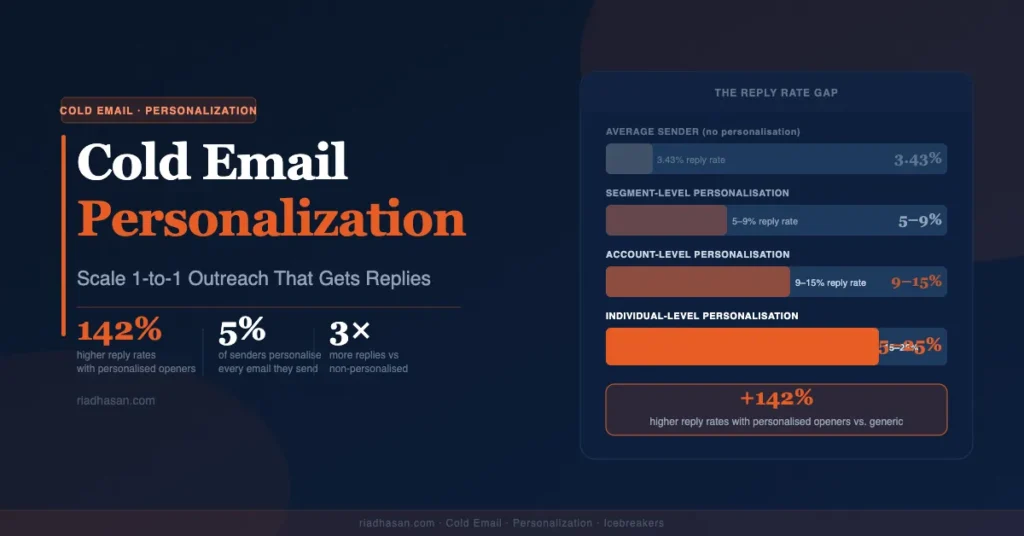
Cold email personalization is the single largest lever for reply rate improvement in outbound. The data is blunt about it: personalised openers generate up to 142% higher reply rates than generic ones. Only 5% of cold email senders personalise every email. Those who do get two to three times the replies of everyone else.
The gap between average performance (3.43% reply rate) and top-quartile performance (10%+) comes down almost entirely to how well the email makes the recipient feel understood rather than targeted.
This guide covers the full personalisation stack: what it actually means, the different levels of it, how to write icebreakers that don’t feel forced, how to reference pain points without making the prospect feel surveilled and how to scale everything without losing the quality that makes it work.
What Cold Email Personalisation Actually Means
Personalisation is not putting someone’s first name in a subject line. Every prospect knows that’s a merge field. It signals nothing about whether you actually looked at them before emailing.
Real personalisation proves research. It references something specific and real about the prospect’s situation that couldn’t be pulled from a list: a recent announcement, a piece of content they published, a company milestone, a challenge evident from their public presence. The prospect should read your opening line and think “this person actually looked at what I’m doing” rather than “this person has my job title in a spreadsheet.”
The goal is to make the recipient feel seen, not studied. Relevant is good. Intrusive is not. There is a line between “I noticed your company just launched a new product line” and “I can see from your LinkedIn activity that you’ve been posting more frequently this month.” The first is professional context. The second reads as surveillance.
The Three Levels of Cold Email Personalisation
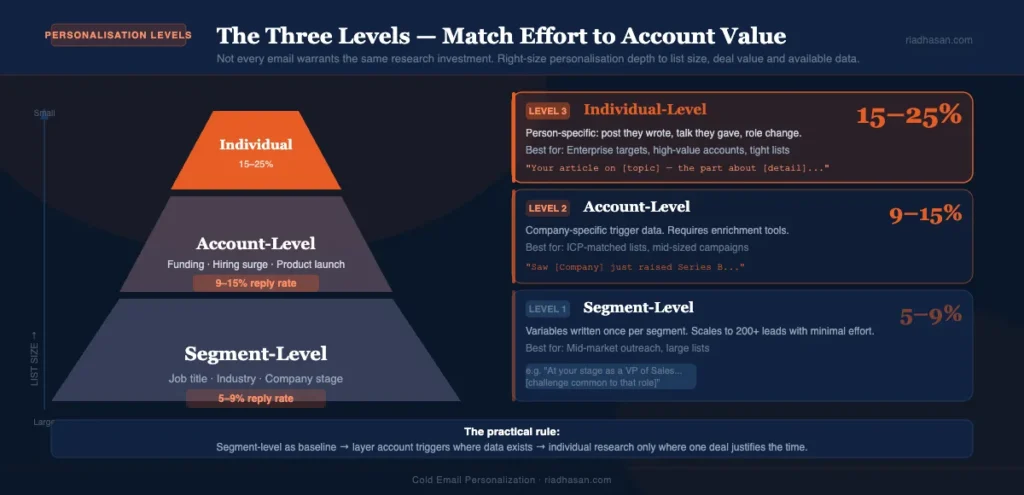
Not every email warrants the same level of personalisation effort. The right level depends on the value of the account, the size of the list and how much research is available for each prospect.
| Level | What it uses | Best for | Expected reply rate |
|---|---|---|---|
| Segment-level | Job title, industry, company stage — variables written once per segment | Large lists (200+ leads), mid-market outreach | 5–9% |
| Account-level | Company-specific trigger: funding, hiring surge, product launch, news mention | Mid-sized lists, ICP-matched outreach | 9–15% |
| Individual-level | Person-specific: LinkedIn post, article they wrote, talk they gave, role change | High-value accounts, enterprise targets, small tight lists | 15–25% |
The practical principle: use segment-level personalisation as the baseline for any campaign, layer in account-level triggers where data is available and reserve individual-level research for the accounts where a single closed deal justifies the time investment.
In the TubeOnAI campaign I ran, the approach was account-level personalisation built around role-specific pain in a competitive AI tools market. The result was 55 replies from 1,350 prospects at a 4% reply rate. Reasonable for a niche with high inbox saturation and no prior relationship with any of the recipients. Tighter targeting and higher personalisation depth would have lifted that number, but the account-level approach was the right balance for list size and deal value.
Cold Email Icebreakers: What They Are and How to Write Them
An icebreaker is the opening line of a cold email. Its job is to prove research happened and create enough relevance that the prospect keeps reading. It is not a greeting, not a self-introduction and not a compliment.
The icebreaker sits between the subject line and the value proposition. The subject line gets the email opened. The icebreaker earns the next three sentences.
Icebreaker type 1: Trigger-event observation
Reference something that happened at the company recently: a funding round, a product launch, a job posting, a leadership change, a press mention. Trigger-event icebreakers deliver 2.3x higher reply rates than generic outreach because they give the prospect an immediate, logical reason to care about this email right now.
Examples:
- Saw [Company] just closed a Series B — scaling the sales team fast usually means the pipeline data starts breaking first.
- Noticed [Company] is hiring three BDRs right now — that kind of growth normally surfaces some infrastructure strain.
- Saw the [product] launch last week. Timing your outreach around it makes sense — that’s a busy period for the team.
The trigger has to be real and verifiable. When the prospect knows it happened, referencing it proves you were paying attention. Vague or inaccurate triggers signal the opposite.
Icebreaker type 2: Content or public work reference
Reference something the prospect wrote, said or published: a LinkedIn post, an article, a podcast appearance, a conference talk. This is the highest-signal icebreaker type because it proves engagement no template can fake. The prospect knows whether they published that content and whether you actually engaged with it.
Examples:
- Your LinkedIn post on [topic] last week — the point about [specific argument] is something I’ve seen play out the same way.
- Listened to your episode on [podcast name] — your take on [specific point] is different from the usual take on that problem.
- Read your piece on [publication] about [topic] — genuinely one of the better frameworks I’ve seen for thinking about [concept].
Don’t use this type if the prospect has no public content or if you’d have to stretch to find something relevant. A forced content reference (“great insights on your website!”) reads worse than no personalisation at all.
Icebreaker type 3: Pain-point question
Open with a direct question that names a specific problem the prospect likely faces. The question is disarming. It invites a mental “yes” before the prospect has even read your value proposition. This works best for segment-level personalisation where you know the job title and can predict the challenge with confidence.
Examples:
- Are your SDRs spending more time cleaning CRM data than actually calling?
- Is [specific operational problem] starting to slow down [Company]’s [growth metric]?
- How are you currently handling [specific process] as the team scales past [threshold]?
The question must be specific enough to feel relevant rather than random. “Are you struggling to grow?” is too broad. “Are your outbound reply rates dropping as inbox saturation increases?” is specific enough to signal real understanding of the prospect’s situation.
Icebreaker type 4: Diagnostic observation
Reference something specific and observable about the prospect’s current public presence that implies a problem or gap. This approach turns your research into an insight rather than a compliment. Insights earn replies where flattery doesn’t.
Examples:
- Looked at [Company]’s organic presence — [Competitor] is ranking for [keyword cluster] that your product should own.
- Noticed [Company] is running [number] ads but most of them are sending traffic to the homepage rather than a dedicated landing page.
- Checked [Company]’s link profile — there’s a gap in [specific area] that’s likely suppressing domain authority relative to where you’re publishing.
Icebreaker type 5: Mutual context
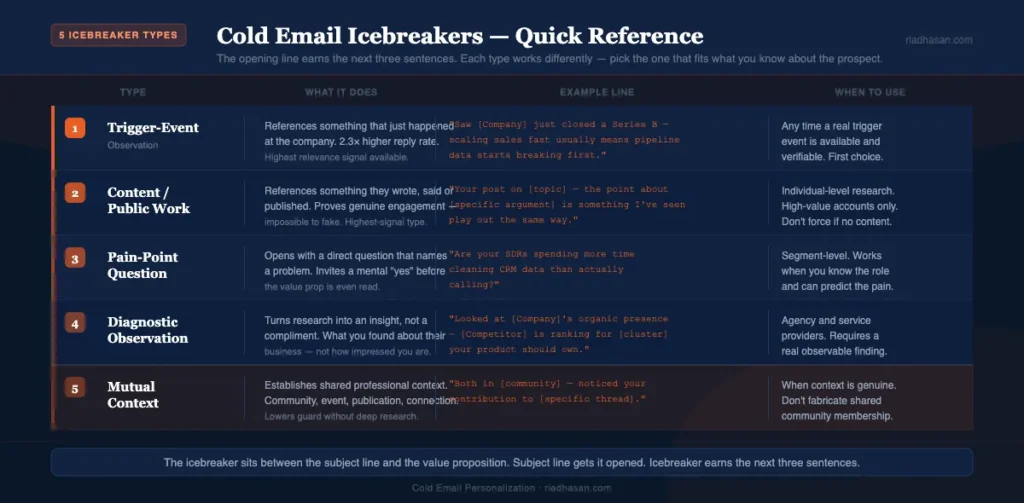
Establish shared professional context: a community, an event, a publication, a mutual connection. This type lowers the prospect’s guard without requiring deep individual research. It works best when the context is genuinely shared, not fabricated.
Examples:
- Both in [community / industry group] — noticed your contribution to [specific thread or topic].
- Saw you speaking at [event name] on [topic] — the question you answered about [specific point] stuck with me.
- [Mutual connection] mentioned your work on [topic] as context for why I’m reaching out.
Cold Email Opening Lines: The Best Formats by Situation
The opening line is the most consequential sentence in the email. Subject lines determine opens. Opening lines determine whether the rest gets read. Across 16.5 million cold emails analysed, the single largest predictor of reply rate after deliverability and list quality was whether the opening line referenced something the prospect actually did or said.
Opening lines that work
- The trigger + implication: “Saw [Company] just [trigger event] — that usually means [implication relevant to your offer].”
- The observation + question: “Noticed [specific thing about their business] — is [related problem] something the team is actively working on?”
- The content reference + connection: “Your [post/talk/article] on [topic] — specifically the part about [detail] — is relevant to what I’m reaching out about.”
- The peer proof opener: “[Similar company] was dealing with [specific problem] before we worked together — I reached out because [Company] looks to be in a similar position.”
- The direct problem statement: “Most [job title]s at [company stage] tell me [specific challenge] is their biggest operational blocker right now.”
Opening lines that don’t work
- “I hope this email finds you well.” — An acknowledged cliché that signals a template immediately.
- “My name is [Name] and I work at [Company].” — The prospect doesn’t care yet. Context before introduction.
- “I came across your profile and was really impressed.” — Flattery without specificity is transparent and gets dismissed.
- “I wanted to reach out because I think we could really help [Company].” — This is about the sender, not the recipient. Reverse it.
- “Congratulations on the amazing work you’re doing at [Company]!” — Generic praise that references nothing real.
How to Reference Buyer Pain Points Without Being Presumptuous
Referencing pain points is one of the most impactful things you can do in a cold email. It signals understanding and positions your offer as a solution to a real problem rather than a product looking for a buyer. Done badly, it feels presumptuous, as if you’re telling the prospect what their problems are when you’ve never met them.
The distinction between good and bad pain point referencing comes down to one word: framing.
Presumptuous framing (avoid)
- “You’re probably struggling with [problem].”
- “Companies like yours always have trouble with [challenge].”
- “I can see that [Company] needs to fix [issue].”
These frames assert problems the sender has no direct knowledge of. Even if accurate, they put the prospect on the defensive.
Contextual framing (use instead)
- “At [Company]’s stage, [problem] tends to surface once [growth threshold].”
- “Most [job title]s I speak with at [company type] tell me [challenge] is where they spend the most time firefighting.”
- “Is [specific challenge] something the team is actively working on, or not a priority right now?”
Contextual framing grounds the pain point in patterns observed across similar companies rather than assumptions about this specific one. It positions you as someone who understands the category, not someone who’s diagnosing a company they’ve never spoken to. The question format at the end is particularly effective — it gives the prospect the option to correct you, which actually increases engagement rather than reducing it.
Conversational Cold Email: What the Tone Should Actually Sound Like
The best cold emails sound like something a knowledgeable colleague would write, not a sales team. That tone is not casual sloppiness. It’s the absence of corporate formality, jargon and pitch language that make an email feel like mass outreach.
Four things that make a cold email sound conversational:
- Short sentences. Long sentences signal effort. Short sentences signal confidence. Two sentences of context beats one paragraph of explanation every time.
- Plain language. Write to a reading level that requires no effort. Avoid industry jargon unless you know the prospect uses it too. If in doubt, use simpler language.
- A single idea per email. Emails that try to explain everything read like brochures. Say one thing, ask one question and it reads like a conversation.
- Lowercase subject lines. Testing consistently shows lowercase subject lines outperform Title Case by 15–20% in B2B cold email. They feel like internal communication rather than marketing.
Real conversational cold email example:
Subject: [Company]'s onboarding drop-off

Hi [First Name],

Saw [Company] just hit [milestone]. At that stage, trial-to-paid conversion is usually where growth either compounds or stalls — especially when onboarding was built for a smaller user base.

Helped [similar SaaS] move their conversion rate from 11% to 19% in 90 days by fixing two specific things in the onboarding flow.

Worth a 15-minute call to see if it's the same pattern?

[Name]
Seventy-two words. A single idea. One question. No jargon. The tone is direct but not aggressive, confident but not pushy. That’s the register that produces replies.
How to Scale Personalisation Without Losing Quality
The most common objection to deep personalisation is time. Researching 200 prospects individually and writing custom openers for each takes hours. The solution is not less personalisation. It’s a smarter workflow.
The four-step scale workflow
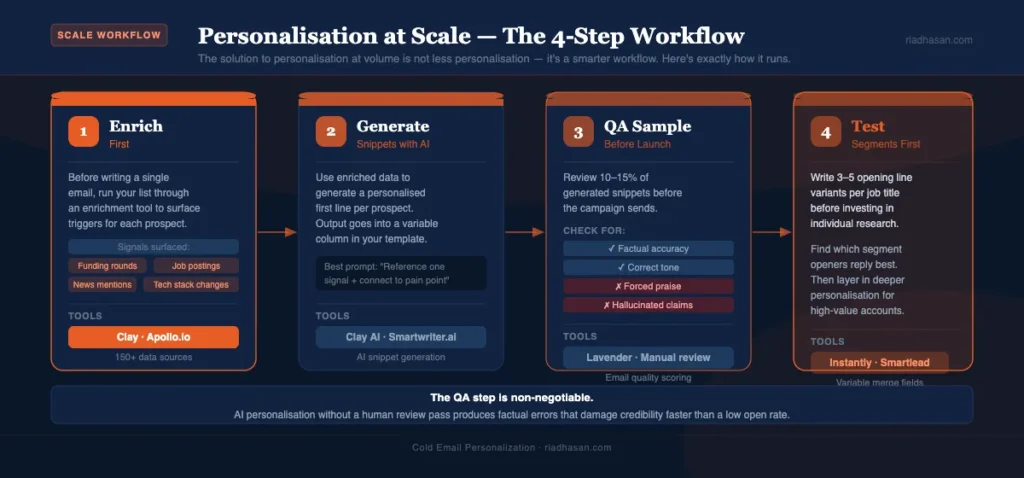
- Enrich first. Before writing a single email, run your list through an enrichment tool. Clay pulls signals from over 150 data sources including LinkedIn, job boards, funding databases and company news. The enrichment step surfaces the triggers — recent hires, funding rounds, tech stack changes — that make personalisation possible at scale.
- Generate snippets with AI. Use the enriched data to generate a personalised first line for each prospect. The best prompts instruct the AI to reference one specific signal and connect it to a relevant pain point. The output goes into a variable column alongside the standard template.
- QA a sample before launch. Review 10–15% of generated snippets before the campaign sends. Check for factual accuracy, tone, forced praise and hallucinated claims. AI personalisation without a quality assurance pass is a liability. One wrong claim about a prospect’s company sent at volume can damage your reputation faster than a low open rate.
- Test segment-level variables first. Before investing in individual-level research, write three to five opening line variations for each job title and company stage segment on your list. Test which segment-level openers produce the best replies, then layer in account or individual triggers for the high-value accounts where results justify the investment.
Tools that make this workable
| Tool | What it does | Best used for |
|---|---|---|
| Clay | Enriches prospects with 150+ data sources; AI agents draft personalised openers | Account and individual-level personalisation at scale |
| Apollo | Prospecting, job title and company data, buying signals | List building and initial enrichment |
| Smartwriter | AI-generated personalised openers from LinkedIn and web data | Content-reference and profile-based icebreakers |
| Lavender | Real-time email scoring and personalisation coaching in Gmail | Manual outreach quality checking and optimisation |
| Instantly / Smartlead | Campaign sending with variable merge fields for personalised snippets | Inserting personalised variables into sequences at scale |
What Bad Personalisation Looks Like
Understanding what bad personalisation looks like is as useful as knowing the good patterns. These are the failure modes that appear most often:
- First name only. “Hi [First Name]” is not personalisation. It’s a mail merge field. Every prospect knows this and it signals nothing about whether you researched them.
- Outdated information. Referencing a company initiative that ended, a role they left or a product that was discontinued signals poor research and creates immediate distrust. If you’re using enrichment data, verify the date stamps on trigger events before sending.
- The compliment sandwich. Opening with generic flattery (“I’ve been following your journey and I’m really inspired by what you’re building”), adding a thin middle and ending with a pitch. The flattery adds no value and the prospect can see through it immediately.
- Personalised opener, generic body. A strong, specific opening line followed by a template pitch that could have been sent to anyone. The mismatch is jarring and signals that the opener was a tactic rather than genuine interest.
- Surveillance-level detail. “I noticed you liked three posts about [topic] in the past two weeks.” This crosses from relevant to intrusive. Stick to publicly available professional activity.
Frequently Asked Questions
What is cold email personalisation?
Cold email personalisation is the practice of tailoring an outreach email to the specific person or company receiving it, using information that demonstrates genuine research rather than generic merge fields. It ranges from segment-level personalisation (writing different openers for different job titles) to individual-level personalisation (referencing a specific post the person wrote or a trigger event at their company). The goal is to make the recipient feel that the email was written for them specifically, not blasted to a list.
What are cold email icebreakers?
A cold email icebreaker is the opening line of an outreach email. Its purpose is to prove research happened and create enough immediate relevance that the prospect keeps reading. Effective icebreakers reference something specific and real about the prospect: a trigger event at their company, content they published, a problem evident from their public presence or shared professional context. The icebreaker is not a greeting or a self-introduction — those come later or not at all.
What are the best cold email opening lines?
The best performing opening lines reference something specific the prospect did or said: a trigger event (funding, hire, launch), a piece of content they published or a challenge common to their role at their company stage. The opening line format that consistently performs well is: observation or trigger + implication relevant to your offer. Under 15 words. No flattery or self-introduction. Prove research in the first sentence and the rest of the email has a chance.
How do I personalise cold emails at scale?
The practical workflow for scale personalisation: enrich your list with a tool like Clay to surface trigger data for each prospect, use an AI tool to generate a personalised snippet for each lead based on that data, quality-check 10–15% of the output before sending and insert the snippets as variables in your sending platform. The key constraint is QA — AI-generated personalisation without a human review pass produces factual errors and hallucinated claims that damage credibility at scale.
How do I reference pain points in a cold email?
Frame pain points as patterns observed across similar companies rather than problems you’ve diagnosed in this specific one. “At your stage, [challenge] tends to surface once [growth threshold]” is more effective than “You’re probably struggling with [challenge].” Contextual framing positions you as someone who understands the category; presumptuous framing positions you as someone making assumptions about a company you’ve never spoken to. End with a question that lets the prospect confirm or correct the assumption — this increases engagement rather than reducing it.
What is conversational cold email copywriting?
Conversational cold email is outreach written in a direct, plain-language tone that reads like a message from a knowledgeable colleague rather than a sales department. The key markers are short sentences, simple language, a single idea per email and one low-friction ask at the end. Conversational tone doesn’t mean casual or unprofessional — it means the absence of corporate jargon, over-engineered pitch language and the formal stiffness that signals mass outreach. The test is simple: would a trusted colleague send this? If yes, the tone is right.
Personalisation Is an Operations Problem, Not a Writing Problem
The teams hitting 10%+ reply rates in 2026 understand that personalisation starts before the email is written. It starts with list quality, enrichment data and a defined ICP that makes it possible to say something specific and relevant to every person on the list.
A brilliant icebreaker sent to a bad list is still going nowhere. Get the targeting right first. Then the personalisation has real data to work with.
- Cold Email Subject Lines — how subject lines should match the personalisation tone of the opening line
- Cold Email Templates for B2B — real templates with personalisation variables built in for every vertical
- Cold Email Lead Generation — how to build the list and ICP that makes deep personalisation possible
- Cold Email Best Practices 2026 — the full system from infrastructure to reply management
If you want campaigns built with proper personalisation at scale (ICP definition, list enrichment, sequence writing), you can work with me directly at riadhasan.com.