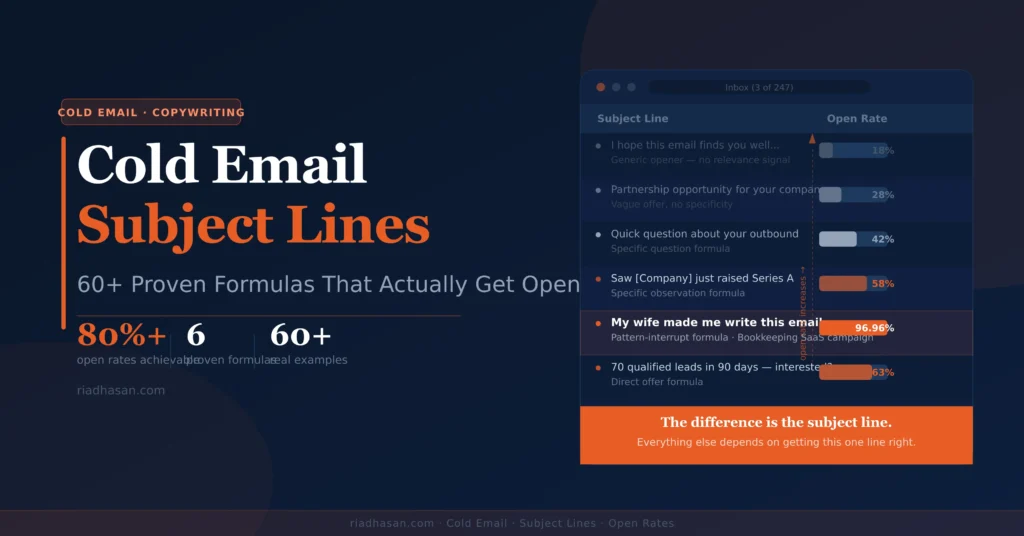
The subject line is the only part of your cold email a prospect reads before deciding whether to open it. Everything else (the copy, the offer, the follow-up sequence) depends on getting this one line right. I’ve tested cold email subject lines across hundreds of campaigns for B2B clients.
The difference between a 20% open rate and a 60%+ open rate almost always comes down to the subject line and the sender name. Nothing else at that stage matters more.
This guide covers what actually works: the formulas, the psychology, 60+ real examples organised by niche and use case and the patterns that kill open rates regardless of how good the rest of the email is.
What Makes a Cold Email Subject Line Work
Before the examples, it’s worth understanding the mechanics. A cold email subject line has one job: get the email opened. Not clicked, not replied to. Opened. Everything after that is the email’s job.
Three things drive opens in cold email:
- Relevance — the subject line signals this email is specifically for this person, not a blast
- Curiosity — it creates a gap between what they know and what the email will tell them
- Familiarity — it reads like something a colleague would send, not a marketing department
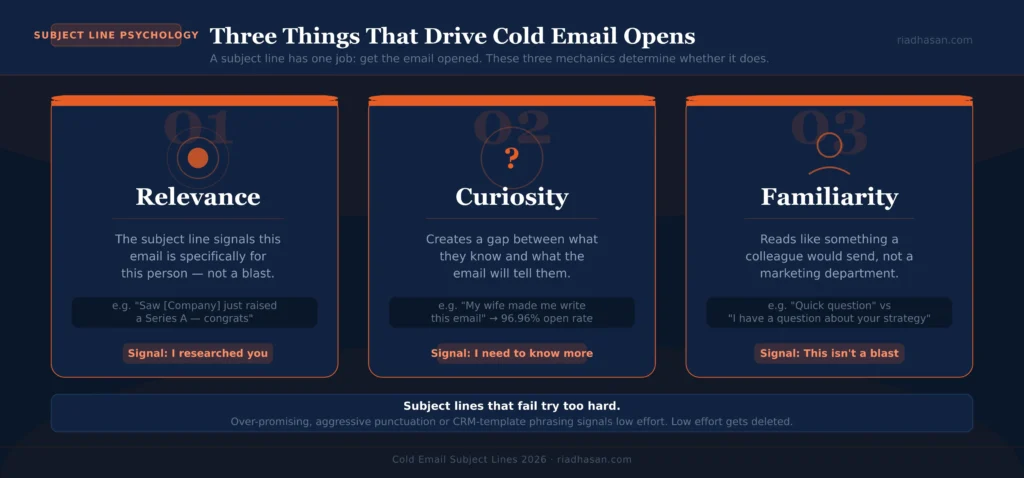
The subject lines that fail are the ones that try too hard. They over-promise, use aggressive punctuation or sound like they came from a CRM template. Prospects have seen them all. A subject line that reads as a cold email immediately signals low effort. Low effort gets deleted.
Length: shorter is almost always better
Aim for 3–7 words. Under 50 characters. The data across campaigns I’ve run consistently shows that shorter subject lines outperform longer ones, particularly on mobile where the preview truncates quickly. “Quick question” outperforms “I have a quick question about your business strategy.” The mystery in the shorter version is the mechanism.
Personalisation signals relevance faster than anything else
A subject line that includes the prospect’s company name, a recent news item about them or a reference to their specific role performs significantly better than a generic line. Not because personalisation is clever. Because it proves you actually looked at who you’re emailing. That’s rare enough to be noticed.
In the TubeOnAI campaign I ran, personalised subject lines referencing the prospect’s specific use case drove a 35% click-through rate on cold outreach. The email was short. The subject line was specific. That combination is what produced the number.
Avoid spam trigger words
Certain words and patterns reliably push emails toward spam filters or promotions tabs regardless of your sender reputation. Keep them out of subject lines entirely:
- Free, discount, offer, deal, save, limited time
- All caps anywhere in the subject line
- Multiple exclamation marks or question marks
- Emojis in B2B cold email (fine for some consumer audiences, actively harmful for B2B)
- “Re:” or “Fwd:” when the conversation is not actually a reply or forward
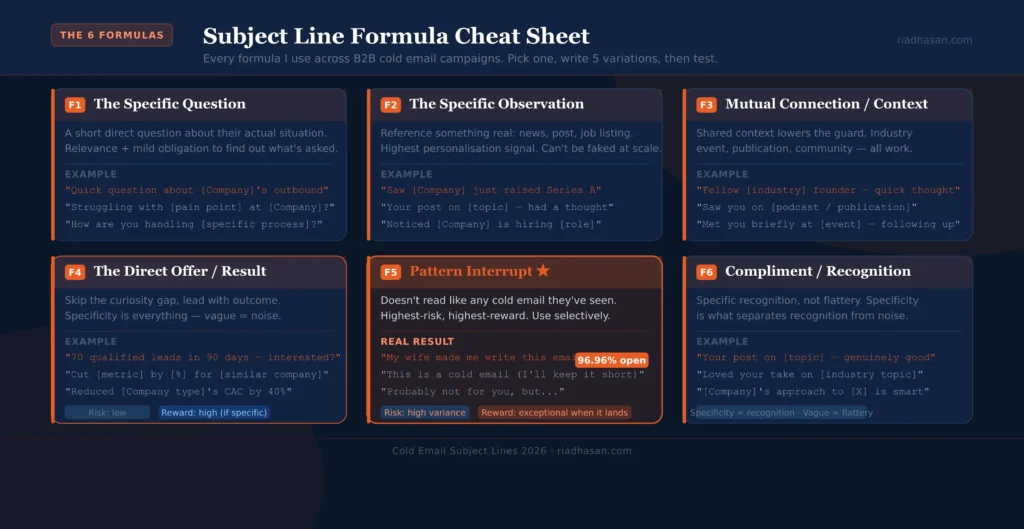
The Subject Line Formulas That Consistently Work
Formula 1: The specific question
A short, direct question addressed to the prospect’s actual situation. The question creates a mild obligation to find out what’s being asked. If it references something real about their business, the relevance signal is immediate.
Examples:
- Quick question about [Company]’s outbound
- How are you currently handling [specific process]?
- Is [specific problem] still a challenge for you?
- Question about your Q3 pipeline
- Struggling with [pain point] at [Company]?
Formula 2: The specific observation
Reference something real and specific about the prospect: a recent company announcement, a piece of content they published, a job posting that signals a need. This formula has the highest personalisation signal of any approach. It can’t be faked at scale, which is exactly why it works.
Examples:
- Saw [Company] just raised a Series A — congratulations
- Your post on [topic] — had a thought
- Noticed [Company] is hiring [role] — relevant to what I do
- [Company]’s [recent news] — sparked an idea
- Re: your [LinkedIn post / article / talk]
Formula 3: The mutual connection or context
Establishing shared context immediately lowers the guard. This doesn’t require a genuine mutual connection. A shared industry event, a publication they’ve been featured in or a community you both belong to creates the same effect.
Examples:
- Fellow [industry] founder — quick thought
- Met you briefly at [event] — following up
- Saw you on [podcast / publication]
- [Mutual connection] suggested I reach out
- Both in [industry] — quick question
Formula 4: The direct offer or result
Skip the curiosity gap and lead with the outcome. This works best when the offer is highly specific and credible. A vague “I can help you grow” is noise. “70 qualified leads in 90 days” is concrete enough to earn attention.
Examples:
- 70 qualified leads in 90 days — interested?
- Cut [specific metric] by [specific %] for [similar company]
- [Result] for [similar company] — same possible for [Company]?
- Reduced [Company type]’s CAC by 40% — can we chat?
Formula 5: The unexpected or pattern-interrupt
A subject line that doesn’t read like any cold email the prospect has ever seen. This is the highest-risk, highest-reward formula. When it lands, open rates are exceptional. Miss and it reads as weird and gets deleted. Use it selectively, on highly targeted lists where you can afford the variance.
The most striking example I’ve seen came from the bookkeeping SaaS campaign: the subject line “My wife made me write this email” produced a 96.96% open rate. It had nothing to do with the product at the subject line level. Entirely human, entirely unexpected and completely irresistible to open. The email itself justified the subject line with a personal story that tied into the offer. The subject line and the email earned each other.
Examples:
- This is a cold email (and I’ll keep it short)
- Bad time?
- Honest question
- Not another sales pitch
- Probably not for you, but…
Formula 6: The compliment or recognition
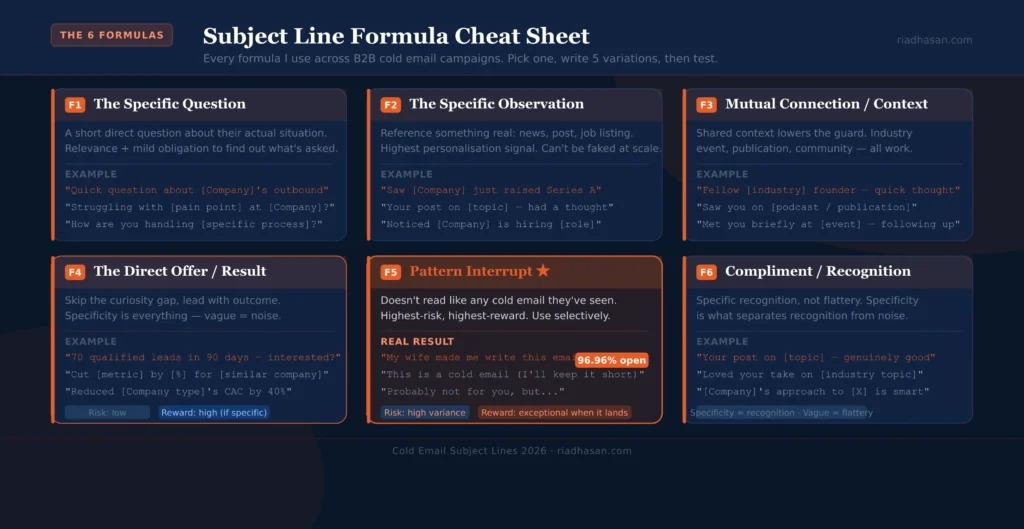
Genuine recognition of something specific the prospect has done or achieved. Not flattery. Specificity. “I love what you’re building” is flattery. “Your piece on [specific topic] changed how I think about [concept]” is recognition. One gets dismissed, the other earns a read.
Examples:
- Your [content / talk / post] on [topic] — genuinely good
- [Company]’s approach to [specific thing] is smart
- Loved your take on [recent industry topic]
60+ Cold Email Subject Lines by Niche and Use Case
B2B SaaS
- Quick question about [Company]’s onboarding flow
- How [Similar SaaS] reduced churn by 30%
- Your free trial conversion — a thought
- Saw [Company] just launched [feature] — relevant timing
- [Company] + [your company] — worth 15 minutes?
- Noticed [Company] is growing headcount fast — a thought
- How [similar company] cut their [metric] by half
- Question about your current [specific tech/tool]
- Reducing [SaaS metric] for [similar company type]
Agencies pitching clients
- Quick question about [Company]’s SEO
- [Company]’s Google rankings — noticed something
- Grew [similar agency client] from [X] to [Y] — interested?
- Question about your current content output
- [Company]’s link profile — honest observation
- How [similar company] added 400 leads/month
- Your [service] vs. what [Competitor] is doing differently
- Quick win I spotted on [Company]’s site
- Your [channel] vs. your competitors — quick comparison
Recruiters and talent outreach
- Opportunity at [Company type] — 2 minutes?
- Your background in [specific skill] — relevant role
- Quick question about your next move
- [Company] is looking for someone with your background
- Not a typical recruiter email
- Saw your work on [project / publication / GitHub]
Partnership and collaboration
- Collaboration idea — [Your Company] + [Their Company]
- Audience overlap between us — worth exploring
- Quick thought on a guest post / podcast swap
- Mutual benefit idea — 5 minutes?
- Love what you’re building at [Company] — an idea
Link building outreach
- Broken link on [specific page] — have a replacement
- Your [article] on [topic] — I wrote something relevant
- Contribution idea for [publication name]
- Data you might want to reference in [article]
- Quick update on your [page] — found something
Financial services and fintech
- Question about [Company]’s current [specific process]
- Saw [Company] is expanding into [market] — a thought
- Reduced compliance overhead for [similar firm] — interested?
- [Metric] improvement for [similar company] in 60 days
- Quick question about your [AML / KYC / payment] stack
E-commerce and DTC brands
- Your [product category] conversion rate — an observation
- [Company]’s abandoned cart rate — had a thought
- How [similar brand] added [revenue] with [approach]
- Question about your current email / SMS strategy
- Saw [Company] running [ad / campaign] — relevant idea
- [Company]’s repeat purchase rate — an idea
- How [similar brand] doubled LTV in 90 days
Real estate
- Off-market opportunity in [area] — worth a look?
- Question about your [area] listings
- [Address] — interested in an offer?
- Buyers looking in your area — quick question
- Your [property type] portfolio — a thought
Cold calling follow-up by email
- Following up from our call earlier
- As promised — quick note from [your name]
- Left you a voicemail — easier over email
- The idea I mentioned on the phone
- From [your name] — we spoke briefly on [day]
Job seekers cold emailing hiring managers
- Your [role] opening — [specific relevant skill]
- Application for [role] — a different approach
- Quick question about the [team / department] at [Company]
- Referral from [mutual connection] — [your name]
- [Specific result] in my last role — relevant to [Company]?
Consulting and professional services
- Question about [Company]’s current [specific process]
- How [similar firm] saved [X hours/$/risk] with [approach]
- Saw [Company] recently [trigger] — relevant idea
- [Specific outcome] for [similar company type] — 20 minutes?
- Quick question about your [service line / practice area]
Short, curiosity-gap subject lines (any niche)
- Quick thought
- Relevant to you?
- Saw something interesting
- A different approach
- Worth a quick call?
- One question
- Have you tried this?
What to Test First (and How)
Subject lines are the highest-leverage thing to A/B test in any cold email campaign. A 10-percentage-point lift in open rate means 10% more people see your copy, without changing a single word of the email itself.
Test one variable at a time
The most common mistake in subject line testing is changing too many things at once. If you test a personalised subject line against a generic one at the same time as changing the sender name and the first line of copy, you have no idea which change drove the result. Change one thing per test. Always.
The four variables worth testing in order
| Variable | What to test | Minimum sample per variant |
|---|---|---|
| Personalisation | Company name included vs. generic | 100 opens |
| Length | 3–4 words vs. 6–8 words | 100 opens |
| Formula | Question vs. observation vs. direct offer | 150 opens |
| Tone | Casual vs. professional vs. pattern-interrupt | 150 opens |
Wait until you have the minimum sample before drawing conclusions. Subject line tests with fewer than 100 opens per variant produce noise, not data. Patience in testing is what compounds into consistently improving open rates over time.
What a good open rate actually looks like
For well-targeted cold email sent from a properly warmed inbox, 45–65% open rates are achievable and realistic. Open rates below 30% almost always indicate a deliverability problem (emails going to spam or promotions), a targeting problem (wrong audience) or a sender name problem. Not just a weak subject line. Diagnose the right variable before changing your subject line.
Subject Line Mistakes That Kill Open Rates
Being too clever
Wordplay, obscure references and overly creative lines confuse more than they intrigue. A prospect scanning their inbox at speed needs to grasp the relevance of a subject line in under a second. If the line requires interpretation, it gets skipped.
Over-personalisation that reads as surveillance
There’s a line between relevant personalisation and making the prospect feel tracked. “Noticed you visited our pricing page twice this week” feels intrusive. “Quick question about [Company]’s growth plans” feels relevant. The distinction is professional context. Keep personalisation to publicly available information and professional activity.
False urgency or scarcity
“Last chance to…” or “Only 3 spots left” in a cold email subject line is an immediate credibility killer. The prospect knows you’ve never spoken before. There’s no basis for urgency. Lines like these identify the email as low-quality outreach before it’s even opened.
Misleading subject lines
A subject line that promises something the email doesn’t deliver destroys trust. Even if it drives the open, the disconnect between what was promised and what was delivered creates a negative first impression that’s nearly impossible to recover from. The subject line and the email need to be honest with each other.
Using “Re:” or “Fwd:” when there’s no prior conversation
This was a widely used trick a decade ago. Today, prospects recognise it immediately, it’s a CAN-SPAM violation in the US and it signals that the sender is willing to deceive to get an open. That’s not how you want to start a business relationship.
Frequently Asked Questions
What is the best subject line for a cold email?
There’s no single best subject line. Context determines what works. For most B2B cold email, a short specific question referencing the prospect’s company or situation consistently outperforms generic lines. “Quick question about [Company]’s [relevant topic]” is a reliable starting point. From there, personalise based on what you actually know about the prospect and test alternatives against it.
How long should a cold email subject line be?
3–7 words is the working range. Under 50 characters is the target. Shorter subject lines get more of the preview text visible on mobile, create more curiosity and read more like something a person would actually write. Lines beyond 8–9 words start to feel like email marketing rather than a genuine outreach message.
Should I include the prospect’s name in the subject line?
Including their company name is more effective than their first name. “Quick question about Acme” feels relevant and researched. “Hi John, quick question” feels like a CRM merge field, which it usually is. Use the company name, a recent trigger event or their specific role rather than the first name alone.
Do emojis work in cold email subject lines?
Not for B2B cold email. Emojis in B2B outreach subject lines consistently reduce open rates and increase spam filter scores. They read as marketing material rather than professional correspondence. Save them for newsletters and consumer-facing campaigns where they’re contextually appropriate.
What are good subject lines for B2B cold email?
The most reliable B2B cold email subject lines share three qualities: they’re short, they reference something specific to the recipient and they read like something a colleague would send rather than a sales team. “Saw [Company] just [trigger event]” and “Question about your [specific process]” consistently perform well across industries. The exact phrasing matters less than the specificity and the brevity.
How do I write a subject line for a cold call follow-up email?
Be direct about the context. “Following up from our call earlier” or “As promised, a quick note from [name]” work well because they reference a real event and set an honest expectation for the email. Don’t try to be clever when there’s already a real context to anchor the subject line to. The conversation itself is the strongest relevance signal you have.
Start With One Formula, Then Iterate
The temptation with subject line guides is to pick the cleverest line and hope for the best. That’s not how open rates improve. Pick one formula that fits your audience, write five to ten variations of it, test two against each other and let the data tell you which direction to push.
The campaigns I’ve run that hit 60%+ open rates didn’t get there in the first week. They got there through two or three rounds of testing, each one sharpening the line based on what the previous version taught us. The subject line is never finished. It’s always in progress.
Here’s where to go next:
- Cold Email Best Practices 2026 — the full system: targeting, copy, follow-up and deliverability
- Cold Email Personalization — how to write first lines that match your subject line’s promise
- Cold Email Follow-Up Guide — what to do when the first email doesn’t get a reply
- What Is Cold Email? — if you’re building your first campaign from scratch
If you want someone to build, test and optimise your cold email campaigns directly, you can work with me at riadhasan.com.