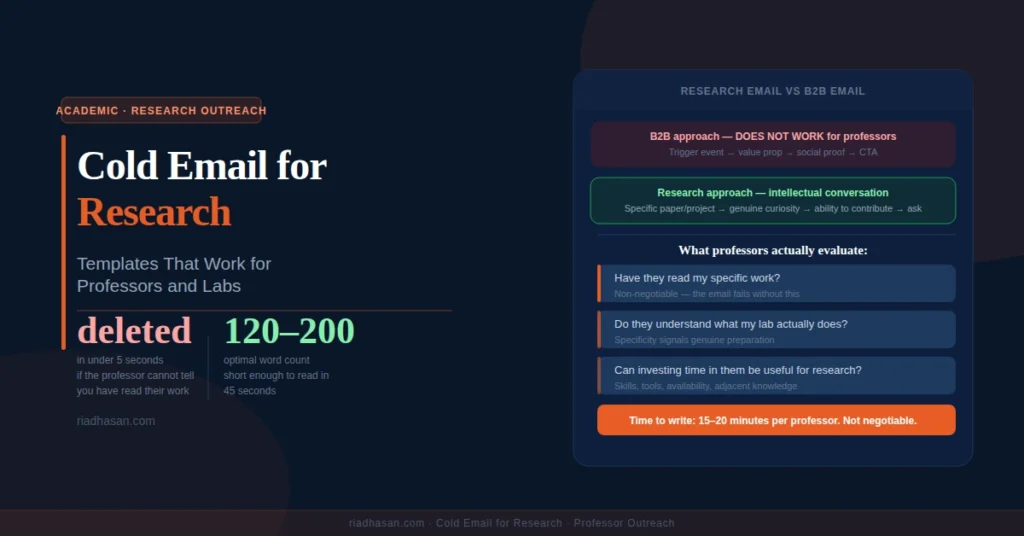
A cold email for research to professor is one of the highest-leverage moves a student can make. Done correctly, a single well-written email to the right professor can open the door to a research position, a publication, a letter of recommendation or a graduate school connection. The badly-done version gets deleted in under five seconds.
This guide covers the structure that works, the mistakes that kill research cold emails before they’re read, templates for undergraduates and high school students, subject lines that get opened and the timing decisions that most guides miss.
Why Research Cold Email Is Different From B2B Outreach
Cold email for a sales or business purpose follows a value-proposition model: here’s what I offer, here’s proof it works, what’s the next step? Research cold email operates on a completely different register.
A professor is not a prospect. They’re not evaluating whether your offer is good for their business. The evaluation is about whether you are genuinely curious about their specific work, whether you understand what their lab actually does and whether investing time in you will produce something useful for their research. The email that works is one that reads like the beginning of an intellectual conversation, not a job application or a pitch.
The practical consequence: the standard B2B cold email structure (trigger event, value proposition, social proof, CTA) does not work for research outreach. The structure that works is different. The mistakes that kill a research cold email are almost entirely the opposite of what kills a B2B one.
What Professors Actually Want to See
Three things determine whether a professor replies to a research cold email:
- Evidence of genuine engagement with their work. Professors receive dozens of emails per week that say “I’m deeply interested in your research.” None of those emails have read the research. The emails that earn replies cite a specific paper, a specific finding, a specific methodological approach — something that proves the student spent more than five minutes on the professor’s faculty page.
- A clear, realistic ask. The professor needs to know exactly what the student wants: a meeting, a lab visit, an informal conversation, an opportunity to contribute to a specific project. Vague requests (“I’d love to get involved somehow”) produce vague responses or no response. Specific requests produce specific answers.
- Brevity and professionalism. Under 200 words is the target. A professor reading email between class, meetings and writing deadlines will not read a long email from an unknown student. Anything over 250 words should be cut. The email’s job is not to tell the professor everything about you — it is to earn a reply and a conversation where you can say more.
One principle that holds across every source and every type of research outreach: if the professor cannot tell from the email that you’ve read their work, the email will not work. This is the non-negotiable. Everything else is structure and execution on top of that requirement.
The 1-2-3-4 Research Cold Email Structure
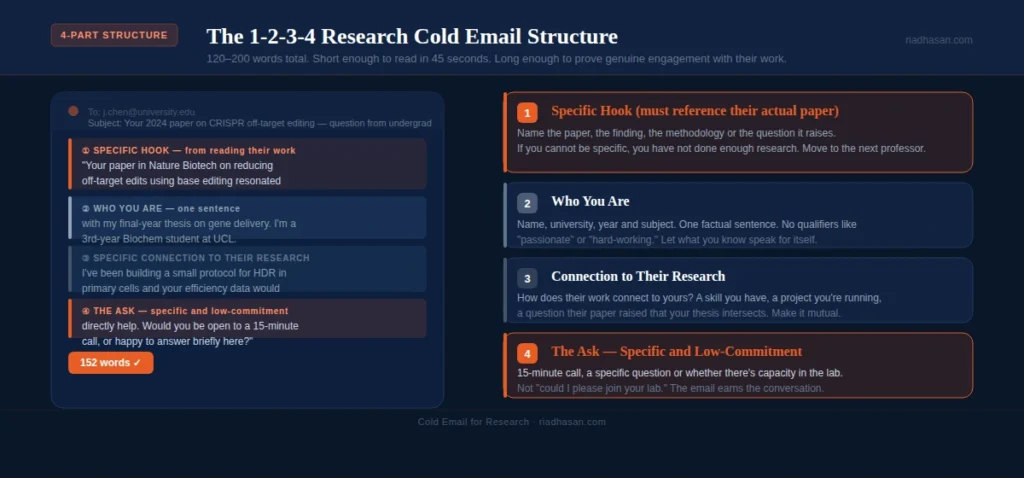
The most consistently effective structure for research cold email has four parts:
- About the professor (1–2 sentences): Reference something specific from their research. A paper you read, a finding that connected with something you’re studying, a methodological approach you found interesting. This is the hook. It must be genuine and it must be specific. Generic praise (“your research is fascinating”) is identical to saying nothing.
- The bridge (1 sentence): Connect their work to your background, interests or a question you’re pursuing. This is the logical reason you’re emailing this professor specifically and not sending the same email to every lab in the department.
- About you (2–3 sentences): Your name, year, institution and the most relevant thing about your academic or research background. Not a CV summary. One or two specific things — a course project, a skill, a relevant experience — that make you a reasonable candidate for whatever you’re asking for.
- CTA (1 sentence): A single, clear, low-commitment ask. A 15-minute call, a brief meeting, a few questions by email. Do not ask for a position directly in the first email — ask for a conversation where you can discuss possibilities.
Total length: 120–200 words. Short enough to read in 45 seconds. Long enough to demonstrate genuine engagement.
Subject Lines for Research Cold Emails
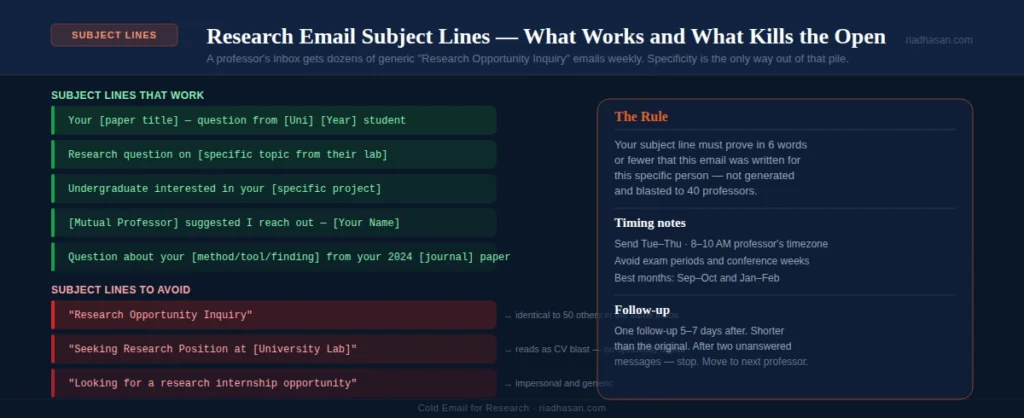
The subject line is what determines whether the email gets opened. For research outreach, the subject line should reference something specific about the professor’s work, not a generic “Research Opportunity Inquiry” that looks identical to every other unsolicited email in their inbox.
Subject lines that work
- Undergraduate student interested in [specific topic from their research]
- Question about your work on [specific paper title or project]
- [Your name], [University] — interest in [Lab Name or Research Area]
- High school student — interest in [specific research area]
- [Mutual connection] suggested I reach out about your [specific project]
- Prospective research contributor — [specific topic]
Subject lines to avoid
- “Research Opportunity Inquiry” — generic, mass-email signal
- “PhD Position Availability” — too forward before a relationship exists
- “I would like to join your lab” — no specificity, immediately forgettable
- “Research Assistant Needed?” — frames it as their problem, not your offer
- Subject lines over 60 characters — often get truncated on mobile
Cold Email Templates for Research
Every template below requires genuine personalisation in the opening section before it sends. The structure provides the frame; the research into the professor’s specific work provides the content that makes the email worth reading.
Template 1: Undergraduate student seeking lab position
Subject: Undergraduate student interested in [specific research area]

Dear Professor [Last Name],

Your [paper/project name] — specifically [one specific finding, method or question it explores] — connects directly with [the specific thing you're studying, a question you're pursuing or a course project you completed].

I'm a [year] undergraduate in [department] at [University]. I have [one specific relevant skill or experience — a technique, a relevant coursework project, a lab skill] and am looking to develop that further through genuine research work.

Would you be open to a 15-minute conversation to discuss your current projects and whether there might be a way I could contribute?

[Your name]
[University, Department, Year]
[Email | Phone (optional)]
Template 2: Graduate school inquiry
Subject: Prospective PhD student — interest in [specific lab/research area]

Dear Professor [Last Name],

Your research on [specific topic] — particularly [one specific paper, method or finding] — is directly relevant to the direction I want to take my doctoral work. [One sentence explaining why or the connection to your own research questions.]

I'm completing my [degree] at [University] in [field], with [one specific relevant experience or skill]. I'm applying to PhD programmes for [year] entry and [University] is at the top of my list because of the work your group is doing on [specific topic].

I would welcome the chance to discuss your current research directions and whether my background might be a fit. Would a brief call be possible?

[Your name]
[Current institution, degree, year]
[Email]
Template 3: High school student research inquiry
Subject: High school student — interest in [specific research area]

Dear Professor [Last Name],

I recently read your paper on [specific paper or project] and was particularly struck by [one specific thing — a method, a result, a question it raised]. It connects with [a project you've worked on, a class you're taking or a question you've been exploring].

I'm a [year] high school student at [School]. I'm genuinely interested in [research area] and am looking for any opportunity to learn more about how research in this field actually works — whether that's observing lab work, helping with low-level tasks or simply having a short conversation about the questions your group is exploring.

I understand you are very busy and that high school students are an unusual request. If there is any way to get involved, even briefly, I would be committed and hardworking. Would you be open to a short email exchange or call?

[Your name]
[School, Year]
[Email]
Template 4: Research mentorship or shadowing (not a paid position)
Subject: [Your name] — interest in shadowing your work on [specific topic]

Dear Professor [Last Name],

I came across your work on [specific project or paper] while [how you found it — a course reading, a conference, a departmental newsletter]. The approach you're taking to [specific method or question] is exactly the direction I want to develop in my own work.

I'm a [year, institution] student in [department]. I'm not looking for a paid position — I'm looking for an opportunity to learn how research actually works in practice. Even observing lab processes, assisting with literature review or attending lab meetings occasionally would be enormously valuable at this stage.

Would you be open to a short conversation about whether any of that would be possible?

[Your name]
[Institution, Department, Year]
[Email]
Template 5: Research follow-up (after no response)
Subject: [same thread]

Dear Professor [Last Name],

Following up on my email from [timeframe]. Completely understand if you're not taking students right now — I just wanted to make sure it hadn't got buried.

[Optional: one brief new line — a new paper of theirs you read, a question the first email raised, or an update on your own work.]

Happy to wait until a more convenient time or try again next semester.

[Your name]
When to Send Research Cold Emails
Timing affects whether a professor reads and responds to an email. Academic calendars create predictable windows of high and low responsiveness:
| Target period | Best time to email | Avoid |
|---|---|---|
| Summer research position | January–March | May onwards (labs already decided) |
| Fall research position | April–June | August (professors on vacation) |
| Spring research position | October–November | December (grading and conferences) |
| Any time of year | Tuesday–Thursday, 9–11 AM professor’s timezone | Monday (backlog), Friday (mental checkout), finals weeks (May/December) |
An opportunistic trigger that beats any calendar window: if the professor just published a new paper or posted about a new project on social media or in a departmental newsletter, that week is the best possible time to reach out. The work is top of mind, the professor is likely to be in a receptive state about it and your email can reference something that is days, not months, old.
Research Cold Email for High School Students
High school students emailing professors for research face one extra layer of difficulty: most professors have no established mechanism for involving students who aren’t enrolled at their institution. That means the email has to do more work. It has to earn a response to an unusual request from someone with minimal formal credentials.
What this changes in practice:
- Target smaller universities and younger faculty first. Full professors at large research universities receive hundreds of emails per semester. An assistant professor at a smaller institution, who is building their lab and more open to unusual contributors, is a better first contact.
- Open with the research, not yourself. A high school student’s academic profile is unlikely to be the hook. The hook is the professor’s work. Genuine engagement with a specific paper or project is the only thing that makes a high school email competitive with undergraduate and graduate inquiries.
- Never mention college applications. “This will help my application” is the single biggest red flag in a high school research cold email. The professor is not a service provider for college admissions. Signal that you care about the research, not the credentials it produces.
- Never ask about paid positions. Most high school research is unpaid or for academic credit. Opening with compensation signals that the work itself is not the primary interest.
- Ask for something small. A lab visit, a 20-minute conversation, a reading list recommendation. A small ask is easier to say yes to and creates the relationship that leads to bigger opportunities.
How to Follow Up on a Research Cold Email
Send one follow-up seven to ten days after the initial email if you haven’t heard back. Keep it brief: two or three sentences. Acknowledge that the professor is busy, restate your interest in one line and offer to wait or reach back another time. The follow-up template in the templates section above is exactly the right length and tone.
After two unanswered emails, stop. A third email without a response signals disrespect for the professor’s time and can close the door permanently. Move on to other contacts and come back to this professor when you have something new to share: a paper you read, a project update, a question from your own work that connects to theirs.
One exception: if the professor is on sabbatical, away at a conference or in the middle of finals week, a third email three months later with a fresh specific reference to their work is entirely appropriate. Context matters.
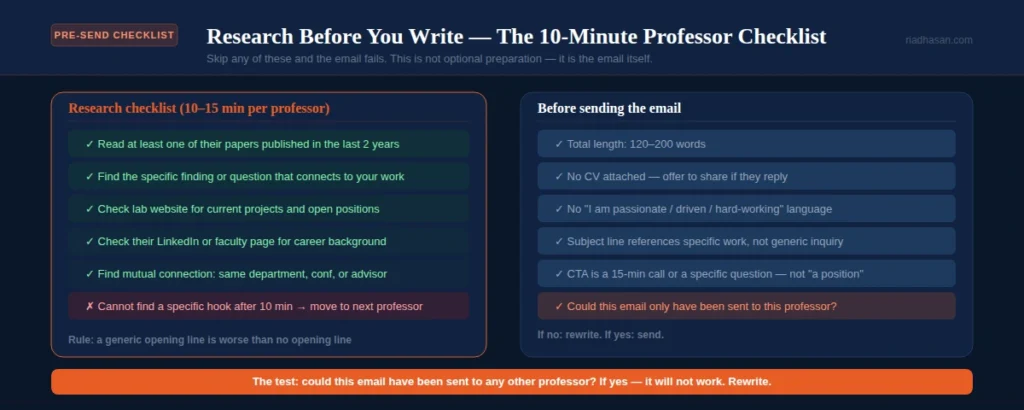
The Mistakes That Kill Research Cold Emails
Generic openers
“I’ve always been passionate about science.” “I’m fascinated by your research.” These sentences appear in nearly every cold email a professor receives. They prove nothing and tell the reader nothing. A professor reading these words knows the email will not get more specific. Delete immediately.
Mass emailing
Professors can identify a mass email within two sentences. The tell is always the same: references to “your research” without any indication that the student has read it, no specific paper or project mentioned, a value proposition that could apply to any lab in any department. Mass emails get mass deleted.
CV attachment without context
Attaching a CV to the first email signals a job application, not a research inquiry. A professor receiving an unsolicited CV has no frame for evaluating it. The email should earn the conversation; the conversation earns the CV review. Offer to share it if the professor is interested. Don’t send it unrequested.
Asking for “any available positions”
Professors don’t have a menu of available research positions. They have specific projects, specific questions and specific needs. Asking for “any openings” signals that you haven’t read their work and don’t know what they’re working on. Ask about a specific project or a specific question their research raises — not a generic slot.
Writing too much
Over 250 words is almost always a problem. A professor processing email between teaching, meetings and writing deadlines allocates seconds, not minutes, to unfamiliar senders. Every word beyond 200 reduces the probability of the email being read. If you can’t make the case in under 200 words, the case isn’t clear enough yet.
Frequently Asked Questions
How do I cold email a professor for research?
Use the 1-2-3-4 structure: open with one to two sentences about a specific paper or project of theirs (not generic praise), add a bridge sentence connecting their work to yours, introduce yourself in two to three sentences with the single most relevant credential and close with one specific low-commitment ask (a brief call, a few email questions, a meeting). Keep the total email under 200 words. Send Tuesday to Thursday, 9–11 AM in the professor’s timezone.
What is a good cold email template for research?
The best research cold email template has four parts: a specific hook referencing the professor’s actual work, a sentence bridging their research to your interest, a brief self-introduction with one relevant credential and a single clear ask. It runs between 120–200 words. Templates that start with “I am deeply interested in your research” or attach an unsolicited CV perform poorly — professors identify mass-email patterns immediately and those emails are deleted without a response.
How do I cold email a professor for research as a high school student?
Target assistant professors at smaller universities first. They are more likely to take unusual contributors. Open with the professor’s specific work, not your academic profile. Never mention college applications as a motivation. Never ask about paid positions. Ask for something small: a 20-minute conversation, a lab visit, a reading recommendation. Use the high school template above and keep the email under 175 words. Genuine curiosity about the actual research is the only thing that makes a high school cold email competitive.
When should I send a research cold email?
Email Tuesday through Thursday, between 9 and 11 AM in the professor’s timezone. For timing relative to the academic calendar: January–March for summer positions, April–June for fall positions, October–November for spring. Avoid December and May (finals and grading weeks), August (peak sabbatical and vacation) and Monday mornings (inbox backlog). The best possible moment to send is the week a professor publishes a new paper or announces a new project.
How long should a cold email to a professor be?
Under 200 words is the target. Over 250 words is almost always a problem, according to EduAvenues’ guide on professor outreach, which notes that professors process unfamiliar messages in seconds during busy teaching and writing periods. Professors reading email between teaching, meetings and writing process unfamiliar messages in seconds. A 200-word email that demonstrates genuine engagement with their specific work will outperform a 400-word email with the same content in every context. If the case takes more than 200 words, the email needs editing, not expanding.
Should I attach my CV to a research cold email?
No. Attaching an unsolicited CV frames the email as a job application rather than a research inquiry. The professor has no frame for evaluating the CV before a relationship exists. Include a brief self-introduction in the email body: your name, year, institution and one relevant credential. If the professor replies positively, offer to share your CV as the next step. The email earns the conversation; the conversation earns the CV review.
The Email Is the Start, Not the End
A successful research cold email produces a conversation. The conversation produces a relationship. The relationship produces the opportunity. Students who cold email expecting a lab position to appear from a single message are approaching this wrong. The ask in the first email should be small and achievable — a 15-minute call, a few email questions, a coffee meeting. The position, the mentorship, the letter of recommendation — these follow from the relationship that starts with the reply.
- Cold Email Subject Lines — subject line formulas and examples across professional and academic contexts
- Cold Email for a Job — the same approach applied to professional roles after graduation
- Cold Email for an Internship — templates for company and lab internship outreach
- Cold Email Personalization — how to write opening lines that prove research happened