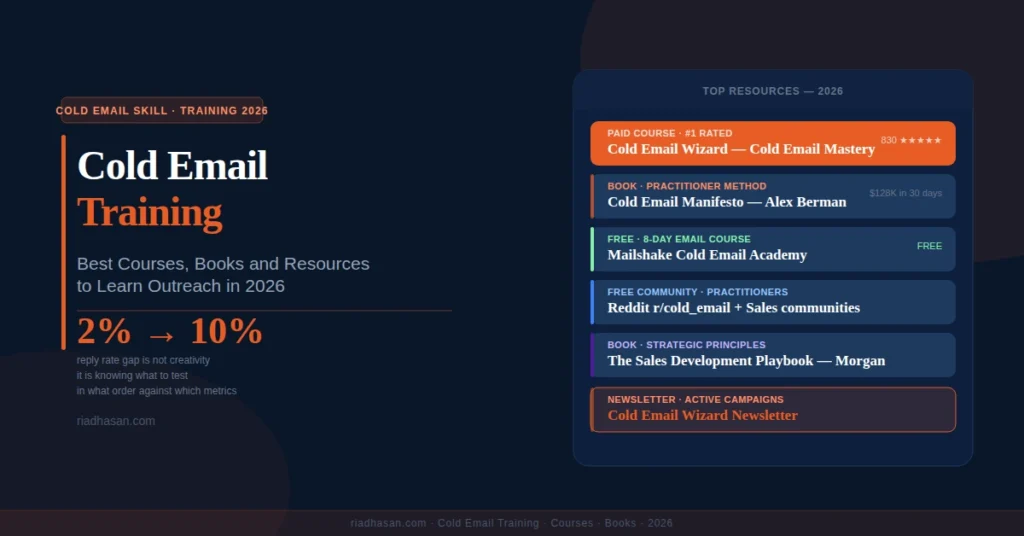
Cold email is a skill, not a talent. The gap between a 2% reply rate and a 10% reply rate is not creativity. It is knowing what to test, in what order, against which metrics. The fastest way to close that gap is structured learning from people who have run campaigns at scale and can show the data behind what they changed. Good cold email training covers five things- infrastructure, ICP and list building, copywriting, sequence design, measurement and iteration.
This guide covers the best cold email training resources available in 2026: paid courses, free academies, books and the practitioner communities where you learn from active campaigns rather than recycled advice.
What Cold Email Training Should Actually Teach
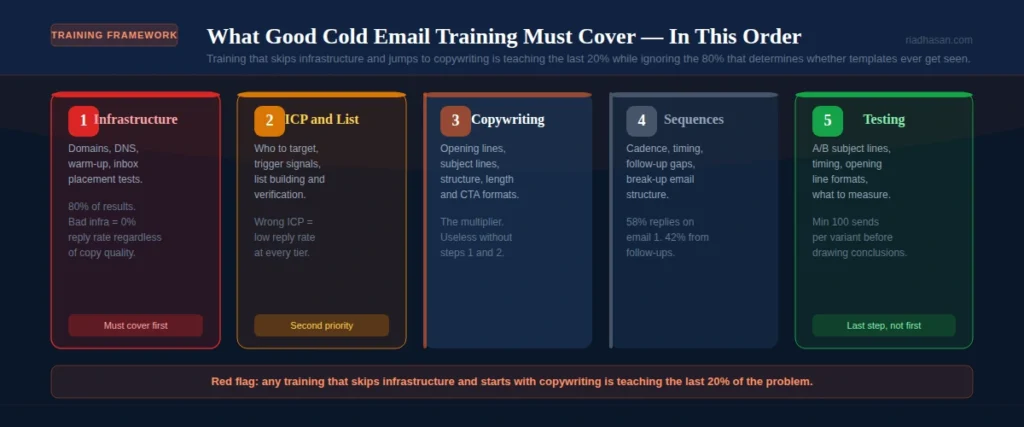
Before the resource list, the framework for evaluating any cold email training. Good training covers five things, in this order:
- Infrastructure: domain setup, DNS authentication, warm-up protocols, inbox placement testing. Everything else is useless if emails don’t reach the primary inbox.
- ICP and list building: how to define who to email and how to build a verified list from the right sources.
- Copywriting: the structure that produces replies: personalised opening, single value proposition, one ask. Not templates you copy, but frameworks you understand.
- Sequence design: cadence, follow-up strategy, when to stop.
- Measurement and iteration: which metrics to track, how to run A/B tests properly, how to diagnose low performance.
Any training that skips infrastructure and jumps straight to copywriting templates is teaching the last 20% of the problem while ignoring the 80% that determines whether those templates ever get seen.
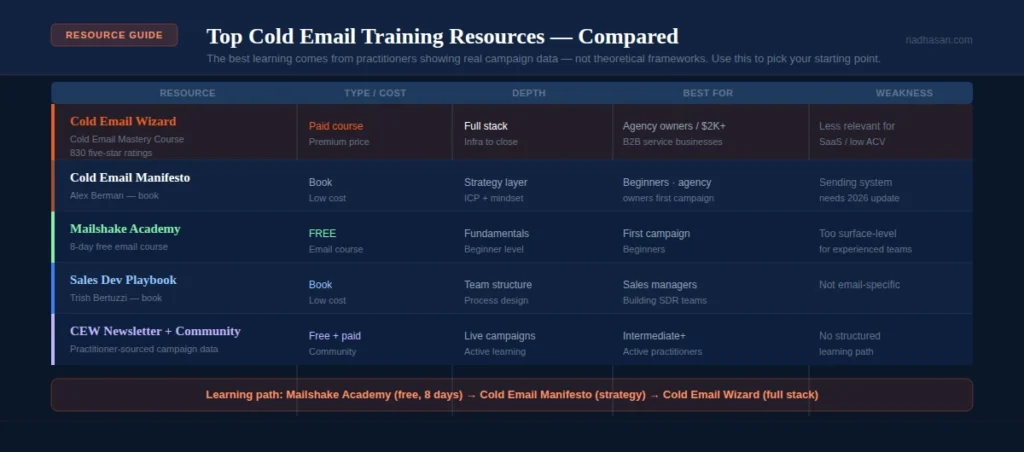
Cold Email Wizard (Cold Email Mastery Course)
Cold Email Wizard is the practitioner brand behind the Cold Email Mastery course, the most widely reviewed cold email course in the market. It has 830 five-star ratings, making it one of the highest-rated B2B outreach courses available. The course is built specifically for selling B2B services priced at $2,000 per month or more and its frameworks are oriented toward agency owners, consultants and service businesses using cold email for client acquisition.
The course covers: ICP selection, deliverability setup, lead sourcing at scale, copywriting frameworks and sending systems. It walks through the full stack from infrastructure to copy to tool selection, using real campaign examples rather than theoretical frameworks.
Best for: Agency owners and service businesses using cold email for B2B client acquisition at $2K+/month price points. Less applicable to SaaS or lower-ACV products.
What Cold Email Wizard covers
- ICP definition and niche selection for agencies
- Lead sourcing: finding contacts at scale for specific niches
- Email deliverability setup — DNS, warm-up, inbox testing
- Copywriting: short-form templates, personalisation at volume
- Offer framing for high-ticket B2B services
- Follow-up sequence design
- Scaling systems for agencies running campaigns for multiple clients
Cold Email Manifesto (Alex Berman)
The Cold Email Manifesto is a book by Alex Berman, co-founder of X27 Marketing, that covers his cold email methodology for B2B client acquisition. Berman’s documented result: 12,000 cold emails sent, 23 calls booked, $128,000 in pipeline generated in 30 days, using three-sentence emails with no AI personalisation. The manifesto covers four areas: mindset, ICP selection, copywriting and sending system.
The book’s core argument is that brevity and specificity (not personalisation at scale or complex sequences) produce disproportionate results. Three-sentence emails outperform well-crafted five-paragraph pitches because they respect the reader’s time and get to the ask without demanding effort in return.
The Manifesto is particularly strong on ICP selection and offer framing. Its weakness is that the sending system section requires updating for 2026: the infrastructure tools and compliance landscape have changed significantly since publication.
Best for: Beginners who want to understand the strategic principles of cold email before getting into tooling and technical setup. Agency owners building their first outreach system.
Mailshake Cold Email Academy (Free)
Mailshake’s Cold Email Academy is an 8-day free email course covering the fundamentals of cold outreach in 2026. It is one of the most accessible structured introductions to cold email available without payment. The course covers: what makes cold emails work in the current inbox environment, deliverability basics, copywriting principles, sequence structure and measurement.
The course is self-paced but structured to be completed over 8 days, with each module building on the previous one. It is practically useful for someone running their first campaign, covering enough to avoid the most common beginner mistakes without requiring significant time investment.
Best for: Beginners who want a structured introduction before committing to a paid course. Free. No prerequisites.
QuickMail Masterclass (Deliverability Focus)
The QuickMail Masterclass focuses specifically on email deliverability: how to avoid spam filters, configure sending infrastructure correctly and maintain inbox placement over time. It is the most technically focused course among the major cold email training options and is the right choice for anyone whose primary problem is emails landing in spam rather than copy or targeting.
The course covers: domain configuration (SPF, DKIM, DMARC), warm-up protocols, inbox placement testing, spam trigger avoidance and how to diagnose and recover from deliverability problems.
Best for: Intermediate practitioners who have copy and targeting figured out but are hitting deliverability walls. Also useful for agencies managing sending infrastructure for multiple clients.
Udemy — Cold Email for B2B Lead Generation (Joshua George)
Joshua George’s Udemy course covers the full cold email process from scratch, with live campaign walkthroughs showing setup in real time. The course is self-paced, can typically be completed in a weekend and covers: lead generation, infrastructure setup, copywriting, sending tool configuration and campaign measurement.
Its main advantage is the real-time demonstration format. Watching someone build a campaign from zero is more useful for beginners than written frameworks alone.
Best for: Visual learners who prefer watching a campaign built live over reading frameworks. Good starting point for solo operators building their first outbound system.
Practitioner Communities: Where Ongoing Learning Happens
Courses teach frameworks. Communities teach what’s working right now, because the inbox environment changes faster than any course can be updated.
Three communities worth spending time in for cold email practitioners:
- r/coldemail (Reddit): The most active community for cold email practitioners sharing campaign data, deliverability issues and tool comparisons. Unfiltered and occasionally chaotic, but the signal-to-noise ratio is better than most private groups. Search for recent posts before asking questions that have been answered ten times.
- Clay community (Slack): The most useful community specifically for advanced personalisation and enrichment workflows. If you’re using Clay for signal-based list building or AI personalisation at scale, this is where the practical expertise lives.
- Instantly community: Active user base sharing campaign results, A/B test outcomes and deliverability findings. Useful for benchmarking your own numbers against active campaigns rather than published reports.
Cold Email Training for Beginners: A Learning Sequence
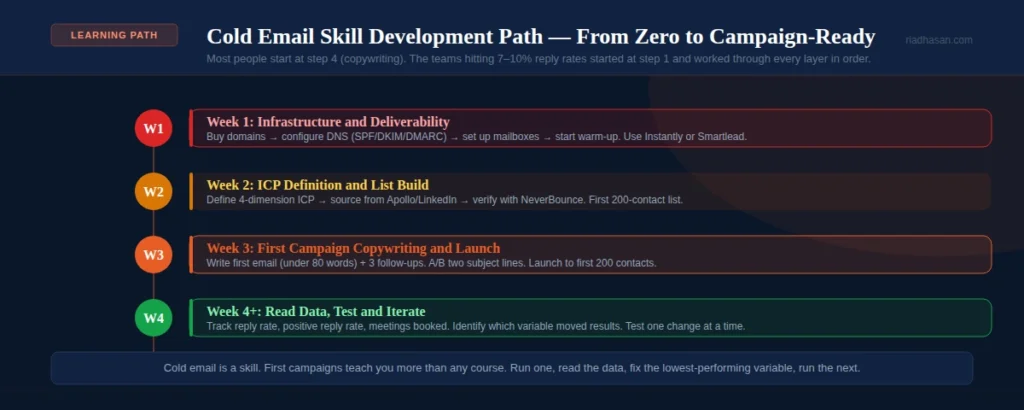
If you’re starting from zero, this is the order that prevents the most common time-wasting mistakes:
| Stage | Resource | Why this order |
|---|---|---|
| 1. Foundation | Mailshake Cold Email Academy (free) | Understand the full system before spending money on tools or courses |
| 2. Strategy | Cold Email Manifesto (book, ~$20) | Understand ICP selection and offer framing before writing copy |
| 3. Execution | Cold Email Mastery (Cold Email Wizard) or Udemy course | Learn the full tool stack and campaign execution from someone who runs it |
| 4. Deliverability | QuickMail Masterclass | Once you’re sending, this fixes the technical layer when it breaks |
| 5. Ongoing | r/coldemail, Clay community, Instantly community | Stay current on what’s working in the current inbox environment |
The most common beginner mistake: buying a course before understanding the problem. The Mailshake Academy is free and covers enough to know which paid resource fills the gap you actually have.
Frequently Asked Questions
What is the best cold email training course in 2026?
For B2B service businesses and agencies focused on client acquisition, Cold Email Mastery by Cold Email Wizard is the most consistently reviewed option (830 five-star ratings). For beginners starting from zero, the Mailshake Cold Email Academy is free and structured. For deliverability specifically, the QuickMail Masterclass is the most technically focused option. The right course depends on your current bottleneck: strategy, copy, deliverability or tool configuration.
What is Cold Email Wizard?
Cold Email Wizard is the practitioner brand behind the Cold Email Mastery course: one of the highest-rated cold email training courses available, with 830 five-star reviews. It is built primarily for agency owners and B2B service businesses selling at $2,000+/month. The course covers ICP selection, lead sourcing, infrastructure setup, copywriting frameworks and scaling systems for agencies running campaigns for multiple clients.
What is the Cold Email Manifesto?
The Cold Email Manifesto is a book by Alex Berman covering his cold email system for B2B client acquisition. Its core principle: brevity and specificity outperform personalisation at scale. Berman’s documented result using the system: 12,000 emails sent, 23 calls booked, $128,000 in pipeline in 30 days, using three-sentence emails. The book covers mindset, ICP selection, copywriting and a sending system. The infrastructure section requires updating for 2026 compliance requirements.
Is there free cold email training?
Yes. Mailshake’s Cold Email Academy is an 8-day free email course covering cold email fundamentals: deliverability basics, copywriting, sequence design and measurement. It is the best free structured introduction available. Beyond that, r/coldemail on Reddit is an active community where practitioners share campaign data and what’s working in the current inbox environment. The Instantly and Clay communities (Slack) provide ongoing practitioner knowledge without a course fee.
What should cold email training cover?
In this order: (1) infrastructure: domain setup, DNS authentication, warm-up, inbox placement testing; (2) ICP and list building: who to email and how to build verified lists; (3) copywriting: structure that produces replies, not templates to copy; (4) sequence design: cadence and follow-up strategy; (5) measurement: which metrics to track and how to diagnose low performance. Training that skips infrastructure and starts with templates is teaching the last 20% of the problem while leaving the 80% that determines inbox delivery untouched.
Start With One Resource, Run One Campaign
The single most common failure mode in cold email training is over-consuming resources without running campaigns. Reading the Manifesto, taking the Mastery course, joining three communities and watching YouTube walkthroughs produces no pipeline. One article of training applied to one live campaign produces more learning than ten articles read and never executed.
Pick one resource. Run one campaign to 100 contacts with a verified list and a proper infrastructure setup. Diagnose the results against the benchmarks in the training. Then go back to the resource for the next fix. That loop is cold email training in practice.
- Cold Email Best Practices 2026 — the full operational system to apply what you learn
- Cold Email Infrastructure Setup — the technical foundation every campaign depends on
- Cold Email Deliverability — what to fix when emails stop reaching the inbox
- Average Cold Email Response Rate — benchmarks to measure your training progress against