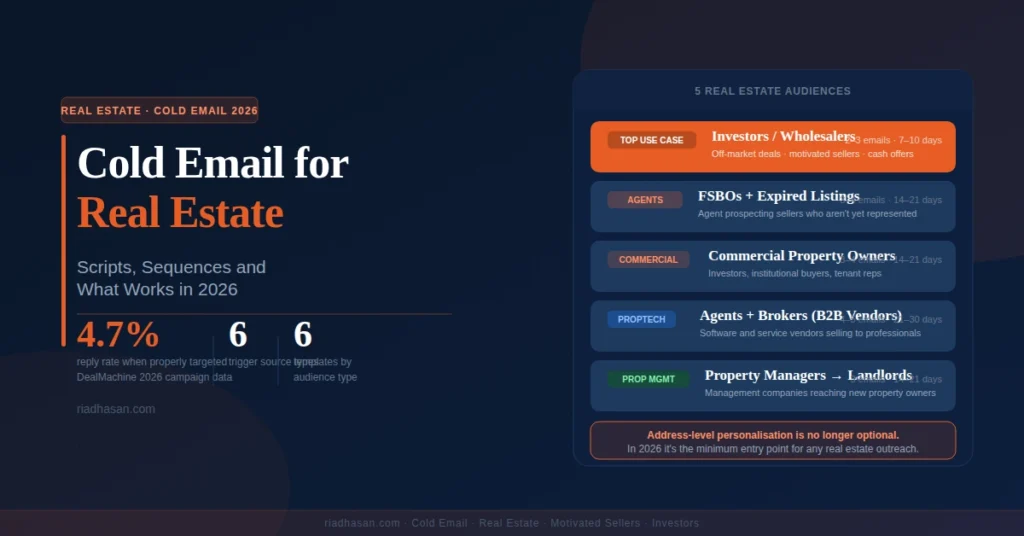
Cold email for real estate works differently from standard B2B outreach. The audiences are more varied (motivated sellers, commercial property owners, agents, property managers, investors) and the stakes on both sides are higher. A homeowner facing foreclosure is not the same prospect as a commercial broker evaluating a proptech vendor. The copy that works, the sequence length and the trigger logic all shift depending on who you’re reaching and why.
This guide covers cold email strategy across the main real estate use cases in 2026: the trigger sources that produce the best lists, what to say to each audience, sequence structure by recipient type, real templates and the compliance rules specific to real estate outreach.
Who Uses Cold Email in Real Estate — and for What
Cold email in real estate covers several distinct outreach contexts. They share the same technical infrastructure but require different approaches to copy, tone and sequence length:
- Investors and wholesalers reaching motivated sellers to find off-market deals
- Real estate agents prospecting sellers, FSBOs and expired listings
- Commercial real estate brokers reaching property owners, corporate tenants and institutional buyers
- Proptech and real estate service vendors selling to agents, brokers and property managers
- Property managers reaching landlords who might outsource management
Real estate professionals receive 30–100+ vendor emails per week. The bar for an email getting opened, let alone replied to, is higher than in most B2B verticals. National-style outreach loses to outreach that references a specific market, a specific property type or a recent local transaction. Regional specificity is not a nice-to-have — it’s the primary differentiator between emails that get read and emails that get deleted.
Trigger Sources: Where the Best Real Estate Lists Come From
The quality of a real estate cold email campaign is almost entirely determined by the trigger data behind the list. Generic lists of property owners produce low engagement. Lists pulled from specific trigger events produce the conversations worth having.
Expired listings
Homeowners whose listings expired without selling are among the most motivated prospects in residential real estate. Their property was on the market, they wanted to sell and it didn’t happen. They’re still motivated and likely frustrated with the previous agent. Expired listing data is publicly available through MLS feeds. Tools like DealMachine, PropStream and REDX aggregate this data and surface it in contact lists ready for outreach.
FSBO (For Sale By Owner)
Homeowners selling without an agent are already active: they’re selling, just not with professional representation. The outreach angle for FSBOs is different from expired listings: you’re not addressing failure, you’re addressing the difficulty of the process they’re in the middle of. FSBOs typically sell for 5–6% less than agent-listed properties. That data point is a relevant value proposition when it’s framed correctly.
Pre-foreclosure
Pre-foreclosure records are filed publicly when a homeowner misses mortgage payments. This is the most sensitive trigger category in real estate outreach and the one that requires the most care in copy tone. The homeowner is under financial stress. Copy that leads with empathy and a clear, fast path to resolution gets replies. Copy that feels opportunistic gets reported as spam.
New ownership records
County deed records show when property ownership changes. A new owner (particularly an absentee owner or a recent inheritance) is often open to selling quickly, especially if the property needs work or is far from where they live. New ownership data is available through county recorder offices and aggregated by PropStream, DataTree and similar services.
Permit activity
Building permits signal active renovation and development activity. An investor pulling permits for a flip is a prospect for financing, materials, design services or future disposition when the project completes. Permit data is publicly available through municipal records and aggregated by services like BuildZoom and ProspectNow.
Commercial signals
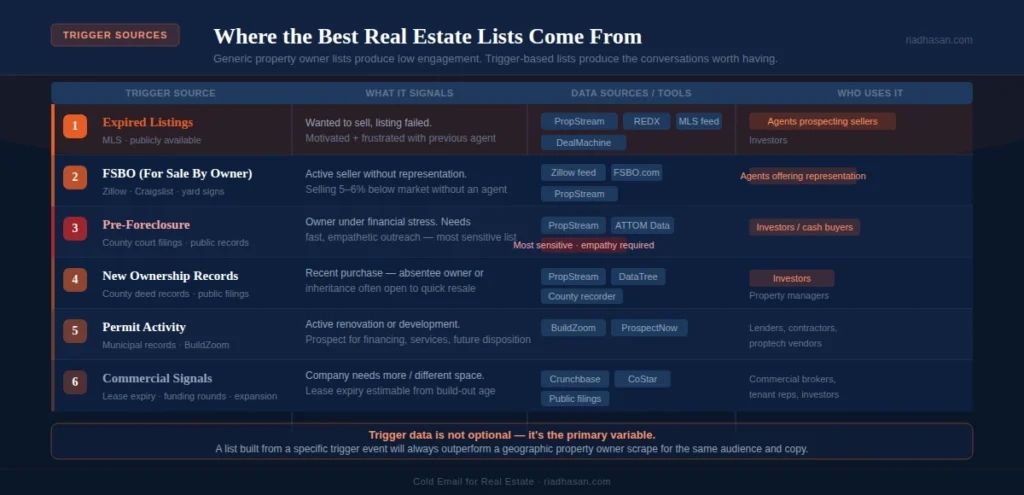
For commercial real estate outreach, triggers include: lease expiry data (many commercial leases are public or estimable from build-out age), company expansion and relocation announcements, funding rounds for companies that will need more space and property portfolio changes signalled through public filings.
Cold Email Strategy by Real Estate Audience
Motivated sellers (investors and wholesalers)
The most common real estate cold email use case. Investors reach motivated sellers (people who need to sell quickly due to financial pressure, inheritance, relocation or property condition) to find off-market deals.
What works for this audience:
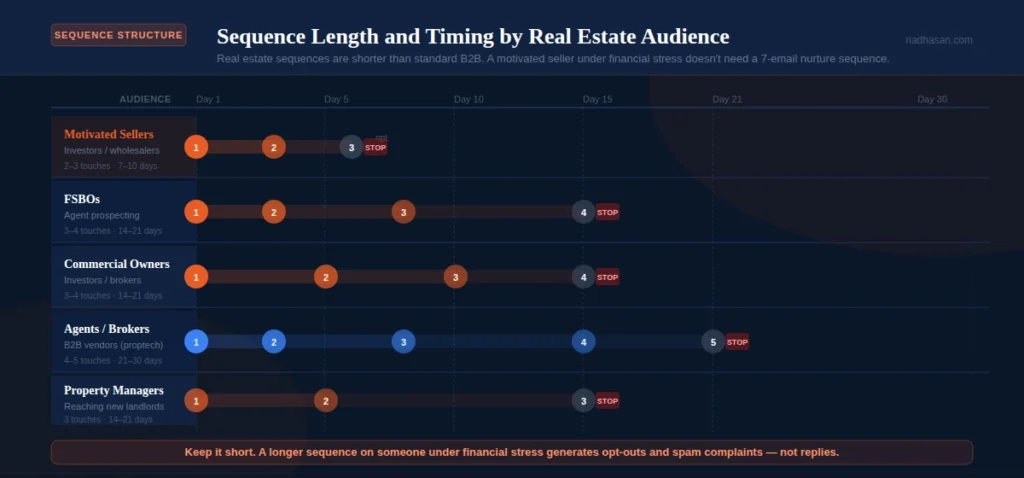
- Reference the specific property address in the opening line. This single change signals the email isn’t a mass blast and immediately increases credibility.
- Lead with what you offer: cash offer, fast close, as-is purchase, no agent fees. The seller’s pain is process friction and uncertainty — your value proposition is speed and simplicity.
- Keep the sequence short: 2–3 touches over 7–10 days. Someone facing foreclosure or financial stress doesn’t need a 7-email nurture sequence. They need to know quickly whether you’re real and whether your offer is relevant.
- Tone: empathetic, direct, no pressure. The seller is evaluating whether you’re trustworthy, not just whether the offer is good.
FSBOs
Agents prospecting FSBOs are selling representation to someone who has already decided not to use an agent. The approach that works is not “let me convince you to use an agent” but rather: “here’s what makes your situation harder than you realise and here’s how I can help.”
Effective FSBO outreach references a specific challenge they’re likely experiencing right now: pricing relative to recent comps in their area, buyer financing requirements they may not be prepared for or the time commitment of showing the property themselves. Show knowledge of their market specifically, not of real estate in general.
Expired listings
Expired listing outreach faces high competition. Every agent in the area is reaching the same contact. Differentiation comes from specificity: what did you see when you looked at the previous listing that explains why it didn’t sell and what would you do differently? A specific observation about the listing (pricing, photography, days on market relative to the area) outperforms a generic “I can sell your home” pitch every time.
Commercial property owners
Commercial property owners and operators are accustomed to receiving investment proposals and vendor pitches. They evaluate outreach on credibility and specificity: does this person know my market, do they understand my asset class and is their proposition worth exploring? Standard B2B cold email structure applies: specific trigger or observation, clear value proposition, relevant proof point, single CTA. Sequence length: 3–4 touches over 2–3 weeks.
Agents and brokers (proptech and service vendors)
Selling to real estate agents and brokers is B2B outreach in a high-noise vertical. These professionals receive constant pitches for CRM tools, lead generation services, coaching programmes and marketing platforms. The emails that cut through reference a specific challenge the agent faces right now (market conditions, lead cost increases, conversion from online leads) rather than leading with product features. Proof points from similar agents in the same market segment are more persuasive than national case studies.
Cold Email Templates for Real Estate
Template 1: Motivated seller outreach (investor/wholesaler)
Subject: [Property Address] — quick question

Hi [First Name],

I noticed the property at [Address] and wanted to reach out directly. I buy homes in [City/Area] in as-is condition, all cash, and can close in as little as [timeframe].

No agent fees, no repairs needed, no waiting on financing.

If you're open to a quick conversation about what an offer might look like, I'd be happy to connect.

[Name]
[Phone]
Template 2: Expired listing (agent prospecting a seller)
Subject: [Address] — a thought on what happened

Hi [First Name],

I noticed your listing at [Address] came off the market. I've sold [X] homes in [neighbourhood/area] over the past [timeframe] and when I looked at your listing, I had a specific thought about why it may not have sold.

Would it be useful to share what I saw? No pitch, just an honest observation.

[Name]
Template 3: FSBO outreach (agent)
Subject: [Address] — quick question about your sale

Hi [First Name],

Noticed you're selling [Address] on your own. I work in [area] and have helped a few FSBO sellers recently who ran into challenges with buyer financing qualifications and negotiation on inspections.

Not trying to take over — just wanted to offer a quick call if any of that comes up for you.

[Name]
Template 4: Commercial property owner (investor)
Subject: [Property type] at [Address] — potential interest

Hi [First Name],

I focus on [commercial property type] acquisitions in [market/area]. I've been tracking [Address] and wanted to reach out directly to understand whether you'd consider a conversation about the property.

I've closed [X] deals in [area] over the past [timeframe] and prefer to work directly with owners rather than through brokers where possible.

Worth a short call?

[Name]
Template 5: Property manager prospecting landlords
Subject: [Address] — management question

Hi [First Name],

I manage [X] properties in [area] and noticed [Address] recently changed ownership. Many new landlords in [area] find tenant screening and maintenance coordination takes more time than expected — especially in the first year.

If you ever want a second opinion on how others handle it locally, happy to connect.

[Name]
Template 6: Vendor/proptech selling to agents
Subject: Lead cost in [City] — a thought

Hi [First Name],

Cost per lead in [City]'s market has increased significantly over the past 12 months for most agents I speak with. [Similar agent type] I worked with reduced their CPL by [X%] by shifting from [paid channel] to [what you offer].

Worth 15 minutes to see if the numbers work for your pipeline?

[Name]
Sequence Structure for Real Estate
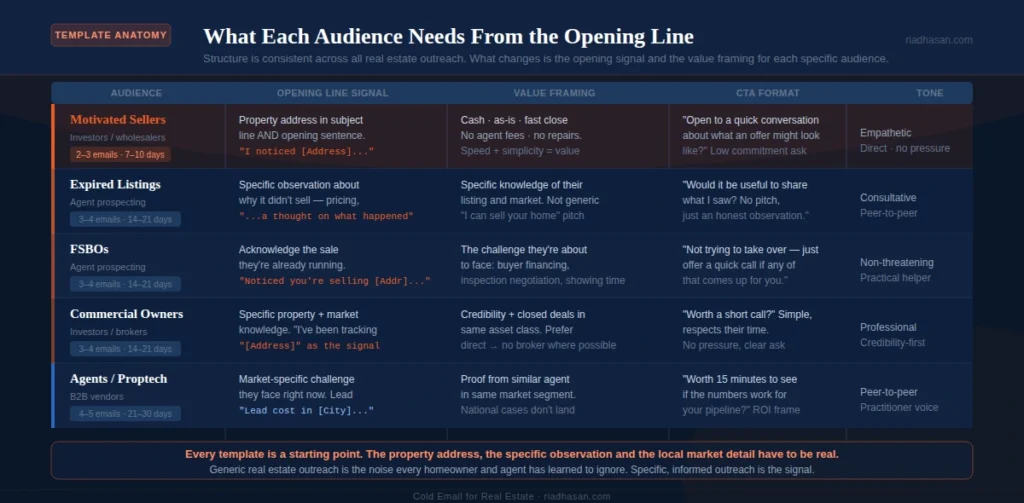
Real estate cold email sequences should be shorter than standard B2B sequences. The reasons are practical: motivated sellers and FSBOs are often in stressful situations where a long sequence feels like harassment and commercial property owners make decisions on their own timeline regardless of how many emails you send.
| Audience | Sequence length | Total duration |
|---|---|---|
| Motivated sellers | 2–3 touches | 7–10 days |
| FSBOs and expired listings | 3–4 touches | 14–21 days |
| Commercial property owners | 3–4 touches | 14–21 days |
| Agents and brokers (B2B) | 4–5 touches | 21–30 days |
| Property managers (landlords) | 3 touches | 14–21 days |
What Changed for Real Estate Cold Email in 2026
Several shifts have affected real estate cold email strategy in 2026:
Address-level personalisation is now table stakes
Referencing a specific property address used to be a differentiator. In 2026 it’s the minimum. Any investor or agent running a campaign at scale is doing this. The new differentiator is deeper contextual personalisation: referencing how long the property has been on market, a specific aspect of the listing, the assessed value vs. the asking price or a recent comparable sale in the neighbourhood. Generic address inclusion no longer sets you apart.
AI-generated outreach is flooding motivated seller inboxes
The ease of AI-generated cold email has raised the volume of real estate outreach significantly since 2024. Motivated sellers and FSBOs are receiving more emails than ever, many of them AI-generated with similar phrasing and structure. The emails that cut through read like they were written by a human with genuine knowledge of the local market. This means:
- Hyper-local references: street names, neighbourhood names, recent transactions the recipient would recognise
- Shorter, more conversational copy rather than polished pitch language
- Avoiding phrasing patterns that are widespread in AI-generated real estate outreach: “I hope this message finds you well”, “I came across your property”, “I specialise in helping homeowners like yourself”
Motivated seller lead costs have increased
Cold email’s cost advantage over direct mail and paid lead generation has become more valuable as those channels have gotten more expensive. A properly set up cold email system generating 2–3 seller leads per day from a small list of targeted contacts costs a fraction of what paid leads from portals cost. Investors who set up the infrastructure correctly in 2026 are generating off-market pipeline at significantly lower cost per lead than their competition on paid channels.
Compliance Rules for Real Estate Cold Email
Cold email to real estate contacts is legal across most contexts but subject to the same regulatory framework as any other outbound email.
CAN-SPAM (United States)
The same rules apply as any cold email: include a physical address, provide a clear unsubscribe mechanism and honour opt-out requests within 10 business days. Real estate outreach is commercial email under CAN-SPAM regardless of whether the recipient is a homeowner or a professional.
GDPR (EU/UK recipients)
If you are emailing property owners or real estate professionals in the EU or UK, GDPR legitimate interest applies. The outreach must be relevant to the recipient’s professional or property context and proportionate. Consumer-facing motivated seller outreach to EU residents carries higher GDPR risk than B2B outreach to commercial property professionals.
State-level real estate regulations
Some US states have additional rules governing solicitation of clients represented by other agents. Cold emailing a seller who is currently under contract with a listing agent may violate NAR (National Association of Realtors) ethics rules and state licensing regulations in some jurisdictions. Verify your state’s rules before targeting active listings.
Do Not Contact lists
Several states maintain Do Not Contact registries for real estate solicitation. These are separate from Do Not Call lists and apply specifically to mail and email solicitation in some jurisdictions. Check local licensing board guidance before launching residential campaigns at scale.
Frequently Asked Questions
Does cold email work for real estate?
Yes. Cold email for real estate produces a 2–3% standard response rate and up to 4.7% when properly targeted, according to DealMachine’s 2026 data from live campaigns. A well-set-up system with tight targeting and property-specific personalisation can generate 2–3 motivated seller leads per day from a list of 10,000 contacts. The channel works best when trigger data (expired listings, pre-foreclosure, new ownership) creates a specific, timely reason for outreach rather than a generic “I want to buy your home” pitch.
What are the best cold email strategies for real estate in 2026?
The highest-performing 2026 approach combines trigger-event targeting with hyper-local personalisation. Build lists from specific signals (expired listings, FSBO data, county deed records, permit activity) rather than broad geographic scrapes. Reference the specific property address and a detail about the property or situation in the opening line. Keep sequences short: 2–3 touches for motivated sellers, 3–4 for FSBOs and commercial owners. Avoid AI-sounding phrasing that floods inboxes from high-volume campaigns.
How do I cold email motivated sellers?
Reference the specific property address in the subject line and first line. State your offer clearly (cash, as-is, fast close) in the first email rather than building to it. Use an empathetic tone that acknowledges the seller may be in a difficult situation without being presumptuous about it. Keep the sequence to 2–3 emails over 7–10 days. A longer sequence on someone under financial stress generates opt-outs and complaints rather than replies. If they’re interested, they’ll respond to the first or second email.
What is the best subject line for real estate cold email?
Property address-based subject lines consistently outperform generic ones for residential outreach. “[Address] — quick question” or “[Address] — a thought on what happened” (for expired listings) signal specificity and earn opens precisely because they don’t look like mass mail. For commercial outreach and B2B real estate, subject lines that reference a specific market observation or trigger event perform best. Lowercase formatting wins in most tests — it reads like a message from a peer, not a marketing department.
How do I find emails for real estate cold outreach?
Property owner contact data is available through county property records (public), real estate data platforms (PropStream, DataTree, DealMachine) and skip tracing services that match property ownership records to contact information. For licensed real estate professionals and commercial operators, Apollo.io and ZoomInfo cover most professional contact data. Email verification is mandatory before sending — real estate lists often have lower data quality than B2B databases and bounce rates above 2% damage sender reputation quickly.
Is cold emailing real estate leads legal?
Yes, in most contexts. Under CAN-SPAM in the US, cold email to property owners is legal as long as you include an unsubscribe mechanism, a physical address and honest sender information. Honor opt-outs within 10 business days. Be aware of state-level real estate solicitation rules: some states restrict cold outreach to sellers who are currently represented by a listing agent. For EU recipients, GDPR legitimate interest applies, which is defensible for relevant, targeted outreach but requires more care than US-only campaigns.
Build the List First, Then Write the Email
Every template above is a starting point, not a finished email. The property address, the specific observation about the listing or situation and the local market reference have to be real before the email earns a reply. Generic real estate outreach is the noise every homeowner and agent has learned to ignore. Specific, informed outreach is the signal.
- Cold Email Lead Generation — list building, data sourcing and verification for any outreach campaign
- Cold Email Infrastructure Setup — domain, DNS and warm-up before any campaign sends
- Cold Email Personalization — how to research at scale and build icebreakers that prove it
- Cold Email Follow-Up Guide — sequence structure, timing and what to say in each touch
If you want a cold email system built for your real estate business (list sourcing, infrastructure, sequences and ongoing management), you can work with me at riadhasan.com.