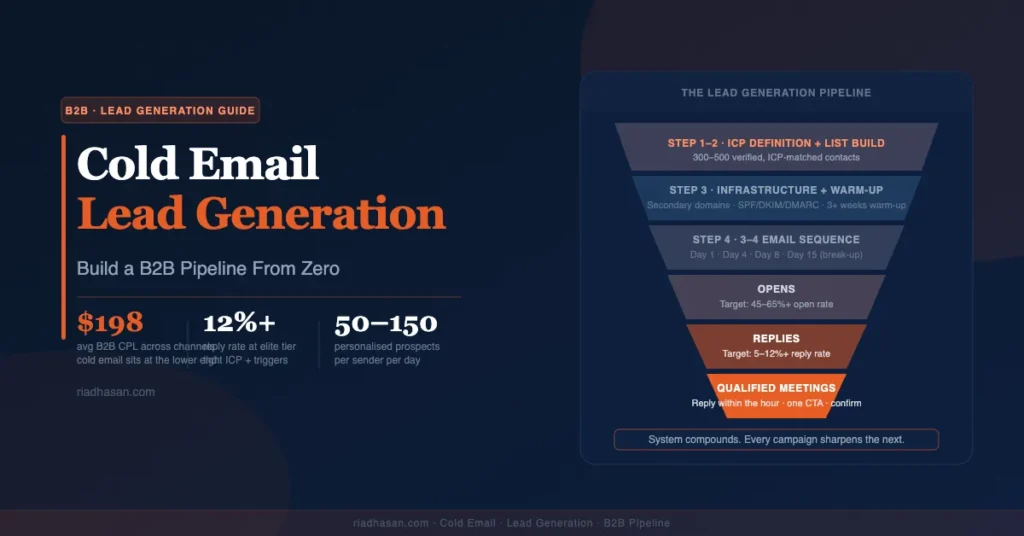
Cold email lead generation is the fastest route to B2B pipeline when you have no existing audience, no inbound traffic and no referral network to draw on. It requires no ad budget, no content library and no brand recognition. What it requires is a clear target, a clean list, proper infrastructure and a process that treats reply rate as the only metric that matters before you have revenue to show for it.
This guide covers the full cold email lead generation process from scratch: how to define an ICP that makes targeting possible, how to find and verify prospect emails, how to run a campaign, what to expect at each stage and how to convert replies into meetings and pipeline.
What Cold Email Lead Generation Actually Is
Cold email lead generation is the practice of using targeted, personalised outbound email to initiate conversations with potential customers who have no prior relationship with your business. The goal is not to close a deal in the first email. The goal is to start a conversation that moves toward a qualified meeting.
It sits in the outbound category alongside cold calling and LinkedIn outreach. Cold email’s specific advantage over both: it scales. A single sender can reach 50–150 prospects per day with personalised messages. Cold calling reaches 20–30 at best. LinkedIn caps connection requests. Cold email has no such hard ceiling once infrastructure is properly set up.
The channel works across B2B verticals: SaaS, agencies, consulting, fintech, manufacturing, energy, engineering and professional services. The mechanics are the same regardless of industry. What changes is the ICP, the pain language and the proof points.
Step 1: Define Your ICP Before You Build a List
The ICP (Ideal Customer Profile) is the single most important input in cold email lead generation. Broad, untargeted lists produce low engagement, high bounce rates and spam complaints that train email providers to treat your domain as a low-quality sender. No amount of clever copy fixes a bad list.
A useful ICP has four dimensions:
- Company: industry, employee count, revenue range, growth stage, geography, tech stack
- Person: job title, seniority level, department, what they’re accountable for
- Problem: the specific operational problem your offer solves — not a general pain category but a concrete blocker
- Trigger: a condition or event that makes this prospect likely to need your solution right now
The trigger dimension is what separates a 3% reply rate from a 10%+ reply rate. Reaching a VP of Operations at a manufacturing firm that just announced a US market expansion is a different conversation than reaching the same title at a firm in steady state. Timing matters as much as targeting.
The ICP tightness test
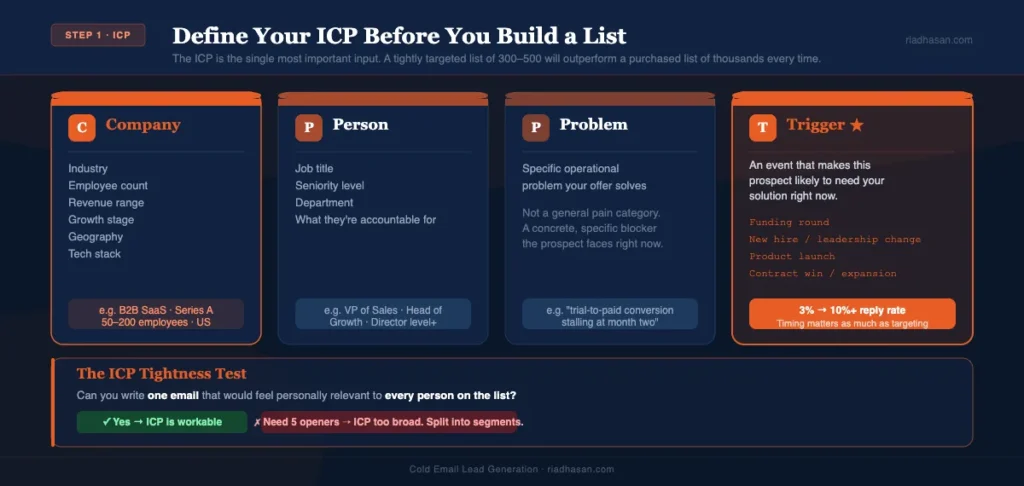
A reliable test for whether your ICP is tight enough: can you write one email that would feel personally relevant to every person on the list? If the answer is yes, the ICP is workable. Five different openers needed to cover your list means it’s too broad. Split into separate segments with separate campaigns.
A tightly targeted list of 300–500 contacts matched to your ICP will produce more replies, more meetings and fewer spam complaints than a purchased list of thousands. The data is consistent on this across every source. The reason is simple: a smaller, more relevant list generates higher engagement signals, which protects sender reputation and improves deliverability for every subsequent send. A large irrelevant list does the opposite — it generates low engagement and spam complaints that compound into deliverability problems before you’ve even found the message that works.
Step 2: Build Your Prospect List
There are three primary methods for building a cold email prospect list: prospecting tools, LinkedIn-based scraping and manual research. Most effective campaigns combine at least two.
Prospecting databases
Apollo is the most widely used starting point for B2B cold email list building. It carries a database of 270+ million contacts, filterable by industry, company size, job title, geography, revenue range, tech stack and hiring signals. The free plan is viable for small campaigns. Paid plans from $49/month add more credits, AI personalisation and sequence tools.
ZoomInfo covers larger enterprise databases with higher data accuracy but at a significantly higher price point, typically viable for enterprise sales teams rather than early-stage outreach. Cognism is the preferred choice for European contact data where GDPR compliance on data sourcing is a consideration.
LinkedIn Sales Navigator
LinkedIn Sales Navigator allows highly specific prospect searches by title, seniority, company size, industry, geography and relationship proximity. The search results can be exported and enriched for email addresses using tools like Apollo’s Chrome extension, Wiza or Findymail. Wiza achieves 99% email accuracy with below 1% bounce rates when used against Sales Navigator results — the most reliable email-finding workflow for quality-critical campaigns.
How to find emails for cold emailing
Once you have a list of target names and companies, finding verified email addresses is the next step. The main approaches:
- Apollo: pulls email addresses directly from its database alongside prospect data
- Hunter: finds emails by company domain, indexing publicly disclosed addresses
- Wiza: extracts and verifies emails from LinkedIn Sales Navigator searches in real time
- Findymail: bulk-exports Sales Navigator leads and verifies emails, integrating directly with Google Sheets
- Clay: enriches prospect lists from 150+ data sources, pulling email addresses, LinkedIn data, hiring signals and company news simultaneously
Verify every email before sending
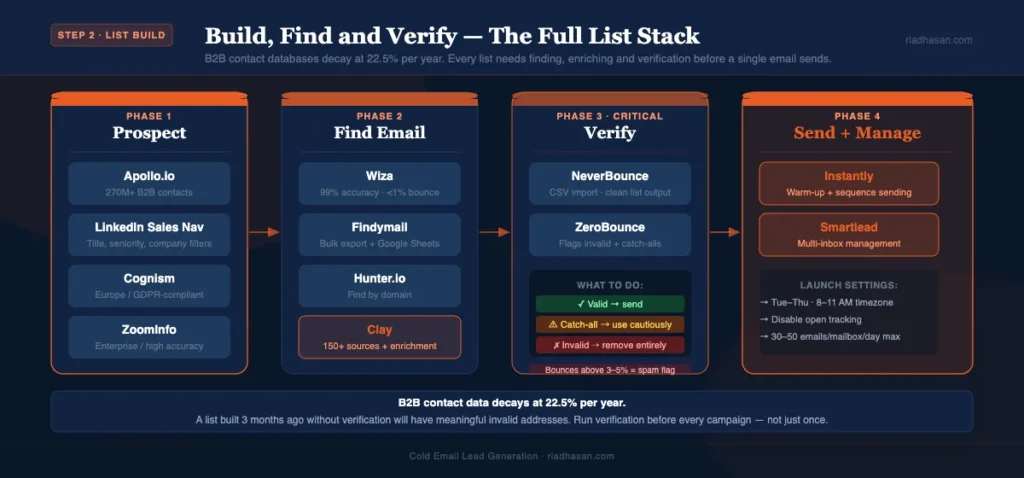
B2B contact databases decay at roughly 22.5% per year as people change jobs, companies close and roles are restructured. A list built three months ago without verification will have a meaningful percentage of invalid addresses. Bounce rates above 3–5% trigger spam flag thresholds with Gmail and Outlook. Run every list through a verification tool before it enters a campaign.
NeverBounce and ZeroBounce are the standard verification tools. Both accept CSV imports and return cleaned lists with invalid, risky and catch-all addresses flagged. Remove hard bounces entirely. Treat catch-all addresses cautiously. They accept any email to the domain without confirming the individual address exists, meaning bounce risk is unknown.
Step 3: Set Up Your Sending Infrastructure
Cold email lead generation campaigns fail more often from infrastructure problems than from copy problems. The sequence of setup matters:
- Buy secondary sending domains (not your primary business domain)
- Configure SPF, DKIM and DMARC DNS records on every domain
- Set up Google Workspace or Microsoft 365 mailboxes (3–4 per domain)
- Run inbox warm-up for minimum 3 weeks before sending
- Verify inbox placement in primary inbox before campaign launch
A typical cold email stack in 2026 costs $500–$2,000 per month for a small team, covering: data provider, sending tool, email verification and domain infrastructure. Factor this into your cost-per-lead calculations before projecting ROI.
One counterintuitive finding from an analysis of 44 million emails: disabling open tracking more than doubled reply rates: 2.36% vs 1.08% on tracked emails. Open tracking pixels add HTML markup that increases spam filter scores and can push emails from primary inbox to promotions or spam. For lead generation campaigns where reply rate is the primary metric, turning off open tracking is worth testing in the first batch of any new campaign. You lose visibility on opens, but the reply rate data is more valuable than the open rate data at the lead generation stage anyway.
Step 4: Write and Structure the Campaign
A cold email lead generation campaign is a sequence of 3–4 emails sent to each prospect over 15–18 days. The first email establishes relevance and makes an ask. Follow-ups add new angles rather than repeating the pitch. The final email is a break-up that typically generates a disproportionately high reply rate through FOMO.
What sells well over cold email
Cold email is most effective for products and services where the offer is clear, the value can be demonstrated quickly and the buying process involves a defined decision-maker:
- B2B services: SEO, paid advertising, cold email management, accounting, legal, recruiting, consulting — any service where a clear outcome can be stated in one sentence
- SaaS products: particularly those with a specific use case and a demo-friendly value proposition
- Professional services: financial advisory, compliance, IT support, HR outsourcing
- Lead generation and data services: agencies, list providers, market research firms
- Industrial and manufacturing solutions: equipment, supply chain services, raw materials — particularly effective with trigger-based outreach (new plant opening, capacity expansion announcement)
- Fintech and financial products: payment solutions, treasury tools, compliance software — effective when reaching CFOs and finance directors with specific regulatory or efficiency pain points
- Energy procurement services: highly effective targeting operations and procurement directors at mid-to-large organisations, particularly around contract renewal cycles
Cold email struggles with high-consideration consumer products, commoditised offerings with no differentiation and anything requiring an emotional or visual experience to convey the value.
Campaign structure and timing
| Day | Purpose | Generates | |
|---|---|---|---|
| Initial email | Day 1 | Specific opener + value prop + single CTA | 58% of all replies |
| Follow-up 1 | Day 4 | New angle — case study, different pain point, new context | ~25% of all replies |
| Follow-up 2 | Day 8 | Low-friction binary question: relevant or not? | ~12% of all replies |
| Break-up email | Day 15 | Final message — FOMO-driven, no pitch | ~5% of all replies |
Industry-Specific Cold Email Lead Generation
Manufacturing
Cold email works well for manufacturing outreach when it targets specific operational roles (operations directors, procurement managers, plant managers) and uses trigger-based targeting. Useful triggers: new facility announcements, capacity expansion news, supply chain disruption coverage in trade press, job postings for roles that indicate a specific need. The first email should reference a specific operational challenge relevant to the prospect’s plant size or production type, not a generic “we help manufacturers” opener.
Martal Group has reported 203 sales-qualified leads in 14 months for a manufacturing company entering the US market using coordinated cold email and LinkedIn outreach.
Fintech
Fintech cold email targets CFOs, heads of finance, compliance officers and treasury managers. Pain language: regulatory compliance overhead, cross-border payment friction, reconciliation time, reporting accuracy. Trigger events: fundraising rounds (companies flush with cash are evaluating new tools), regulatory changes in their jurisdiction and executive hires in finance leadership. Fintech deals tend to be high-value, which justifies deeper individual-level personalisation per account.
Energy procurement
Energy procurement outreach targets operations directors, facilities managers and procurement heads at mid-to-large organisations. The most effective trigger is the contract renewal cycle: reaching prospects 3–6 months before their energy contract expires. ESG commitment announcements (net-zero pledges, Scope 2 targets) create a second strong trigger for sustainability-linked procurement services. Cold email in this space works best with a direct, professional tone and a clear cost or compliance outcome in the first email.
Engineering and professional services
Engineering firm outreach focuses on project-based work, so ICP targeting should include project stage signals: new contract wins (findable via public tender databases and trade press), expansion announcements and hiring surges for specific engineering disciplines. The buyer is typically a project director or managing partner who responds to specific technical credibility rather than generic value propositions.
2026 Benchmarks: What to Expect From a Cold Email Lead Generation Campaign
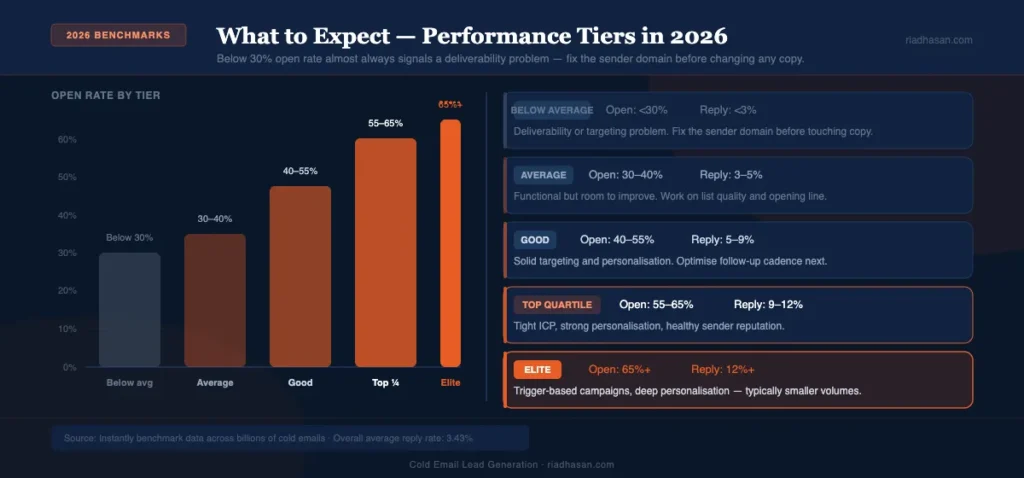
| Performance tier | Open rate | Reply rate | What it typically means |
|---|---|---|---|
| Below average | Below 30% | Below 3% | Deliverability problem or poor targeting — fix infrastructure first |
| Average | 30–40% | 3–5% | Functional but room to improve; work on list quality and opening line |
| Good | 40–55% | 5–9% | Solid targeting and personalisation; optimise follow-up cadence |
| Top quartile | 55–65% | 9–12% | Tight ICP, strong personalisation, healthy sender reputation |
| Elite | 65%+ | 12%+ | Trigger-based campaigns, deep personalisation — typically smaller volumes |
Below 30% open rate almost always signals a deliverability problem rather than a copy problem. Fix the sender domain before changing any copy. Changing subject lines on a broken domain achieves nothing.
The average cost per lead across B2B sits at approximately $198. Cold email, when infrastructure is set up and the campaign is well-targeted, sits at the lower end of B2B CPL by channel, particularly compared to paid acquisition. The returns compound as the infrastructure matures and sender reputation improves.
Converting Replies Into Pipeline
A reply is not a meeting. Most cold email campaigns generate replies that never become qualified conversations because the follow-through process is undefined. Reply management is the last mile of lead generation and the one most teams underinvest in.
A reply is not a meeting. The gap between “got a reply” and “booked a qualified meeting” is where most cold email campaigns lose value.
Three rules for reply management:
- Reply within the hour when possible. Reply rate to your follow-up drops sharply after 24 hours. The prospect was engaged when they replied. That engagement window closes fast.
- Don’t oversell in the response. When someone replies with interest, the next email should do one thing: confirm a time for a call. Not send a deck, not expand the pitch, not copy in the founder. Confirm the meeting first.
- Handle objections as qualification. “Not right now” and “try me in Q3” are not rejections — they’re soft leads. Add them to a re-engagement sequence with a 90-day delay and a note of the stated timing. A prospect who told you when to follow up is a warm lead, not a dead one.
Frequently Asked Questions
What is cold email lead generation?
Cold email lead generation is the practice of using personalised outbound email to initiate conversations with potential customers who have no prior relationship with your business. The goal is to generate qualified meetings and pipeline, not to close deals directly. It’s most effective for B2B businesses with a defined ICP, a clear value proposition and an offer that can be understood in one sentence.
How do I find emails for cold emailing?
The most reliable workflow for B2B email finding is: build a target list in LinkedIn Sales Navigator, extract and verify email addresses using a tool like Wiza, Apollo or Findymail, then run the full list through a verification service like NeverBounce or ZeroBounce before any email sends. Apollo’s 270M+ contact database covers most B2B prospecting needs directly. For European contacts where data sourcing compliance matters, Cognism is the preferred source.
What products and services work best for cold email lead generation?
Cold email works best for B2B services with a clear outcome (SEO, consulting, recruiting, cold email management), SaaS products with a demo-friendly value proposition, professional services (financial, legal, compliance, HR) and industrial offerings where trigger events like contract renewals or capacity expansions create a clear reason to reach out. It struggles with commoditised products, high-consideration consumer purchases and anything needing a visual or emotional experience to convey its value.
How do I run a cold email marketing campaign?
The sequence: define your ICP, build a verified prospect list of 300–500 matched contacts, set up secondary sending domains with SPF/DKIM/DMARC configured, warm inboxes for 3+ weeks, write a 3–4 email sequence where each touch adds a new angle, launch on a Tuesday or Wednesday targeting 8–11 AM in the recipient’s timezone, monitor reply rates and bounce rates daily and manage positive replies within the hour. Test subject line first, then opening line, then CTA — one variable at a time.
What is a good reply rate for a B2B cold email campaign?
The overall average in 2026 is 3.43% (Instantly benchmark across billions of emails). Anything above 5% is above average. Top-quartile campaigns hit 9–12%. Elite performance is 12%+, typically achieved with tight ICP targeting, trigger-based personalisation and strong sender reputation. Below 3% almost always points to a deliverability or targeting problem rather than a copy problem. Fix the domain before touching the email content.
How much does cold email lead generation cost?
A full cold email stack in 2026 (data provider, sending tool, email verification and domain infrastructure) runs $500–$2,000 per month for a small team. Done-for-you cold email agency services typically run $1,500–$5,000+ per month depending on volume and complexity. The average cost per lead across B2B is approximately $198. Cold email sits at the lower end of B2B CPL by channel when infrastructure is properly set up and the campaign is tightly targeted.
Cold Email Lead Generation Is a System, Not a Tactic
The teams generating consistent pipeline from cold email aren’t running one-off blasts. They’re running a system: clean data flowing into a tested sequence, delivered from a healthy sender infrastructure, with replies managed and re-engaged on a defined schedule.
Build the system once and it compounds. Every campaign teaches you something about what the ICP responds to. Every round of A/B testing sharpens the copy. Every healthy sender month improves deliverability for the next.
- Cold Email Infrastructure Setup — the technical foundation every campaign runs on
- Cold Email Best Practices 2026 — the full operational guide from targeting to reply management
- Cold Email Personalization — how to make every email feel written for that specific prospect
- Cold Email Templates for B2B — proven templates by industry and use case
If you want the system built for you (ICP research, list building, infrastructure, sequences and campaign management), you can work with me at riadhasan.com.