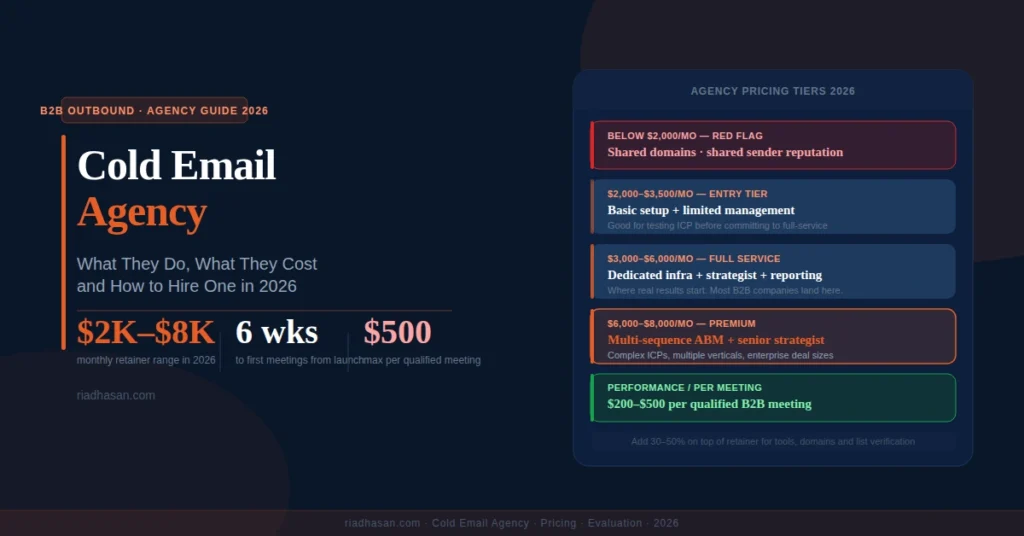
A cold email agency manages the full outbound prospecting system on your behalf: infrastructure setup, list building, copywriting, sequence management, deliverability monitoring and reply handling. The right agency compresses what takes an in-house team three to six months to build into a system that is running qualified meetings into your calendar within six weeks. The wrong agency burns your sending domains, books low-quality meetings and blames your offer when the pipeline stays flat.
This guide covers what cold email agencies actually do, what they cost in 2026, how to evaluate one before you hire them and the red flags that experienced buyers watch for.
What a Cold Email Agency Does
A full-service cold email agency owns the entire outbound prospecting system end to end. That means:
- Infrastructure setup: purchasing sending domains, configuring SPF, DKIM and DMARC, setting up Google Workspace or Microsoft 365 mailboxes, running warm-up protocols and verifying inbox placement before any campaigns send
- ICP research and list building: defining the Ideal Customer Profile with the client, building and verifying prospect lists from data sources, enriching contact data with relevant signals (tech stack, hiring activity, funding events)
- Copywriting and sequence design: writing personalised first-touch emails and follow-up sequences, building A/B test variants, adapting copy based on reply rate data from live campaigns
- Deliverability management: monitoring sender reputation, bounce rates and spam complaint rates, rotating domains when needed, maintaining warm-up alongside active campaigns
- Reply management and reporting: handling positive replies and forwarding qualified conversations to the client, producing weekly or monthly reports on reply rate, positive reply rate and meetings booked
Some agencies offer a partial service: infrastructure setup and templates handed over to the client, who then handles sending and reply management. Understand which model you’re buying before signing. A full-service agency charges more but also owns the outcome in a way that a setup-and-handover model does not.
Cold Email Agency Pricing in 2026
Full-service cold email agency retainers run $2,000–$8,000 per month in 2026, with the range reflecting significant differences in what you get at each tier. Most B2B companies paying for serious pipeline results land in the $3,000–$6,000 range.
| Tier | Monthly range | What you’re buying |
|---|---|---|
| Budget / proof of concept | $1,000–$2,000 | A test of market reachability. Shared infrastructure common. Rarely produces consistent pipeline on its own. |
| Mid-tier (most companies) | $2,000–$5,000 | Where real results start. Dedicated infrastructure, dedicated strategist, full-service management. |
| Premium / enterprise | $5,000–$8,000+ | Signal-based targeting, multichannel sequences (email + LinkedIn + phone), enterprise-grade infrastructure. |
| Per-meeting pricing | $200–$500 per qualified meeting | Performance model. Mid-market SaaS: $250–$400. Enterprise ($100K+ ACV): $400–$500. Above $600 = agency’s targeting needs work. |
Three pricing models are common. Each creates different incentives between you and the agency:
Retainer (fixed monthly fee)
You pay a fixed monthly fee regardless of how many meetings the agency books. The agency’s incentive is retention: they need to demonstrate enough consistent progress to keep the contract. Retainers work when the agency controls the full stack and can show clear weekly KPIs. Most full-service agencies in 2026 price retainers at $2,000–$6,000 per month.
Per-meeting / performance pricing
You pay per qualified meeting booked, with zero upfront risk. The agency carries all costs until they deliver. The problem: this model only works when both sides agree on what “qualified” means before the contract starts. Disputes about meeting quality are common when the definition wasn’t locked in writing. $200–$500 per qualified B2B meeting is the standard range in 2026.
Hybrid model
A fixed monthly base covers the agency’s infrastructure and management costs, with a variable performance bonus per meeting booked above a baseline. This model aligns incentives better than pure retainer (the agency can’t coast on a flat fee) while giving the agency predictable revenue to cover their tool stack.
Hidden costs to budget for
The base retainer is not the full cost. Extra domains, data enrichment tools and list verification add 30–50% to base retainer costs, according to Reachoutly’s 2026 agency pricing analysis. Budget the following on top of the retainer:
- Domain purchases and Google Workspace: $15–25 per domain per month
- List verification: $0.01–$0.05 per verified contact
- Data enrichment and lead sourcing: varies by source
- Setup fee: some agencies charge $500–$2,000 for the initial infrastructure build
Agency vs. In-House: When to Hire and When to Build
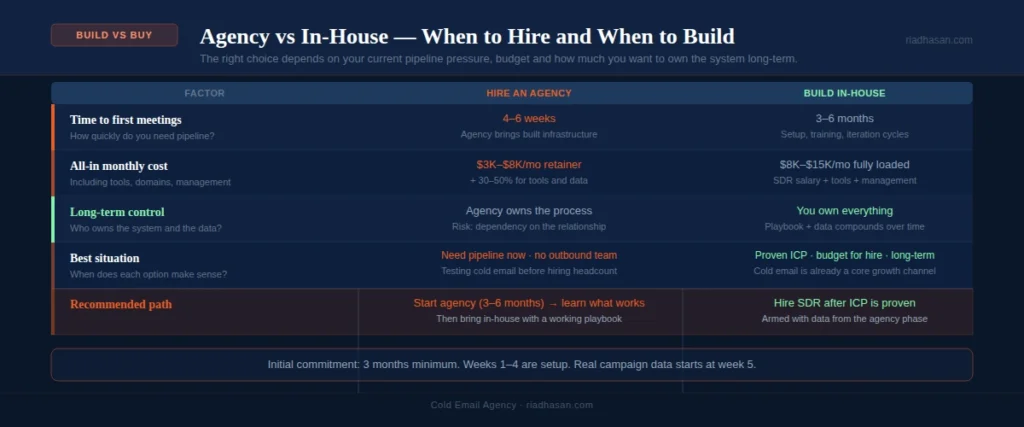
Agencies deliver two to three times more qualified meetings in the first quarter than a newly formed internal team, according to Reachoutly’s analysis. In-house teams outperform agencies over 18 months or more, once the institutional knowledge, ICP refinement and process optimisation have had time to compound.
The honest framework:
| Situation | Hire agency | Build in-house |
|---|---|---|
| Time to first meeting | Need pipeline in 6–12 weeks | Willing to invest 3–6 months building infrastructure and learning |
| Budget | Have $3,000–$6,000/month for a managed system | Prefer to invest in people + tools ($500–$2,000/month + time) |
| Team capacity | No one internally to own infrastructure + copy + data + sending | Have or can hire someone with outbound experience |
| ICP clarity | ICP is defined; need execution, not discovery | Still validating ICP; iterating on messaging internally is faster |
| Long-term plan | Bridge gap while building internal capability or as a permanent outsourced channel | Plan to own outbound as a core competency within 18 months |
One comparison that rarely makes it into agency sales conversations: the fully loaded cost of an internal SDR. $8,000–$12,000 per month when salary, benefits, tools, management time and ramp-up period are included (Astra GTM 2026). That number assumes the SDR ramps successfully — industry data puts average SDR ramp time at 3–6 months, during which they’re generating below-capacity pipeline at full cost. At $4,000–$6,000 per month, a full-service cold email agency produces the pipeline output of an SDR at roughly half the cost — and with no ramp period, no training overhead and no risk of attrition resetting the learning curve.
What to Look for When Evaluating a Cold Email Agency
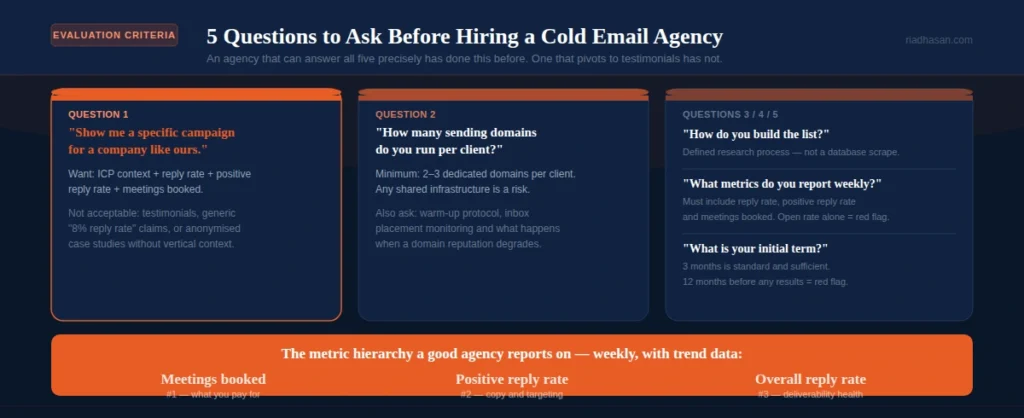
They show you real campaign data
A credible cold email agency can show you specific reply rates, positive reply rates and meeting booked rates from real campaigns for real clients, with company type and ICP context, not just anonymised headline numbers. “We average 8% reply rates” is a claim. “Here’s a campaign we ran for a Series B SaaS company targeting VP Operations at 200+ employee companies, with 7.4% reply rate and 2.1% meeting booking rate from 340 contacts” is evidence. Ask for the second type.
They can explain their deliverability process
Infrastructure is where most bad agencies cut corners. Ask specifically: How many sending domains do you run per client? What warm-up protocol do you use? How do you monitor inbox placement? What do you do when a domain’s reputation degrades? An agency that answers these questions precisely has done it before. An agency that pivots to talking about their “proprietary system” has not.
They have a defined ICP research process
List quality is the single biggest differentiator between cold email campaigns that produce qualified pipeline and campaigns that produce meetings with people who have no budget, no authority and no urgency. Ask the agency how they build prospect lists. What data sources do they use? How do they verify emails before sending? What signal-based filtering do they apply — tech stack, hiring, funding, job posting triggers — to narrow the list before any email sends?
They report on the right metrics
An agency that leads their reporting with open rates is telling you what they prioritise. Open rate is a directional signal inflated by Apple Mail Privacy Protection. Reply rate, positive reply rate and meetings booked are what produce pipeline. A good agency reports on all three weekly, with trend data showing whether performance is improving or degrading over time.
They commit to a 3-month initial term before asking for more
The first four to six weeks of any cold email campaign are warm-up and infrastructure. No replies are expected in that window. A 3-month commitment allows for four to six weeks of setup and four to six weeks of actual sending with enough data to evaluate performance. Any agency requiring a 12-month upfront commitment before you’ve seen a single campaign result is a red flag.
Red Flags That Cost Companies Thousands
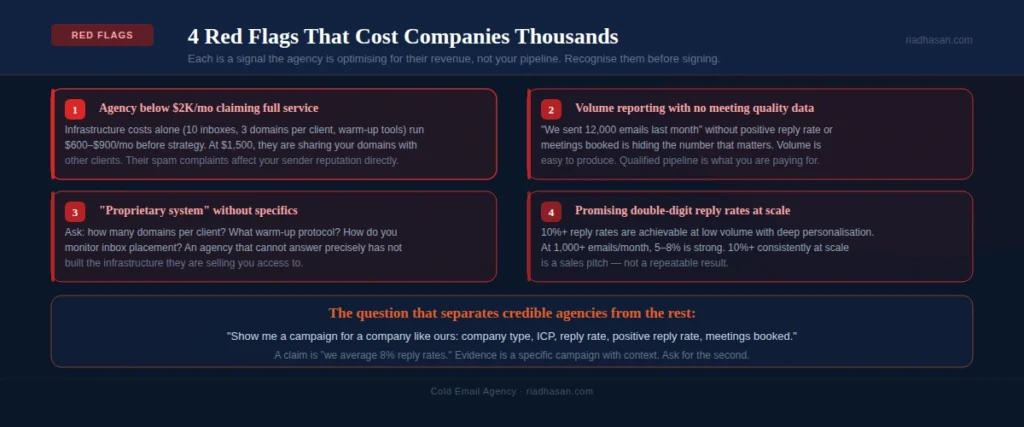
The cold email agency market has a meaningful number of operators who produce impressive proposals and poor results. These are the patterns that experienced buyers have learned to avoid:
Agencies below $2,000/month that promise full-service results
A 5-client agency running 10 inboxes per client across 3 dedicated domains each, with proper list verification tools, has infrastructure costs of $600–$900 per month before a single hour of strategy, copywriting or client management. An agency charging $1,500 per client either has no dedicated infrastructure or is sharing domains across clients — which means your sender reputation depends on what every other client on that infrastructure is doing. Shared domains are a deliverability risk that no copy quality compensates for.
Volume-focused reporting with no meeting quality tracking
An agency that leads with “we sent 12,000 emails last month” without telling you how many positive replies those emails generated and how many of those converted to qualified meetings is hiding the number that matters. Volume is easy to produce. Qualified pipeline is what you’re paying for.
“Proprietary system” language without specifics
Every legitimate cold email operator uses the same core tool stack: Apollo or Clay for data, Instantly or Smartlead for sending, Google Workspace or Microsoft 365 for mailboxes, NeverBounce or ZeroBounce for verification. An agency claiming a proprietary system that they won’t explain in specific terms is either obscuring a process that isn’t proprietary or using tools they don’t fully understand.
Promising consistently double-digit reply rates at scale
At volume (5,000+ emails per month), 2–4% reply rates are standard even for well-run campaigns, according to Prospeo’s 2026 agency buyer’s guide. Top-tier targeting can hit 8–12% on tighter lists. Consistent double-digit reply rates at scale are not achievable. Anyone promising them is either misleading you about what “reply rate” they’re measuring or planning to send to tiny lists where the numbers are unrepresentative.
What Realistic Results Look Like
A well-run cold email agency campaign in 2026 should produce:
| Metric | Benchmark | Notes |
|---|---|---|
| Overall reply rate | 3–5% | Top tight-segment campaigns hit 8–12% |
| Positive reply rate | 1–2% | Interested prospects only, excluding opt-outs |
| Cost per qualified meeting | $200–$500 | At $4,000–$6,000/month retainer tier |
| Time to first meeting | 6–8 weeks from campaign launch | Weeks 1–4 are infrastructure and warm-up only |
| Meaningful performance data | Week 8 from launch | Enough data to evaluate copy, targeting and offer |
- 3–5% overall reply rate from a properly targeted, verified list (top campaigns hit 8–12% on tighter segments)
- 1–2% positive reply rate (interested prospects, not opt-outs or negative replies)
- $200–$500 cost per qualified meeting at the $4,000–$6,000/month retainer tier
- First meetings in week 6–8 from campaign launch (weeks 1–4 are infrastructure and warm-up)
- Meaningful data by week 8 for evaluating whether copy, targeting or offer needs adjustment
Before hiring any agency, request a sample campaign report from an active client engagement — not a case study presentation, but an actual weekly report showing reply rate, positive reply rate, meetings booked and deliverability health for a campaign that is currently live. If the agency can’t produce that in 48 hours, that’s the information you need.
I rebuilt RankWizards from near shutdown to a 25+ person team using cold email as the primary growth channel. The system that produced that result is not complicated: a clean sending infrastructure, a precisely defined ICP, short personalised emails and a disciplined follow-up cadence. What took me time to build from scratch, a good agency delivers pre-built — which is the entire value proposition of the model.
Frequently Asked Questions
What is a cold email agency?
A cold email agency manages your entire outbound prospecting system: infrastructure setup, prospect list building, email copywriting, sequence management, deliverability monitoring and reply handling. Full-service agencies own the outcome end to end. Some agencies offer partial services (setup and templates only) where the client handles sending and reply management. Understand which model you’re buying before signing, as the accountability structure differs significantly between the two.
How much does a cold email agency cost in 2026?
Full-service cold email agency retainers run $2,000–$8,000 per month in 2026. Most B2B companies paying for consistent pipeline results land in the $3,000–$6,000 range. Below $2,000/month, agencies typically cut corners on infrastructure. Shared domains and minimal list verification are common at this tier. Per-meeting pricing runs $200–$500 per qualified B2B meeting; above $600 per meeting indicates the agency’s targeting or copy needs work. Budget an additional 30–50% on top of the base retainer for domains, list data and verification tools.
When should I hire a cold email agency vs building in-house?
Hire an agency when you need pipeline in the next 6–12 weeks and don’t have the internal capacity to build deliverability infrastructure, ICP research, copywriting and sending management simultaneously. Build in-house when you’re willing to invest 3–6 months in the learning curve and plan to own outbound as a core competency for the long term. Agencies deliver 2–3x more meetings in the first quarter than newly formed internal teams; in-house teams outperform over 18+ months once institutional knowledge has compounded.
What should I look for in a cold email agency?
Five criteria that separate credible agencies from operators who will waste your budget: specific reply rate and meeting data from named client types (not anonymised headline numbers), a clear deliverability process they can explain precisely, a defined ICP research and list building methodology, reporting focused on reply rate and meetings booked rather than open rate and volume and a 3-month initial commitment rather than a 12-month upfront lock-in before you’ve seen campaign results.
What are red flags when hiring a cold email agency?
Agencies offering full-service results below $2,000/month typically use shared domains that damage your sender reputation. Volume-focused reporting without meeting quality tracking hides poor conversion. “Proprietary system” language without specifics usually means the agency uses the same standard tool stack as everyone else but won’t explain their process. Promises of consistent double-digit reply rates at scale (5,000+ emails/month) are not credible — 2–4% is standard at volume, 8–12% is excellent on tight segments.
What is a cold email lead generation agency?
A cold email lead generation agency is a cold email agency with explicit focus on generating qualified leads and meetings as the primary deliverable, as opposed to brand awareness or newsletter list building. Most cold email agencies in 2026 are effectively lead generation agencies: the goal is qualified conversations in your calendar, not brand impressions or content distribution. The distinction matters mainly when comparing agencies to marketing agencies that happen to offer email as a service, which typically have a different model and different performance expectations.
The Agency Is a System, Not a Shortcut
There is a category of company that fires cold email agencies after 60 days because it did not work. In almost every case, they fired the agency before the system had enough data to diagnose what needed to change. Cold email is an iterative channel: the first 8 weeks tell you whether your ICP is right and whether your offer resonates. The next 8 weeks tell you whether the copy is converting at the rate it should. The agencies that produce durable pipeline results are the ones that get to run that iteration loop rather than being replaced before it completes.
The companies that get the best results from cold email agencies are the ones that treat it as a system to iterate on rather than a tap to turn on. The agency handles the execution. You need to close the feedback loop: what are meetings teaching you about ICP, offer and positioning? That input goes back to the agency to refine the targeting and copy for the next campaign cycle.
An agency that runs the same sequence to the same segment for six months without iteration is not a partner. They’re a service provider operating on autopilot. The relationship that produces consistent pipeline involves the agency learning from your sales conversations and you learning from the agency’s deliverability and targeting data.
- Cold Email Infrastructure Setup — the technical foundation every cold email system runs on
- Cold Email Lead Generation — how the list building and targeting process works behind the scenes
- Cold Email Deliverability — what to verify when an agency claims strong inbox placement
- Cold Email Best Practices 2026 — the full operational system an agency should be running for you
If you want cold email campaigns built and managed by a practitioner who has run them for companies across multiple verticals (rather than a team of junior SDRs handed a template), you can work with me directly at riadhasan.com.