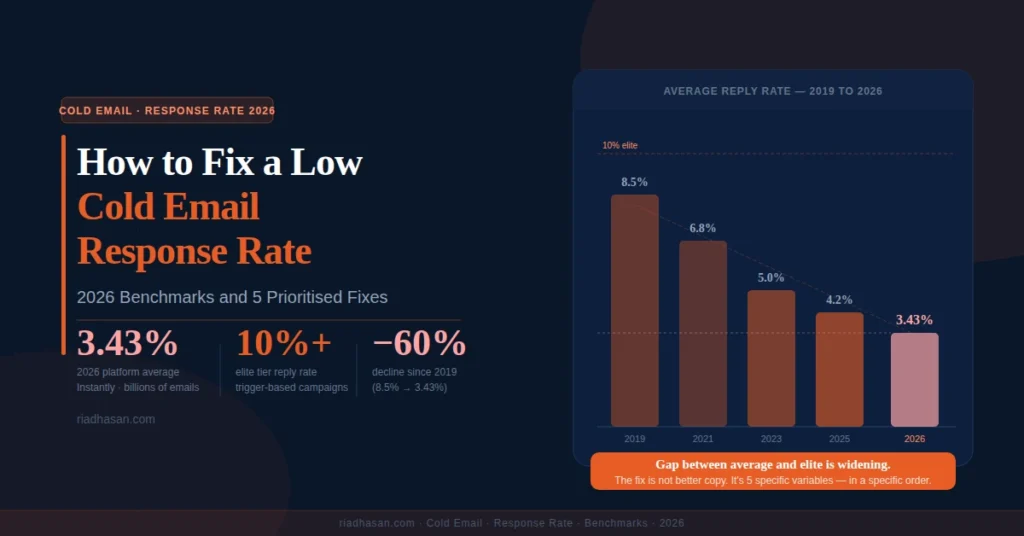
The average cold email response rate in 2026 is 3.43%, according to Instantly’s benchmark report analysing billions of emails across thousands of active workspaces. That means for every 100 cold emails that reach a real inbox, roughly three to four generate a reply.
The number is lower than most guides admit. It has also declined steadily: from 8.5% in 2019 to 5% in 2025 to 3.43% now, driven by inbox saturation, better spam filtering and a flood of low-effort AI-generated outreach that has conditioned prospects to ignore unfamiliar senders faster than ever.
But 3.43% is the average. Top-quartile campaigns hit 5.5%. Elite campaigns exceed 10%. The gap between average and top performance is not a matter of luck or budget. It is a matter of five specific variables, each of which can be changed before your next campaign sends.
What Cold Email Response Rate Means
Cold email response rate (also called reply rate) measures the percentage of delivered emails that generate a reply. It is calculated as:
(Unique replies ÷ delivered emails) × 100 = response rate %
Response rate is the most reliable primary metric for cold email campaigns. Unlike open rate (which is inflated by Apple Mail Privacy Protection and other proxy mechanisms) or click rate (only relevant for campaigns with tracked links), response rate measures genuine human engagement. A reply requires intent. A machine can trigger an open pixel. A machine cannot write a reply.
Response rate vs positive reply rate vs meeting booked rate
The three metrics that actually matter exist in a hierarchy:
| Metric | What it measures | 2026 average |
|---|---|---|
| Response rate (all replies) | Any reply — positive, negative or neutral | 3.43% (Instantly benchmark) |
| Positive reply rate | Replies showing genuine interest or requesting more information | ~1–3% of emails sent |
| Meeting booked rate | Replies that convert into a scheduled conversation | 0.2% (Snov.io 2026); top campaigns: 1–4% |
Response rate gets reported most often because it is the easiest to measure. Positive reply rate tells you more about whether your targeting and copy are working. Meeting booked rate tells you whether the campaign is generating real pipeline. Track all three, but optimise for positive reply rate when improving copy and for response rate overall when diagnosing infrastructure or targeting problems.
2026 Cold Email Response Rate Benchmarks by Tier
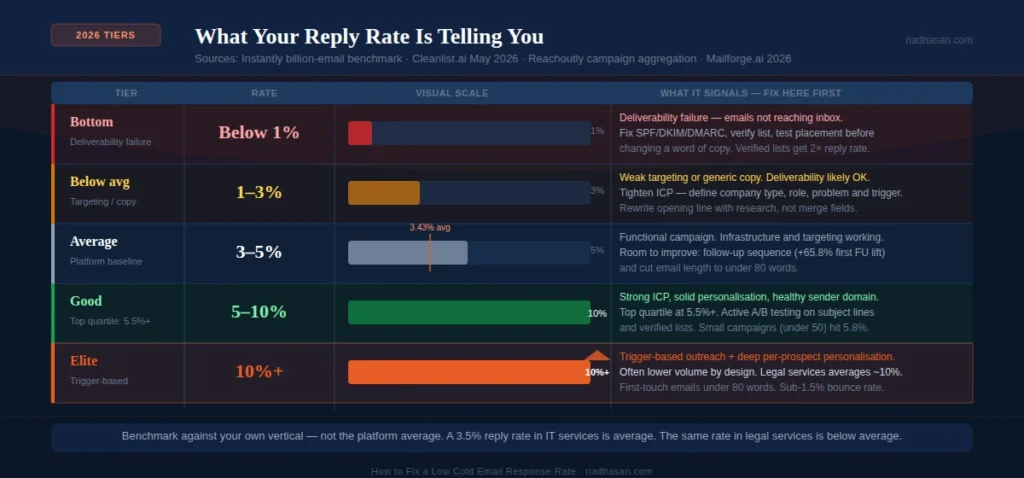
Response rates in 2026 vary significantly by execution quality. The data below is drawn from Instantly’s billion-email benchmark, Cleanlist.ai’s May 2026 analysis and Reachoutly’s campaign aggregation across active outbound teams:
| Tier | Reply rate | What it typically signals |
|---|---|---|
| Bottom (below 1%) | Below 1% | Deliverability failure or fundamentally wrong ICP — fix infrastructure before touching copy |
| Below average (1–3%) | 1–3% | Weak targeting or generic copy — work on ICP definition and opening line |
| Average (3–5%) | 3.43% platform average | Functional campaign — room to improve targeting depth and personalisation |
| Good (5–10%) | 5–10% | Strong ICP, solid personalisation and healthy sender domain |
| Top quartile (5.5%+) | 5.5%+ | Top 25% of all senders — tight ICP, verified lists, active A/B testing |
| Elite (10%+) | 10%+ | Trigger-based outreach, deep personalisation — often lower volume by design |
Cleanlist.ai’s May 2026 analysis adds two important data points: verified email lists get 2x the reply rate of unverified lists and bounce rate is the single biggest differentiator between top and bottom performers. The gap between best and worst is not copy. It is data quality, targeting precision and sending infrastructure.
Cold Email Response Rates by Industry
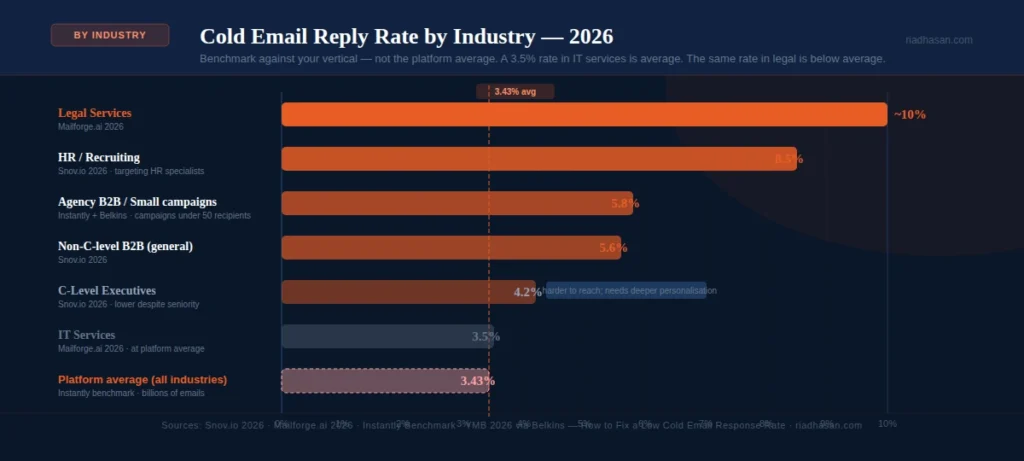
Industry context matters. A 3.5% reply rate in IT services is average; the same rate in legal services represents below-average performance. Benchmark your results against your own vertical, not the platform-wide number.
| Industry | Average reply rate | Source |
|---|---|---|
| Legal services | ~10% | Mailforge.ai 2026 |
| HR/recruiting (target: HR specialists) | 8.5% | Snov.io 2026 |
| Agency-managed B2B campaigns | 5.8% | Instantly + Belkins, via YMB 2026 |
| Non-C-level executives (general B2B) | 5.6% | Snov.io 2026 |
| Small campaigns (<50 recipients) | 5.8% | Mailforge.ai 2026 |
| C-level executives | 4.2% | Snov.io 2026 |
| IT services | 3.5% | Mailforge.ai 2026 |
Two findings worth noting: C-suite response rates (4.2%) are lower than non-C-level (5.6%). Senior executives are harder to reach and faster to ignore generic outreach, which means personalisation depth matters more at the executive level, not less. And smaller, tighter campaigns consistently outperform large generic blasts: campaigns under 50 recipients produce 5.8% average reply rates vs 2.1% for large lists (Mailforge.ai 2026).
Cold Email Open Rate: What the Number Actually Means in 2026
The average cold email open rate in 2026 ranges from 27.7% to 44% depending on the source and how Apple Mail Privacy Protection (MPP) is accounted for. Treat open rate as a directional signal, not a primary performance metric.
Apple’s MPP, active since 2021, pre-loads email content including tracking pixels before a human actually opens the email. This inflates open rates across every platform. A campaign showing 70% open rate may have seen only 35–40% of those “opens” from real humans. The open rate decline from 36% (2023) to 27.7% (2026) doesn’t fully reflect genuine engagement trends because the baseline was already artificially inflated.
The practical rule for 2026: target a 40–60% open rate as a health indicator of your subject lines and sender reputation. Elite campaigns reach 65%+. Below 30% usually signals a deliverability problem. But use open rate to diagnose, not to measure campaign success. Response rate is the metric that tells the truth.
Why Cold Email Response Rates Have Declined
Average response rates dropped from 8.5% in 2019 to 3.43% in 2026, according to Reachoutly’s analysis of Instantly’s benchmark data across that period. Three forces drive the decline:
- Inbox saturation. Cold email volume has grown faster than the audience it targets. The average B2B professional receives significantly more cold outreach today than five years ago, which means the bar for what earns a reply has risen proportionally.
- AI-generated outreach flooding inboxes. Since 2023, the cost of producing cold emails dropped to near zero with LLM tools. Volume increased dramatically; quality did not. Prospects have become faster at identifying and deleting AI-pattern emails that feel generated rather than written.
- Tighter spam filtering. Google and Outlook have substantially improved their automated filtering since Google and Yahoo’s February 2024 bulk sender enforcement update. Emails that would have reached the inbox in 2022 now land in spam or promotions tabs more frequently, reducing the pool of delivered emails that even have a chance of generating a reply.
The open rate decline tells a related story. The drop from 36% (2023) to 27.7% (2026) reflects a partial correction of MPP-inflated numbers rather than a genuine collapse in human engagement. Many of the opens counted in 2022-2023 benchmarks were proxy servers, not people. The underlying human engagement trend is less dramatic than the headline numbers suggest.
The good news: because the average has declined, the gap between average and strong performance has widened. A 7% reply rate in 2026 represents greater relative performance than a 7% reply rate in 2019 did. Teams that invest in proper targeting, personalisation and infrastructure are separating further from the average, not converging toward it.
5 Changes That Actually Improve Cold Email Response Rate
Each of these changes is independently verified across multiple 2026 datasets. They are ranked by impact, not by ease of implementation.
1. Fix deliverability before touching copy
Most teams troubleshoot their copy when reply rates are low. Most of the time, copy is not the problem. The email never reached the inbox in the first place. A below-average reply rate that hasn’t responded to copy or subject line changes is almost always an infrastructure issue.
A campaign with broken deliverability has a 0% effective response rate. The emails never reach a real inbox. Below 1% reply rate almost always indicates a deliverability problem, not a copy problem. Verify: SPF, DKIM and DMARC are configured on every sending domain. Bounce rate is below 2% (top performers stay under 1.5%). Spam complaint rate is below 0.1%. Inbox placement tests show 90%+ primary inbox placement.
Verified email lists get 2x the reply rate of unverified lists and 5–6x the reply rate of purchased lists, according to Cleanlist.ai’s 2026 data. List quality is deliverability by another name.
2. Tighten your ICP before expanding your list
Smaller, more targeted campaigns consistently outperform large generic ones. The 5.8% average for campaigns under 50 recipients vs 2.1% for large lists (Mailforge.ai 2026) reflects a fundamental principle: relevance at scale is harder than relevance in a tight segment. Start narrow. Define a precise ICP with four dimensions: company type, person role, specific problem and trigger event. Send to the first 200 people who match all four. The reply rate from that cohort determines whether the ICP is correct before you scale.
3. Personalise the opening line, not just the name
Personalisation that improves response rates refers to opening lines that prove research happened: a trigger event at the company, a piece of content the prospect published, a specific challenge relevant to their role at their company stage. Customised subject lines improve open rates by 50% (Saleshandy 2026). Personalised email bodies produce a 32% higher response rate (Mailforge.ai 2026). Name-only personalisation (“Hi [First Name]”) produces no measurable lift over generic templates because prospects know it’s a merge field.
4. Run a proper follow-up sequence
58% of all replies in a campaign come from the first email. The remaining 42% come from follow-ups. Stopping after one email leaves nearly half your potential replies uncollected. The first follow-up increases reply rates by 65.8% (YMB 2026, citing Belkins data). Two to three follow-ups is the optimal number — beyond four, spam complaint rate begins to rise and deliverability suffers. Space follow-ups using the widening gap cadence (Day 1, Day 3, Day 7–8, Day 14–16) rather than fixed equal intervals.
5. Cut email length to under 80 words
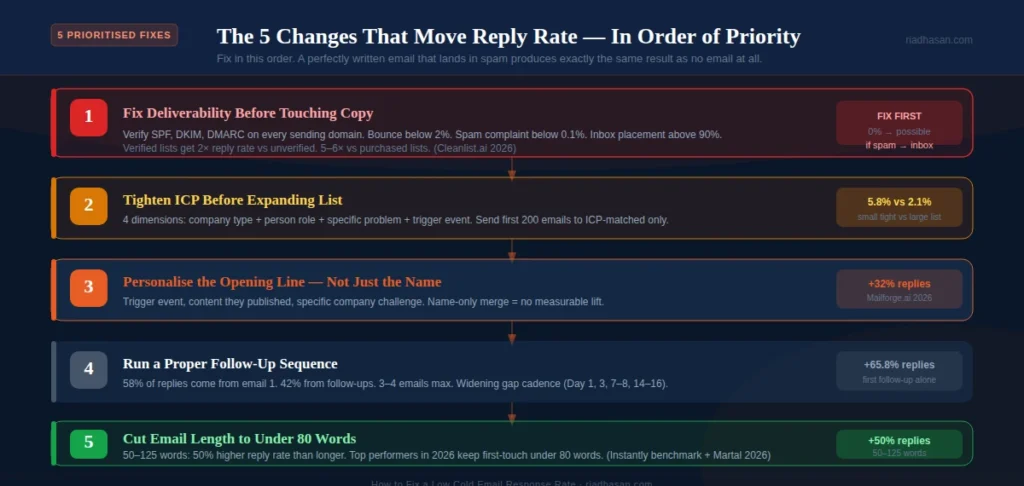
Emails of 50–125 words achieve 50% higher reply rates than longer formats (Martal 2026). Top performers in 2026 keep first-touch emails under 80 words (Instantly benchmark). Every word beyond what’s needed to establish relevance and make a single ask is a word working against you. The counterintuitive reality: shorter emails get higher response rates not because they ask less but because they signal respect for the recipient’s time — which itself is a signal of quality targeting and intentional outreach.
How to Calculate Your Cold Email Response Rate
The formula is straightforward but the inputs require precision:
Response rate = (Unique replies ÷ Successfully delivered emails) × 100
Use unique replies, not total replies (one reply per thread, not counting re-replies to your follow-ups). Use delivered emails, not sent emails (subtract hard bounces). Count all replies in your response rate (positive, negative and unsubscribes) to get your true rate. Then track your positive reply rate separately by tagging replies as positive, negative or neutral in your CRM or sending tool.
Track response rate weekly during active campaigns, not just at the end. A rate that starts at 5% and drops to 1.5% over three weeks signals deliverability degradation in progress. Catching it early means pausing the campaign, diagnosing the problem and resuming before domain reputation is seriously damaged. A rate that holds steady tells you list quality and sending infrastructure are stable.
One common mistake: counting sent emails instead of delivered emails in the denominator. If you sent 500 emails and 50 bounced, your delivered count is 450, not 500. Running your reply count against 500 understates your true rate and makes it harder to see whether your list quality is improving.
Frequently Asked Questions
What is the average cold email response rate in 2026?
The average cold email response rate in 2026 is 3.43%, according to Instantly’s benchmark report analysing billions of emails across thousands of active workspaces. This is down from 5% in 2025 and 8.5% in 2019, driven by inbox saturation, improved spam filtering and AI-generated outreach volume. Top-quartile campaigns achieve 5.5%+ and elite campaigns exceed 10% through tight targeting, verified lists, personalised opening lines and consistent follow-up sequences.
What is a good cold email reply rate?
A good cold email reply rate in 2026 is 5–10%, which places you in or above the top quartile of all senders. The platform-wide average is 3.43%. Below 1% almost always signals a deliverability problem. The emails are not reaching the inbox. Between 1–3% indicates weak targeting or generic copy. Above 10% represents elite performance, typically achieved with trigger-based outreach, deep per-prospect personalisation and sub-80-word first-touch emails.
How do I improve my cold email response rate?
The five highest-impact changes in order of priority: first, fix deliverability (verify SPF/DKIM/DMARC, verify your list, confirm inbox placement above 90%). Second, narrow your ICP before scaling. Third, personalise the opening line with research, not just the name. Fourth, run a proper 3–4 email follow-up sequence. Fifth, cut email length to under 80 words. Start at step one — a perfectly written email that lands in spam produces the same result as no email at all.
How does response rate vary by industry?
Legal services achieves the highest average at ~10%, followed by HR/recruiting at 8.5% (when targeting HR specialists). General B2B non-executive outreach averages 5.6%. IT services averages 3.5%. C-level outreach averages 4.2%, lower than non-C-level despite the assumption that senior decision-makers are more decisive. Campaign size also matters: campaigns under 50 recipients average 5.8% vs 2.1% for large generic lists. Always benchmark against your own vertical rather than the platform average.
Why are cold email response rates declining?
Three forces have pushed the average from 8.5% in 2019 to 3.43% in 2026: inbox saturation from rising cold email volume, the flood of AI-generated outreach since 2023 (which trained prospects to delete unfamiliar emails faster), and tighter spam filtering from Google and Outlook following their February 2024 bulk sender enforcement. The gap between average and top-quartile performance has widened as a result — teams running well-targeted, personalised outreach are seeing stronger relative returns even as the baseline has fallen.
What is the difference between response rate and open rate for cold email?
Response rate measures the percentage of delivered emails that generate a human reply: genuine engagement that requires intent. Open rate measures the percentage of delivered emails where the tracking pixel fired, which includes automated fires from Apple Mail Privacy Protection proxy servers and corporate email security scanners. Nearly half of “opens” in 2026 are not humans. Open rate is a useful directional signal for subject line and sender reputation health, but response rate is the metric that tells the truth about whether your campaign is working.
The Number That Matters Is the One You Can Move
One more data point worth holding onto: Martal’s 2026 B2B email statistics note that companies excelling at email outreach generate 50% more sales-ready leads while cutting costs by one-third compared to companies running generic campaigns. The return from investing in targeting and personalisation compounds — it doesn’t just lift the current campaign, it improves every campaign that runs on the same system afterward.
The 3.43% average is the starting point, not the ceiling. Most teams sitting at average are sitting there because of fixable problems at the infrastructure or targeting layer, not because cold email has stopped working or because their offer is weak.
Fix deliverability first. Narrow the ICP second. Then personalise the opening line, tighten the sequence and cut the copy. Doing all five in order moves teams from 3.43% to 7–10% without changing the product, the offer or the price. The benchmarks are descriptive, not prescriptive. Your response rate is something you choose to work on, not something that happens to you.
- Cold Email Deliverability — why emails go to spam and how to fix inbox placement
- Cold Email Personalization — icebreaker types, opening line formulas and how to scale research
- Cold Email Sequences — cadence structure and the widening gap method
- Cold Email Best Practices 2026 — the full system from targeting to reply management
If you want a cold email system built to consistently hit 7–10% reply rates for your specific ICP, you can work with me directly at riadhasan.com.