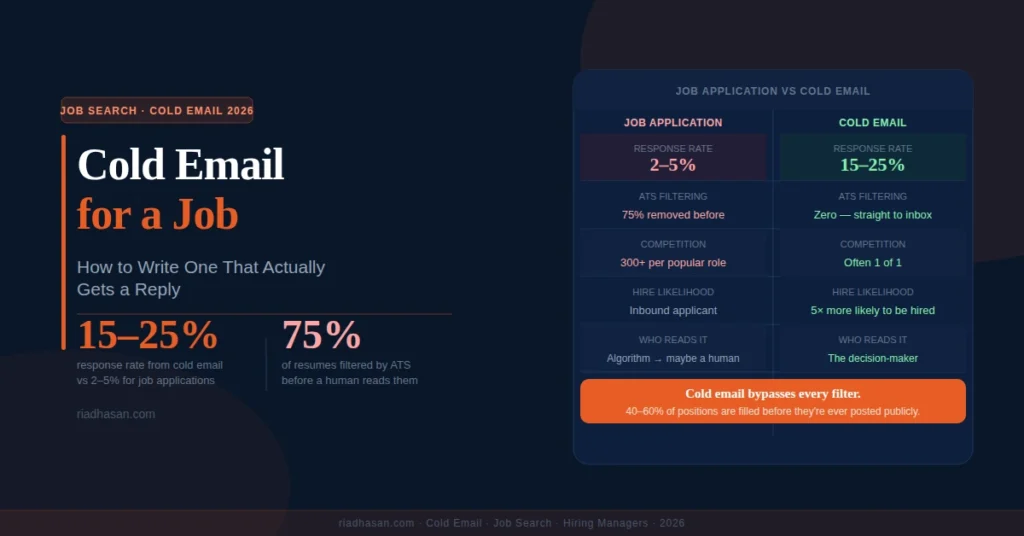
Cold email for a job is the fastest way to bypass the applicant queue. Roughly 75% of resumes get filtered by an ATS before any human reads them. Online applications to popular roles generate 300+ submissions within hours. A direct, personalised email to the hiring manager or recruiter skips that entire process and puts your name in front of the person who actually makes the hire.
The response rate backs this up: cold emails sent directly to hiring managers see a 15–25% response rate compared to 2–5% for standard online applications. That gap exists because the hiring manager is reading something written for them specifically, not one of hundreds of identical submissions.
The catch is that most cold emails for jobs are written badly. A generic, copy-paste message does worse than not reaching out at all. It signals low effort to someone who receives dozens of similar emails every week. This guide covers how to write one that stands out: who to contact, how to find their email, what to say, what not to say and real templates for every job search scenario.
Is It OK to Cold Email a Recruiter or Hiring Manager?
Yes. Both audiences expect it and most welcome it when done correctly.
Cold emailing recruiters
Recruiters are paid to find qualified candidates. A relevant, professional cold email from someone who matches what they’re looking for is not an imposition. It’s exactly what they’re trying to generate from every job posting they write. Recruiters have quotas, they’re actively searching for talent and most job seekers never contact them directly. That’s your competitive opening.
Between 40–60% of positions are filled through referral or direct outreach before they’re ever posted publicly. The recruiter you email today may have a role that fits you in two weeks and no current public listing. Your name being in their inbox when that moment arrives is the entire point of the outreach.
Cold emailing hiring managers directly
Hiring managers are a higher-risk, higher-reward contact. They’re busier than recruiters, less accustomed to direct outreach from candidates and more likely to ignore a generic email. But when the email is specific and relevant, they often respond faster than any recruiter would, because they’re the one with the problem the hire will solve.
The etiquette rule that matters most: always apply through the ATS first if a role is posted, then send the cold email. This signals professionalism, creates a paper trail and prevents awkwardness if the hiring manager asks whether you submitted an application.
Why Cold Email Works Better Than Job Applications in 2026
The ATS is not broken. It works exactly as designed: to filter you out. Sourced candidates (people found through direct outreach) are 5x more likely to be hired than inbound applicants. That gap exists for structural reasons:
- ATS filtering removes 75% of applications before a human sees them. Keywords, formatting, file type, location fields — any mismatch triggers rejection before your experience is evaluated.
- Direct outreach bypasses the queue entirely. A cold email lands in a real inbox, read by a real person, without any algorithmic filtering.
- Volume suppresses quality on job boards. 300+ applications per role means recruiters allocate seconds per resume. A short, specific email earns more attention than a perfect resume buried under hundreds of others.
- AI-generated applications have saturated job boards. In 2026, recruiters tell us they cannot distinguish most applications from each other. A genuine, researched cold email genuinely stands out.
Who to Contact and How to Find Their Email
Who to target
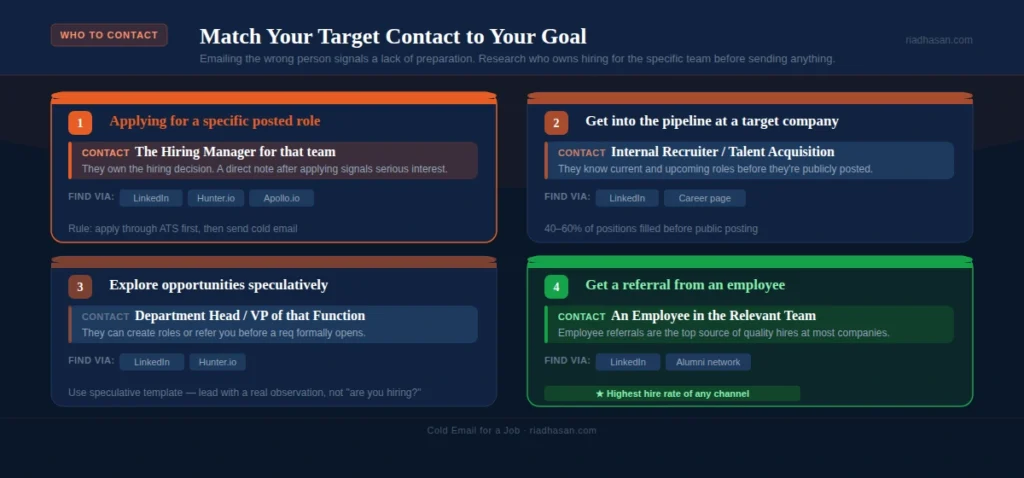
The right contact depends on your goal:
| Goal | Contact | Why |
|---|---|---|
| Apply for a specific posted role | The hiring manager for that team | They own the decision. A direct note after applying shows serious interest. |
| Get into the pipeline at a target company | Internal recruiter or talent acquisition manager | They know current and upcoming roles before they’re posted. |
| Explore opportunities speculatively | Department head or VP of the function you’d join | They can create roles or refer you before a req opens formally. |
| Get a referral | An employee in the relevant team | Employee referrals are the top source of quality hires at most companies. |
How to find their email address
- LinkedIn: Find the person by title and company. Many list contact emails in their profile. Use Sales Navigator for advanced filtering.
- Hunter.io: Enter the company domain and get email patterns and verified addresses for people at that organisation.
- Apollo.io: Broader prospecting database. Enter company and job title to find contact details.
- Company career page: Some job postings include recruiter names and email addresses directly.
- Email pattern guessing: Most companies use consistent formats — firstname@company.com, firstname.lastname@company.com, or f.lastname@company.com. Test with a verification tool like NeverBounce before sending.
How to Write a Cold Email for a Job
The four-part structure
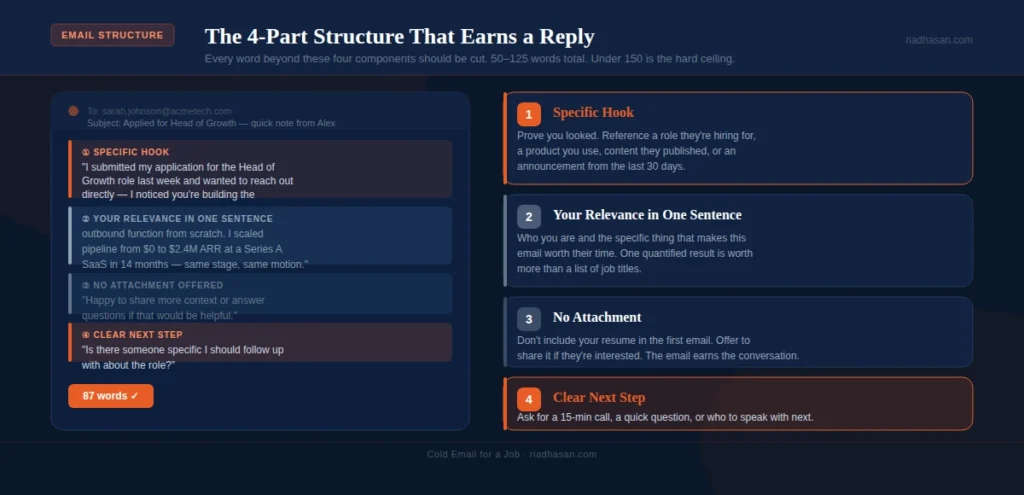
A cold email for a job has four components. Every word beyond these four components should be cut.
- A specific hook: one sentence that references something real — a role they’re hiring for, a product you use, a piece of content they published, a company announcement. Prove you looked.
- Your relevance in one sentence: who you are and the specific thing you’ve done that makes this email worth their time. One quantified result is worth more than a list of job titles.
- A clear next step: not “I’m looking for a job” or “Are you hiring” — ask for a conversation. Specifically: a 15-minute call, a quick question, or whether there’s someone you should speak with.
- No attachment: don’t include your resume in the first email. Offer to share it if they’re interested. The email earns the conversation; the conversation earns the resume review.
Length
50–125 words is the range that performs best across every source I’ve reviewed. Under 150 words is the hard ceiling. If your email is longer than that, you’re asking too much of a stranger’s time. Cut every sentence that doesn’t directly serve the goal of earning a reply.
The one thing most people get wrong
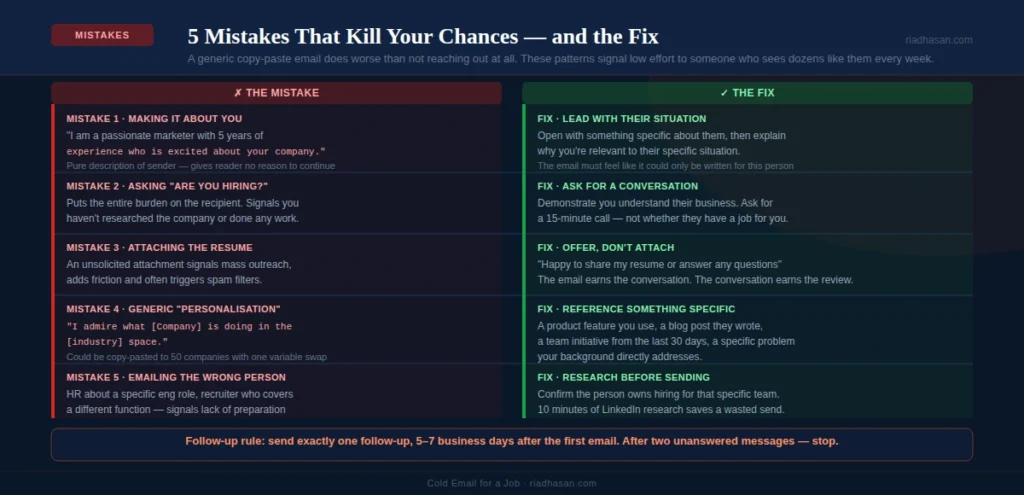
They make the email about themselves. “I am a passionate marketer with 5 years of experience who is excited about your company” is a description of the sender, not a reason for the recipient to keep reading. Flip it: lead with something specific about them, then explain why you’re relevant to their specific situation. The email should feel like it could only have been written for this person.
Subject Lines for a Cold Email Job Outreach
Personalised subject lines earn 38–45% open rates vs 20–22% for generic ones. For job cold emails, the subject line should be short, specific and avoid sounding like a cover letter submission.
Subject lines that work
- [Your Title] background — [Company Name] opportunities
- Applied for [Role] — quick note from [Your Name]
- Question about [specific team/product/initiative]
- Re: [Job Title] at [Company] — [Your Name]
- [Mutual connection] suggested I reach out
- [Specific result from your background] — relevant for [Team/Company]?
Subject lines to avoid
- “Opportunity” — vague, looks like spam
- “Following up” — generic, has no context before a first contact
- “Resume attached” — implies mass sending, not personal outreach
- “Looking for a job at [Company]” — too direct, frames you as a supplicant rather than a value-add
- Anything over 8 words — gets cut off on mobile
Cold Email Templates for Job Searches
Each template stays under 120 words and follows the four-part structure. Personalise the hook in every email before it sends. The structure does the heavy lifting, but the opening line must be written for this specific person.
Template 1: Emailing after applying for a specific role
Subject: Applied for [Role] — quick note from [Your Name]

Hi [First Name],

I submitted an application for the [Role] position last week and wanted to reach out directly.

I've spent [X years] doing [specific, relevant thing] — most recently at [Company], where I [one-sentence quantified result]. Given the [specific aspect of the role or team] you're building, I think there's a strong fit.

Happy to share more context or answer any questions. Is there someone specific I should follow up with about the role?

[Your Name]
Template 2: Cold email to a recruiter at a target company
Subject: [Your Title] background — [Company Name] opportunities

Hi [First Name],

I've been following [Company]'s work on [specific product/initiative/recent news] and have wanted to find a way in for a while.

I'm a [title] with [X years] of experience in [specific area]. Most recently at [Company], I [one-sentence result relevant to what they hire for].

Are you the right person to speak with about [function] roles, or could you point me toward who is?

[Your Name]
Template 3: Speculative outreach to a hiring manager (no open role)
Subject: Question about [team/product] at [Company]

Hi [First Name],

[Specific observation — you read their recent blog post, used their product, saw a company announcement]. It sparked a question I've been sitting with about [specific relevant topic].

I'm a [title] who's spent [X years] doing [relevant thing]. I'd love to ask you a few questions about the [team] and whether the work you're doing maps to what I've been building.

Worth 15 minutes?

[Your Name]
Template 4: Cold email via a mutual connection or referral
Subject: [Mutual Name] suggested I reach out

Hi [First Name],

[Mutual connection] mentioned you'd be a good person to speak with about [specific topic/team/role].

I've been doing [specific relevant work] for [X years] — most recently [one-line context]. I'm exploring what's next and [Company] is at the top of my list because [specific, genuine reason].

Would a 15-minute call make sense?

[Your Name]
Template 5: Cold email to a recruiter (for recruiters reaching out to candidates)
Subject: [Role] at [Company] — relevant for you?

Hi [First Name],

I came across your profile while sourcing for a [Role] position at [Company]. Your background in [specific skill or experience] is exactly what they're looking for — specifically the [one relevant detail from their profile].

The role involves [one-sentence description]. Compensation is [range if you can share it].

Worth a quick call to see if it fits?

[Your Name]
[Your Title], [Company]
How to Follow Up on a Job Cold Email
Send one follow-up. That’s the rule for job cold emails: not the B2B four-email sequence, not the break-up email. One follow-up, five to seven business days after the first email.
The follow-up has a single job: remind them you exist without making them feel chased. Reference the first email briefly, add one new piece of context if you have it (a recent company announcement, something that connects your background more directly to what they’re working on) and re-ask the question.
Follow-up template
Subject: [same thread]

Hi [First Name],

Following up on my note from last week — just wanted to make sure it didn't get buried.

[Optional: one new piece of context — "Saw [Company] just announced [X], which makes the [team] work even more relevant to what I've been building."]

Happy to share my resume or answer any questions if that would help.

[Your Name]
After two unanswered emails, stop. Three or more messages without a response tips from persistence into intrusion. Move to the next person on your target list and come back to this contact in 60–90 days if circumstances change.
Mistakes That Kill Your Chances
Making the email about you, not them
Every sentence that starts with “I am” or “I have” without a direct connection to something the recipient cares about is a sentence they don’t need to read. Lead with their situation. Bring in yours only in the context of how it’s relevant to them.
Asking “Are you hiring?”
This question puts the entire burden of the conversation on the recipient and signals you haven’t done any research. Instead of asking whether they’re hiring, demonstrate that you understand their business and ask for a conversation. The job discussion happens naturally once rapport exists.
Attaching your resume in the first email
An unsolicited attachment signals mass outreach, adds friction and often triggers spam filters. Offer to share it if they’re interested. The email’s job is to earn the request for the resume, not to deliver it unprompted.
Generic personalisation
Mentioning the company name is not personalisation. “I admire what [Company] is doing in the [industry] space” is a sentence that could be sent to 50 companies with a single variable swap. Reference something specific: a product feature you use, a blog post they wrote, a team initiative announced in the last 30 days, a specific problem their industry faces that your background directly addresses.
Emailing the wrong person
An email to HR about a specific engineering role, or to a recruiter who handles a completely different function, signals a lack of preparation. Research who owns hiring for the specific team you’re targeting before sending anything.
Frequently Asked Questions
Is it OK to cold email a recruiter for a job?
Yes. Recruiters are paid to find qualified candidates and most welcome relevant, professional cold email from job seekers. SHRM (Society for Human Resource Management) research consistently identifies direct contact and referrals as the top sources of quality hires — beating job boards and career sites. The key word is relevant: your background must match what they hire for. A generic “I’m looking for work” email to a recruiter who doesn’t cover your function or industry is unwelcome, but a specific, well-researched message to the right recruiter is exactly what they’re trying to generate through every job posting they write.
What is the response rate for cold emailing hiring managers?
Cold emails sent directly to hiring managers see a 15–25% response rate, compared to 2–5% for standard online applications, according to outreach data from Woodpecker and Mailshake. The higher rate exists because the hiring manager is reading something written for them specifically rather than evaluating one of hundreds of identical ATS submissions. The quality of the message determines where in that range you land.
How long should a cold email for a job be?
50–125 words. Under 150 words is the hard ceiling. Anything longer asks too much of someone who didn’t request the email. The four components (specific hook, your relevance in one sentence, a clear next step, no attachment) can all fit inside 100 words. Every word beyond what’s needed to make those four points clear is a word that works against you.
Should I attach my resume to a cold email for a job?
No. Don’t attach your resume in the first email. An unsolicited attachment signals mass outreach, can trigger spam filters and gives the recipient something to evaluate before you’ve established any reason for them to care. Offer to share it if they’re interested. The email’s job is to earn the conversation. Once someone asks for your resume, you’ve already started a real exchange.
How do I find a hiring manager’s email address?
The most reliable methods: LinkedIn (many people list contact emails on their profile), Hunter.io (finds email patterns and verified addresses by domain), Apollo.io (broader prospecting database with job title filtering) and the company’s career page (some job postings include recruiter contact details directly). For email pattern guessing (firstname@company.com, firstname.lastname@company.com), verify the address with a tool like NeverBounce before sending to avoid bounces.
How many times should I follow up on a cold email for a job?
Once. Send one follow-up five to seven business days after the first email. After two unanswered messages, stop. Three or more emails without a response crosses from persistence into intrusion and can permanently close a door that was only temporarily silent. Add the contact to a 60–90 day re-engagement list and focus energy on other targets in the meantime.
The Cold Email Gets You in the Room — Your Work Gets You the Job
Cold email for a job is a front-door strategy. It gets you into conversations that the ATS would have filtered out and the job board queue would have buried. The 15–25% response rate it produces isn’t a guarantee of an offer. It’s a guarantee of a conversation that the standard application process rarely produces at all.
Write for the specific person you’re emailing. Keep it short. Ask for a conversation, not a job. Follow up once. Track everything in a spreadsheet so no contact gets double-emailed or forgotten.
- Cold Email Subject Lines — 60+ proven subject line formulas across industries and situations
- Cold Email Personalization — how to write opening lines that prove research happened
- Cold Email Follow-Up Guide — sequence structure, timing and what to say in each touch
- Cold Email Best Practices 2026 — the full system for any cold outreach campaign