B2B cold email templates are only useful if it gets personalised before it sends. Copy-paste it unchanged and you’re competing with every other sender who found the same list. The prospect can tell. Generic outreach gets deleted.
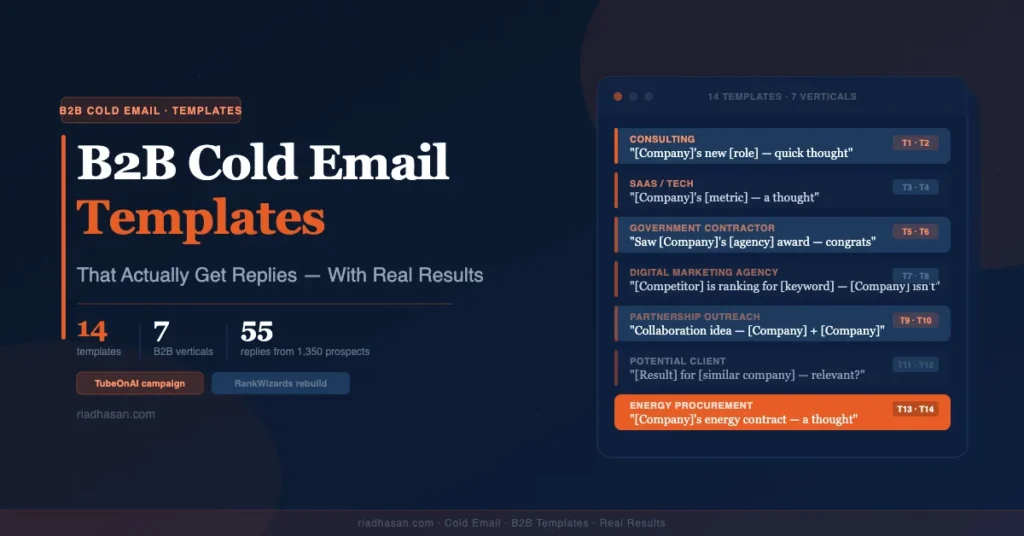
What follows are templates built for specific use cases: consultancies, SaaS founders, government contractors, digital marketing agencies, energy procurement and partnership outreach. Each one includes the structure, the logic and the variables that need personalising before it leaves your outbox.
These aren’t pulled from a swipe file. They’re built from five years of running B2B cold email campaigns, including a multi-step sequence for TubeOnAI that produced 55 replies from 1,350 prospects in a competitive AI tools market and a RankWizards agency rebuild where cold email became the primary growth channel from near shutdown to a 25+ person team.
What Every High-Performing B2B Template Has in Common
Before the templates, the anatomy. The structure of a high-performing cold email is consistent across every vertical. What changes is the trigger event, the pain language and the proof point. The frame stays the same.
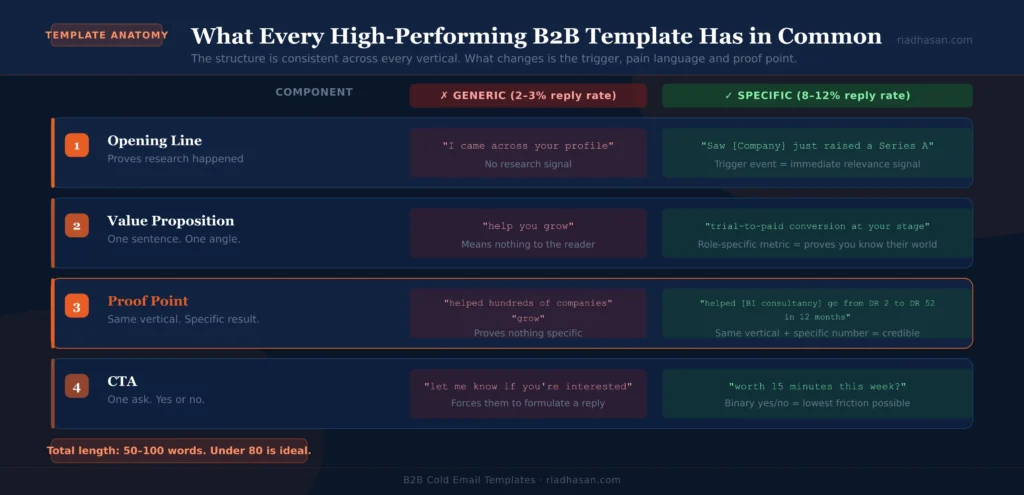
Every template that works has four components:
- A specific opening line — something real about this person or company, not a template opener. It proves research happened.
- One clear value proposition — what you offer and why it’s relevant to them, in one sentence. Not a list of services.
- Social proof in one or two sentences — a result for a similar company. Specific beats vague every time.
- A low-friction CTA — one ask. A yes/no question or a simple meeting request. Not a link to a deck, a video and a booking page simultaneously.
Total length: 50–100 words for the first email. The best-performing campaigns keep first-touch emails under 80 words. Shorter forces clarity. Every word earns its place or gets cut.
The most common mistake: including two or three value propositions in a single email. Pick one. Your follow-up sequence exists to introduce additional angles. The first email has one job: earn a reply.
Trigger-based vs. generic cold email templates
The biggest differentiator between templates that produce 8–12% reply rates and templates that sit at 2–3% is the trigger. Templates without a trigger feel random. A trigger makes outreach feel timely. A trigger is any event that creates a logical reason for your outreach right now: a funding round, a new hire, a recent product launch, a job posting, a contract win or a piece of content the prospect just published.
Variable-based personalisation (trigger event, tech stack, role-specific pain) outperforms name-and-company personalisation alone. At scale, tools like Clay can pull trigger data automatically. But the research into what matters to a specific ICP still has to be done first.
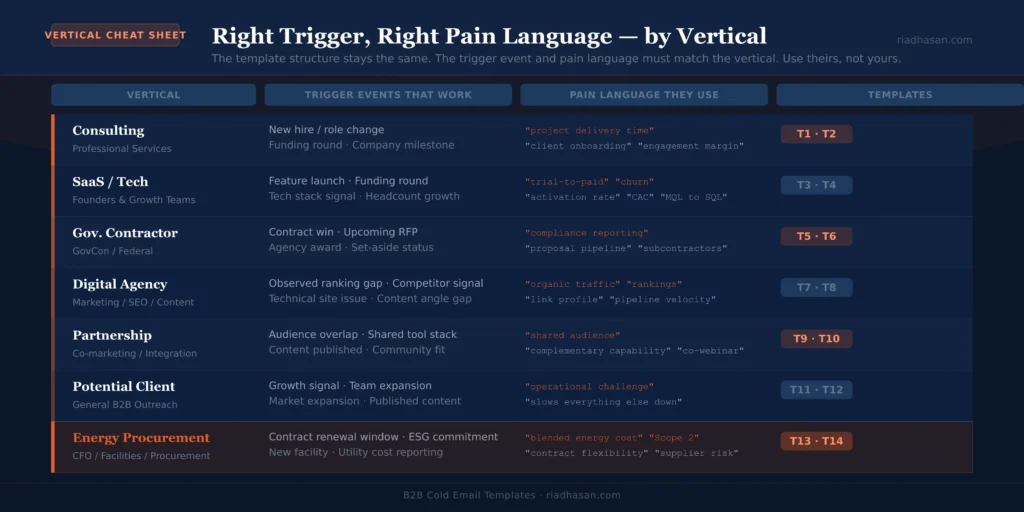
Consulting and Professional Services Templates
Consulting buyers scan for credibility signals before value propositions. The person buying a $50K engagement wants to know you understand their world before they’ll consider your offer. The opening line has to prove that.
Template 1: Consulting — trigger-based (new hire or role change)
Subject: [Company]'s new [role] — quick thought

Hi [First Name],

Congrats on the [role] move at [Company]. When [role type] leaders step into [company stage/size], [specific operational challenge] usually surfaces early — especially if [inherited process/tool] wasn't built for where the company is now.

We helped [similar firm] navigate exactly that in [timeframe] and [specific outcome].

Worth a 15-minute call to see if we're relevant?

[Name]
Template 2: Consulting — result-led (same vertical proof)
Subject: [specific result] for [similar firm type]

Hi [First Name],

We recently helped [similar consulting client] [specific outcome — e.g. cut project delivery time by 30% / reduce client onboarding from 6 weeks to 2] by [one-line explanation of what you did].

Given [Company]'s work in [specific practice area], I think there's a relevant conversation here.

Open to a brief call this week?

[Name]
Key personalisation variables: the role or trigger event in subject line, the specific challenge that’s common to that role at that company stage and the proof point from a comparable firm. Don’t use a proof point from a different vertical. It signals you don’t understand their specific world.
SaaS and Tech Founders Cold Email Templates
SaaS founders respond to specificity around metrics. CAC, churn, activation rate, trial-to-paid conversion: these are the terms that signal you know what matters to them. Generic “grow your business” framing gets ignored. SaaS-specific language gets read.
Template 3: SaaS — metric-specific problem
Subject: [Company]'s [specific metric] — a thought

Hi [First Name],

Saw [Company] recently [trigger — launched feature / raised funding / hit milestone]. At that stage, [specific SaaS metric — e.g. trial-to-paid conversion / onboarding activation / churn in month two] is usually the thing that either compounds growth or quietly kills it.

We helped [similar SaaS] move [metric] from [X] to [Y] in [timeframe].

Is this something [Company] is actively working on?

[Name]
Template 4: SaaS – tech stack trigger
Subject: Noticed [Company] is using [tool]

Hi [First Name],

Most teams using [tool] at [Company]'s stage hit [specific friction point] once [growth trigger, e.g. user base passes X / team grows past Y].

We built something that removes that friction — [similar company] cut [specific metric] by [amount] after switching.

Would it make sense to show you how?

[Name]
The TubeOnAI campaign produced 55 replies from 1,350 prospects in a competitive AI tools market using personalised multi-step sequences built around role-specific pain and a clear, single CTA. The key wasn’t the template structure. It was the specificity of the trigger and the relevance of the proof point to the exact type of prospect being targeted.
Government Contractor Cold Email Templates
Government contractor outreach is one of the harder B2B niches. GovCon firms get saturated with vendor pitches and generic outreach dies quickly. Specificity around contract vehicles, agency exposure, compliance requirements and recent contract wins is what earns attention. The best opening lines reference a contract win, a recent award, an upcoming RFP or a partnership move.
Template 5: Government contractor – contract win trigger
Subject: Saw [Company]'s [agency/contract] award — congrats

Hi [First Name],

Congratulations on the [contract/award name] with [agency]. Firms scaling past that kind of win often run into [specific operational challenge — e.g. compliance reporting overhead / subcontractor management / proposal pipeline capacity] before the next contract cycle.

We've helped [similar GovCon firm type] [specific result] around exactly that.

Worth a quick call to see if it's relevant to where [Company] is headed?

[Name]
Template 6: Government contractor – upcoming RFP or set-aside angle
Subject: [Agency] RFP cycle — relevant to [Company]?

Hi [First Name],

With [agency]'s [upcoming RFP / Q[X] procurement cycle] coming up, [specific challenge — e.g. proposal turnaround time / compliance documentation / subcontracting requirements] tends to become a bottleneck fast.

[Similar firm] used us to [specific result] ahead of a similar cycle last year.

Is [Company] preparing for this one?

[Name]
What kills most GovCon outreach: leading with your certification stack or NAICS codes rather than a specific, timely reason for reaching out. The prospect doesn’t care about your credentials in the opening line. They care whether you understand their current situation.
Digital Marketing Agency Cold Email Templates
Marketing agencies pitching other businesses face a crowded inbox. Every founder has been cold emailed by a dozen SEO agencies this month. The template needs a specific, observable hook (something you noticed about their actual presence) rather than a generic “I can help you grow” opener.
Template 7: Digital marketing agency specific observation
Subject: [Company]'s [channel] — noticed something

Hi [First Name],

Looked at [Company]'s [specific channel — e.g. organic search profile / link profile / content output] and noticed [specific observation — e.g. a gap competitors are ranking for / a technical issue / a content angle that's underserved].

We fixed the same issue for [similar company] and they went from [X] to [Y] in [timeframe].

Would a quick look at [Company]'s full picture be useful?

[Name]
Template 8: Digital marketing agency – competitor angle
Subject: [Competitor] is ranking for [keyword] — [Company] isn't

Hi [First Name],

[Competitor] is currently outranking [Company] for [specific high-intent keyword or keyword cluster]. It's pulling traffic [Company] should own given your [product / service / market position].

We helped [similar client] close that kind of gap and [specific result] within [timeframe].

Is this something you'd want to look at?

[Name]
The template that works for a marketing agency pitching e-commerce clients will fail with B2B SaaS. The pain language is different. “Conversion rate” and “abandoned cart” land in e-commerce. “Pipeline velocity” and “MQL to SQL conversion” land in B2B SaaS. Use their language, not yours.
Partnership Outreach Cold Email Templates
Partnership cold email is different from sales cold email in one important way: the ask is mutual value, not a purchase. That changes the tone and the structure. You’re not pitching a solution to a problem. You’re proposing something that benefits both sides. The opening line still needs specificity, but the value prop is about shared audience, complementary capability or mutual reach rather than pain and fix.
Template 9: Partnership – audience overlap
Subject: Collaboration idea — [Your Company] + [Their Company]

Hi [First Name],

I've been following [Company]'s work on [specific topic / content area] and noticed we're reaching similar audiences in [shared niche] without competing directly.

I run [Your Company], which [one-line description]. I think there's a natural [content swap / co-webinar / newsletter feature / guest post] opportunity here that would be useful for both audiences.

Worth a 20-minute call to explore?

[Name]
Template 10: Partnership – integration or co-marketing angle
Subject: [Company] + [Your Company] — potential fit?

Hi [First Name],

A lot of [Company]'s users likely also use [Your tool/service] as part of their [specific workflow]. I've seen a few natural integration points that could make both products stickier for shared users.

Would it make sense to get on a call and see if there's something worth building here?

[Name]
Potential Client – Cold Outreach Templates
These are general-purpose templates for reaching a potential client when you don’t have a specific vertical trigger. They rely on a strong opening line that proves research, a clear one-line value prop and a single CTA.
Template 11: Potential client – problem-first
Subject: Question about [Company]'s [specific process]

Hi [First Name],

[Specific observation about their situation — e.g. Noticed [Company] is growing the sales team fast / Saw [Company] recently expanded into [market]]. At that stage, [specific operational challenge] tends to become the thing that slows everything else down.

We helped [similar company] solve that and [specific result].

Is this on [Company]'s radar right now?

[Name]
Template 12: Potential client – result-led, direct
Subject: [Result] for [similar company type] — relevant to [Company]?

Hi [First Name],

We recently helped [similar company] [specific result — e.g. book 40 qualified meetings in 60 days / reduce customer onboarding time by half / grow organic traffic from 2K to 18K in 4 months].

Given what [Company] does in [their space], I think there's a similar opportunity.

Worth 15 minutes to find out?

[Name]
Energy Procurement Templates
Energy procurement outreach targets procurement managers, facilities directors, CFOs and operations leads at mid-to-large organisations. The pain language is cost reduction, contract flexibility, supplier risk and regulatory compliance. Trigger events include energy contract renewal periods, new facility openings, ESG commitment announcements and rising utility cost reporting.
Template 13: Energy procurement – contract renewal trigger
Subject: [Company]'s energy contract — a thought

Hi [First Name],

With [Company]'s energy contract coming up for renewal [timeframe / or: based on typical contract cycles for [industry] firms your size], now is usually when a second opinion on procurement strategy pays for itself.

We helped [similar organisation] reduce their blended energy cost by [X%] over the last contract cycle through [one-line explanation].

Worth a brief conversation before the renewal window closes?

[Name]
Template 14: Energy procurement – ESG or sustainability trigger
Subject: [Company]'s sustainability targets — quick question

Hi [First Name],

Saw [Company]'s [ESG commitment / net-zero target / sustainability report]. Organisations at that stage often find that energy procurement strategy is the fastest lever for hitting Scope 2 targets without capex investment.

We helped [similar firm] reduce Scope 2 emissions by [amount] while cutting procurement costs in the same contract cycle.

Is this something you're actively working through?

[Name]
How to Personalise These Cold Email Templates Before Sending
Cold email templates without personalisation are spam with better formatting. These are the variables that actually move reply rates when changed from defaults to specifics:
| Variable | Generic (low performance) | Specific (high performance) |
|---|---|---|
| Opening line | “I came across your profile” | “Saw [Company] just raised a Series A” |
| Pain point | “help you grow” | “trial-to-paid conversion at your stage” |
| Proof point | “we’ve helped hundreds of companies” | “we helped [BI consultancy like yours] go from DR 2 to DR 52 in 12 months” |
| CTA | “let me know if you’re interested” | “worth 15 minutes this week?” |
| Subject line | “Partnership opportunity” | “[Company]’s new VP of Sales — quick thought” |
The proof point deserves particular attention. A result from a company in the same vertical is worth five times more than a generic claim. “We helped a SaaS company” means nothing to the reader. “We helped a B2B fintech at Series A reduce CAC by 40%” is specific enough to be memorable and checkable.
What Bad Templates Look Like
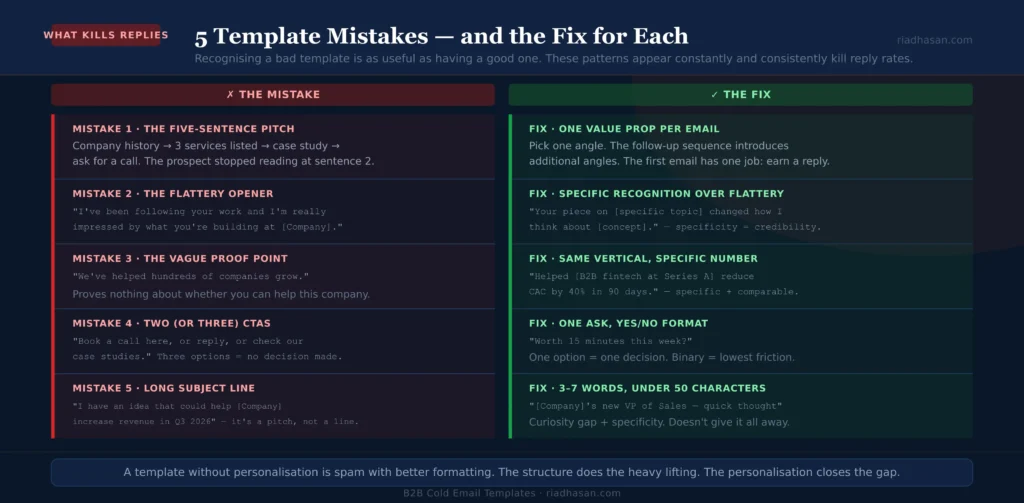
Recognising bad cold email templates is as useful as having a good one. These are the patterns that appear constantly in cold email and consistently kill reply rates:
- The five-sentence pitch: opening with your company history, then listing three services, then adding a case study, then asking for a call. The prospect stopped reading at sentence two.
- The flattery opener: “I’ve been following your work for a while and I’m really impressed by what you’re building at [Company].” It reads as template flattery because it is.
- The vague proof point: “We’ve helped hundreds of companies grow.” This proves nothing about whether you can help this company with this problem.
- Two CTAs: “You can book a call here or reply to this email or check out our case studies.” Three options creates no decision. One option creates one decision.
- The long subject line: “I have an idea that could help [Company] increase revenue in Q3 2026” is a pitch, not a subject line. It tells the reader everything before they’ve opened it — and gives them a reason not to.
Frequently Asked Questions
What is the best B2B cold email template?
There’s no single best template because the ICP determines what works. The structure that consistently performs across verticals is: a specific trigger-based opening line, one value proposition relevant to their role, a proof point from a similar company and a single yes/no question as the CTA. Under 80 words total. What changes is the trigger and the pain language. Both must match the specific person and company you’re emailing.
What are good cold email templates for consultancies?
Consulting cold email templates work when it leads with credibility before pitch. The highest-performing consulting cold email templates reference a specific trigger (new hire, funding, company milestone) that creates a logical reason for outreach now, connect that trigger to a challenge common to consulting buyers in that situation and prove the connection with a result from a comparable engagement. Generic “we help consultancies grow” framing doesn’t work against a sophisticated consulting buyer.
How do I write a cold email to a potential client?
Research the prospect first and identify one specific, observable thing about their situation: a recent company development, a role change, a piece of content they published or a market move. Open with that. Follow with one sentence explaining why you’re reaching out and one sentence of social proof from a comparable company. End with a single low-friction question. Keep the whole email under 100 words. The research is what makes the email feel personal rather than automated.
What are the best cold email templates for founders and authors?
Founder-facing templates work best when they reference a specific stage or milestone the founder has recently hit: funding, product launch, team growth, public announcement. Authors and content creators respond to templates that reference their specific work rather than their general profile. In both cases, the opening line must prove the sender actually engaged with what the recipient built or wrote, not just found their name on a list.
How do I personalise cold email templates at scale?
At scale, personalisation happens through structured variables populated by enrichment tools. The opening line variable is the most important. It should pull from trigger data (funding, job changes, news mentions) rather than just company name and first name. Tools like Clay can pull trigger data from LinkedIn, Crunchbase and news sources and insert it automatically. The research into which triggers matter to a specific ICP still has to be done manually first. The tool handles the execution once the logic is defined.
What is cold email templates for a digital marketing agency?
The most effective digital marketing agency templates open with a specific, observable finding about the prospect’s current digital presence: a gap in their organic rankings, a content angle their competitors are winning, a technical issue on their site. This proves you looked rather than just reached out. The value prop is the specific outcome you got for a comparable company. The CTA is a simple offer to share the full finding, not a pitch to sign a contract.
The Template Is the Starting Point, Not the Finish Line
Every template here becomes more effective the more it’s adapted to the specific person receiving it. The structure does the heavy lifting. The personalisation is what closes the gap between a template that could work and an email that actually gets a reply.
Start with one template that fits your primary ICP. Personalise the opening line and proof point for the first ten sends. Track what gets replies. Adjust from there.
- Cold Email Subject Lines — how to write the subject line that earns the open for each of these templates
- Cold Email Personalization — scaling personalisation without losing the human quality that makes it work
- Cold Email Follow-Up Guide — what to send after the first email when the reply doesn’t come immediately
- Cold Email Best Practices 2026 — the full system from infrastructure to reply management
If you want the templates built specifically for your ICP with proper infrastructure behind them, you can work with me directly at riadhasan.com.