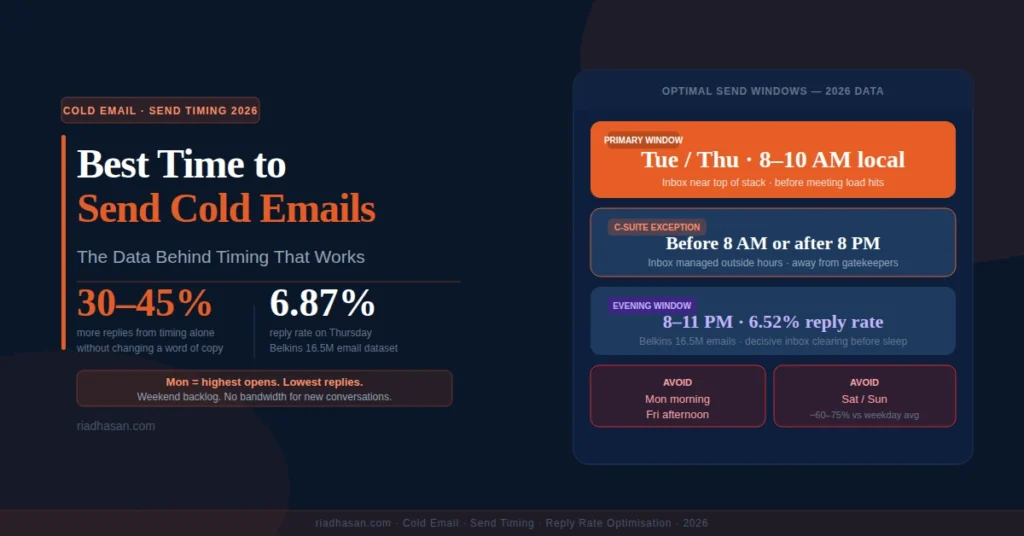
Moving a cold email campaign from “send whenever” to “Tuesday 10 AM in the recipient’s local timezone” produces 30–45% more replies without changing a single word of copy. That is the entire case for paying attention to best time to send cold emails. Not because timing is the biggest lever in cold email (it isn’t: targeting and infrastructure are bigger) but because it is the highest-ROI optimisation most teams never bother to make.
This guide covers what the data actually says about the best time to send cold emails in 2026: the best days, the best hours, the C-suite exception that most timing guides miss, why open rate data lies and a simple three-step process for finding the right timing for your specific ICP.
The Best Day to Send Cold Emails
Tuesday is the best day for B2B cold email reply rates in 2026. Wednesday and Thursday follow closely. All three days produce 30–45% higher reply rates than Monday or Friday sends, according to Growleads’ analysis of 400+ campaigns across 2025–2026.
| Day | Reply rate performance | Why |
|---|---|---|
| Tuesday | +45% above weekly average — best single day | Week is in motion but not yet dominated by meeting load |
| Wednesday | +35–40% above weekly average | Mid-week cadence; solid processing time before end of week |
| Thursday | 6.87% reply rate — highest in Belkins 16.5M dataset | Prospects starting to close out their week; decision-ready |
| Monday | High opens (22% per Growth List), low replies | Inbox backlog from weekend; no mental bandwidth for new conversations |
| Friday | 30–45% below mid-week average | Mental checkout before weekend; replies deprioritised |
| Saturday / Sunday | 60–75% below weekday average | Work email is not being actively processed; Saturday worst of the two |
Monday’s counterintuitive position deserves explanation. Growth List’s 2026 data shows Monday generates the highest open rate (22% of weekly cold email opens) but the weakest reply rate.
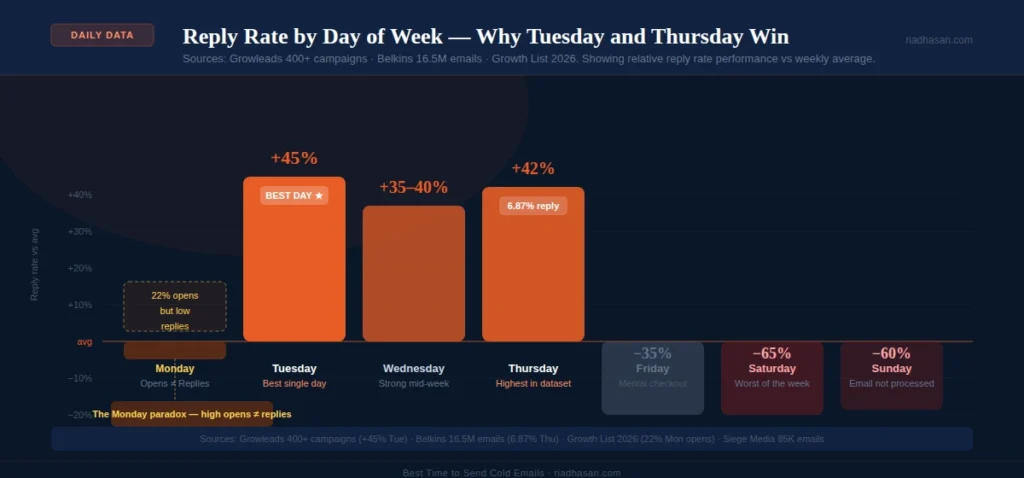
The reason: professionals clear their weekend inbox backlog on Monday morning, processing email at speed rather than engaging with new outreach. They see your email, note it vaguely and move on. The open registers. The reply doesn’t come.
The Best Time of Day to Send Cold Emails
The best time window for cold email reply rates is 8–10 AM in the recipient’s local timezone. This is consistent across the largest datasets available in 2026.
From Leadsmonky’s analysis of 10 billion emails (May 2026): the 8–10 AM window produces the highest reply rates for most B2B audiences. Thursday 9–11 AM specifically reaches 44% open rates in B2B benchmarks. The 7–11 AM window is consistently the strongest block overall, appearing in both the Belkins 16.5M-email dataset and Siege Media’s 85,000-email analysis.
Why early morning works
Inbox competition is lowest early in the morning. When a prospect opens their email at 8 AM, your message is near the top of a manageable stack rather than buried under everything that arrived during a busy mid-day. The 10 AM–12 PM window retains strong engagement (27.9% open rate per Salesmate analysis) — this is the second-best block, as prospects have cleared urgent messages and become more receptive to new conversations.
The evening window: the counterintuitive data
Here is the finding most timing guides miss: the 8–11 PM window produces a 6.52% reply rate in Belkins’ dataset of 16.5 million cold emails across 93 business domains. That is higher than most mid-morning windows.
The explanation is decision-maker behaviour in practice. By evening, the calendar is clear and the inbox is the last task before closing the laptop. Prospects in this window default to quick, decisive actions (including replies) rather than flagging emails for “later”, which most often means never. This window is particularly effective for C-suite targets, senior decision-makers and anyone who manages their inbox personally rather than through an EA.
Best times by audience type
| Audience | Best time window | Reasoning |
|---|---|---|
| B2B general (director/VP and below) | 8–10 AM local, Tue–Thu | Pre-meeting window; inbox near top of stack |
| C-suite / founders | Before 8 AM or after 8 PM, Tue/Thu | Inbox managed outside business hours away from gatekeepers |
| Sales / SDRs | 10 AM–12 PM local, Tue/Wed | Pre-lunch window before afternoon calls dominate their schedule |
| Agency owners / consultants | 8–10 AM or 8–10 PM, Tue–Thu | Variable schedules — both morning and evening work |
| Recruiters | 9–11 AM local, Tue/Wed | High email volume; mornings most structured for inbox processing |
Why Timezone Matters More Than Absolute Time
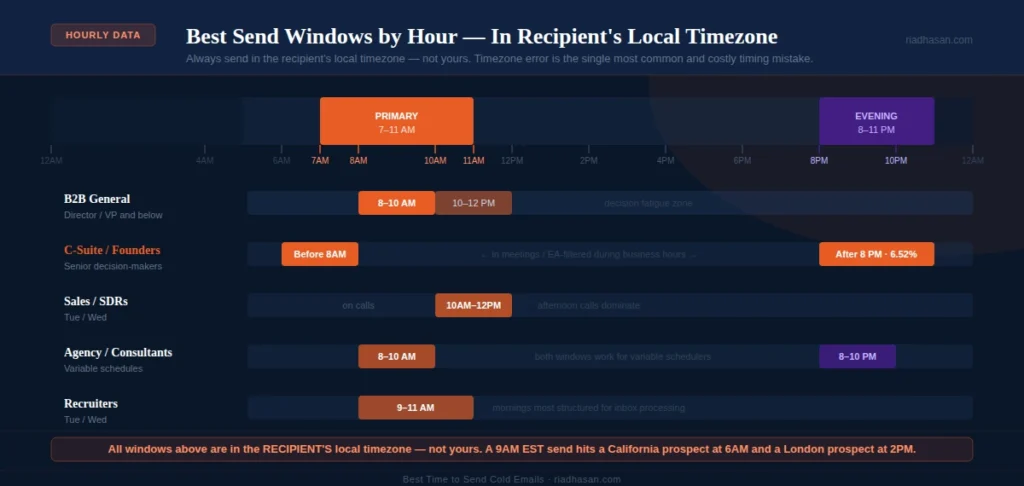
The most common timing mistake in cold email is the unsegmented timezone blast: scheduling a campaign for 9 AM EST and sending it to prospects in California (6 AM), London (2 PM) and Singapore (9 PM) simultaneously. Some of those sends are well-timed. Most are not.
Send timing within the recipient’s timezone matters more than the absolute time on your clock. A 9 AM EST send hitting a UK prospect at 2 PM, right as afternoon decision fatigue sets in, loses the open rate advantage of the morning window entirely.
How to handle timezone segmentation
- Segment by geography before launching any campaign. Most sending tools (Instantly, Smartlead) allow timezone-based send scheduling. Use it.
- Prioritise the three major B2B zones: US East (EST), US West (PST) and Western Europe (GMT/CET). These three cover the bulk of most B2B target lists.
- Use the recipient’s local time as the reference point, not yours. A prospect in Berlin receiving your email at their 9 AM is better positioned to reply than one receiving it at their 4 PM — even if both hits feel like “morning” from your desk.
- For global campaigns, build separate sequences by timezone block. One sequence fires at 9 AM EST for US East prospects; another fires at 9 AM CET for European prospects; a third fires at 9 AM SGT for APAC. Same content, different send schedules.
Why Open Rate Timing Data Is Unreliable in 2026
Nearly half the “opens” in your cold email dashboard are not humans. They are Apple Mail proxy servers, corporate security scanners and bot traffic pre-loading tracking pixels. Apple’s Mail Privacy Protection, active since 2021 and now covering a substantial share of iOS and macOS users, fires tracking pixels before a human actually opens the email. Google began flagging more emails with “suspicious message” banners in August 2024, further suppressing genuine pixel loads.
The practical consequence: timing guides built on open rate data are partially misleading. The metric that tells the truth about timing is reply rate.
This is why the Belkins 16.5M-email dataset (which measures replies, not opens) is more reliable as a timing reference than most blog posts citing open rate studies. Its findings (7–11 AM and 8–11 PM as the strongest windows; Thursday at 6.87%; weekends 60–75% below average) are based on actual human responses, not bot-triggered pixels.
The implication for your own campaigns: use reply rate as your primary timing metric when running send-time A/B tests. Open rate will lie to you. Reply rate won’t.
How Much Does Send Time Actually Matter?
Timing is real but it is not the biggest variable. The 30–45% improvement Growleads documents from timing optimisation is meaningful. But the difference between a well-targeted campaign and a poorly-targeted one, or between a properly warmed domain and a broken one, is measured in multiples, not percentages.
The order of priority for cold email optimisation:
- Infrastructure (deliverability) — emails that land in spam have a 0% chance of a reply regardless of send time
- ICP targeting — relevant emails to the right person outperform irrelevant emails at any time
- Personalisation and copy — the opening line and value proposition determine whether a read becomes a reply
- Send timing — optimises the window in which all of the above get the best shot at being seen
Timing is a multiplier on everything else, not a substitute for it. A well-timed bad campaign is still a bad campaign. A strong campaign timed well produces 30–45% more replies than the same campaign timed randomly. Worth getting right, but only after the three layers above it are solid.
How to Find the Best Send Time for Your Specific ICP
General benchmarks are a starting point. Your ICP’s specific behaviour is the final answer. Here is a three-step process to find your own optimal window:
Step 1: Start with Tuesday or Thursday, 9–10 AM local
Use the consensus data as the baseline: send your first campaign on Tuesday or Thursday, targeting 9–10 AM in each recipient’s local timezone. This is the most consistently strong window across all major datasets and gives you a reliable performance floor to compare against.
Step 2: Run a simple A/B timing test
Once you have baseline performance data from at least 200 emails sent, split your next campaign into two timing variants:
- Variant A: Tuesday 9 AM local
- Variant B: Thursday 9 AM local (or Tuesday 8:30 PM for C-suite segments)
Run both variants for the same duration, to the same ICP segment. Compare reply rates, not open rates. Wait until you have at least 100 sends per variant before drawing conclusions. Anything less is noise.
Step 3: Narrow toward your winning window
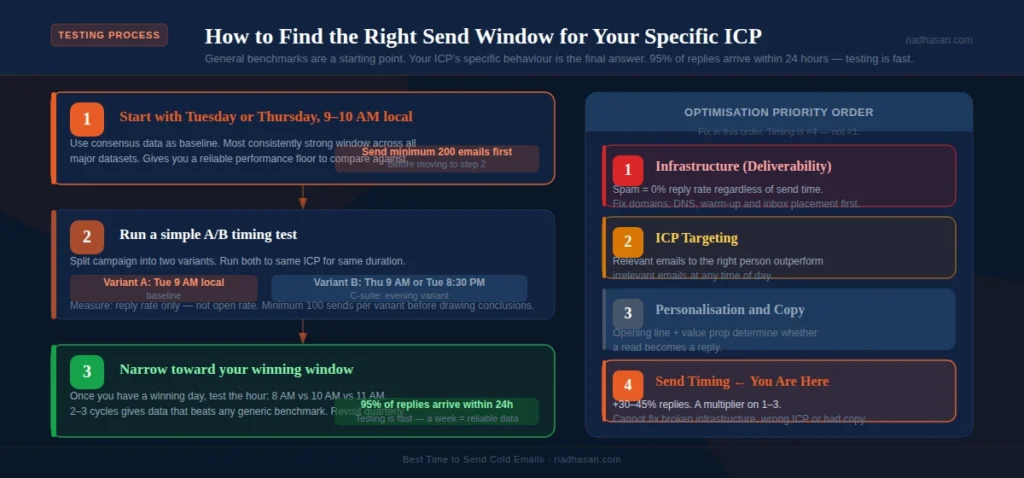
Once you have a winning day, test the hour within that day. The 8–10 AM block is the starting point. Test 8 AM vs 10 AM vs 11 AM. Again, minimum 100 sends per variant. Over two to three testing cycles, you will have data specific to your audience that beats any generic benchmark. After that, schedule all campaigns to that window and revisit the test once per quarter in case your ICP’s behaviour shifts.
95% of replies to cold emails arrive within 24 hours of sending, according to Growth List’s 2026 data. Testing timing is therefore fast. A week of data gives you a reliable read on whether a send window is working.
The Timing Mistakes That Cost the Most Replies
Sending to everyone at the same clock time
The single most common and most costly timing error. A campaign scheduled for “9 AM” that delivers at radically different local times across geographies loses the benefit of the morning window for most of its recipients. Always send in the recipient’s local timezone.
Sending on Monday morning
Monday morning has the highest open rate and one of the lowest reply rates. Prospects are processing weekend backlog, not engaging with new outreach. Save your campaigns for Tuesday or Thursday and use Monday for other preparation tasks.
Sending on Friday afternoon
Mental checkout before the weekend starts as early as 2 PM on Friday in most markets. A Friday afternoon cold email has a high probability of sitting unread until Monday, at which point it competes with the full weekend backlog. The reply never comes.
Optimising send time before fixing deliverability
Moving a campaign from Monday to Tuesday is worthless if the emails are landing in spam. Timing optimisation belongs at step four in the optimisation sequence, not step one. Verify inbox placement before worrying about the hour.
Frequently Asked Questions
What is the best time to send cold emails?
The best time to send cold emails is between 8 AM and 10 AM in the recipient’s local timezone on a Tuesday or Thursday. Belkins’ analysis of 16.5 million cold emails found Thursday generates the highest reply rate at 6.87%. An evening window of 8–11 PM also performs strongly (6.52% reply rate), particularly for C-suite targets who manage their own inbox after hours. Both windows produce significantly better results than mid-afternoon or weekend sends.
What is the best day to send cold emails?
Tuesday is the best day for B2B cold email reply rates, producing +45% above the weekly average according to Growleads’ analysis of 400+ campaigns. Wednesday and Thursday follow at +30–40%. Monday generates the highest open rate (22% of weekly cold email opens per Growth List) but a weak reply rate — professionals clear their weekend backlog on Monday without engaging new outreach. Avoid Friday afternoons and weekends, which produce 30–75% below-average performance.
Does send time actually affect cold email reply rates?
Yes. Moving from unsegmented timing to Tuesday or Thursday at 10 AM in the recipient’s local timezone produces 30–45% more replies without any copy changes, according to Growleads’ campaign data. That said, timing ranks fourth in order of impact behind deliverability infrastructure, ICP targeting and copy quality. It is a multiplier on everything else — a strong campaign timed well outperforms the same campaign timed randomly, but timing alone cannot fix a campaign with broken deliverability or poor targeting.
What is the best time to send cold emails to C-suite executives?
For C-suite executives and senior decision-makers, send before 8 AM or after 8 PM on a Tuesday or Thursday. Senior executives manage their own inboxes outside business hours: before their day fills with meetings and after their calendar clears in the evening. Sending during standard business hours means your email competes with a full schedule and often gets processed by an EA rather than read directly. The evening window (8–11 PM) produces a 6.52% reply rate in the Belkins 16.5M dataset, making it particularly strong for this audience.
Does timezone matter for cold email timing?
Yes. It matters more than the absolute time on your clock. Sending at 9 AM EST to a prospect in California delivers the email at 6 AM, before most people are at their desks. The same send hitting a London-based recipient arrives at 2 PM, in the middle of decision-fatigue afternoon. Always send in the recipient’s local timezone. Most sending platforms (Instantly, Smartlead) support timezone-based scheduling. Build separate sequences for US East, US West and Western Europe at minimum.
Why is open rate unreliable for testing send times?
Apple’s Mail Privacy Protection, active since 2021, pre-loads tracking pixels before a human actually opens an email. Nearly half the “opens” in most dashboards are machines, not people. A campaign can show 70% open rate and still produce 2% replies. The opens were bots. Open rate tells you nothing reliable about whether your timing is reaching humans at the right moment. Use reply rate as your timing metric instead. Reply rate cannot be faked by a proxy server.
Pick a Window, Test It, Then Move On
Most teams spend months debating send timing while running campaigns at random hours. The data is clear enough to act on: start with Tuesday or Thursday, 9–10 AM in the recipient’s local timezone. If you’re targeting C-suite, add an 8 PM test variant. Run 200 emails, compare reply rates and let the data narrow your window from there.
Timing is worth 30–45% more replies. That’s real. But it’s the last thing to optimise, not the first. Get the infrastructure, the list and the copy right first, then squeeze the extra performance out of timing.
- Cold Email Infrastructure Setup — the deliverability foundation that makes timing irrelevant until it’s solved
- Cold Email Best Practices 2026 — the full system from targeting to reply management
- Cold Email Sequences — cadence structure, the widening gap method and how timing applies across a sequence
- Cold Email Deliverability — inbox placement testing before any campaign launches
If you want campaigns built with proper timing, infrastructure and targeting optimised for your ICP, you can work with me directly at riadhasan.com.