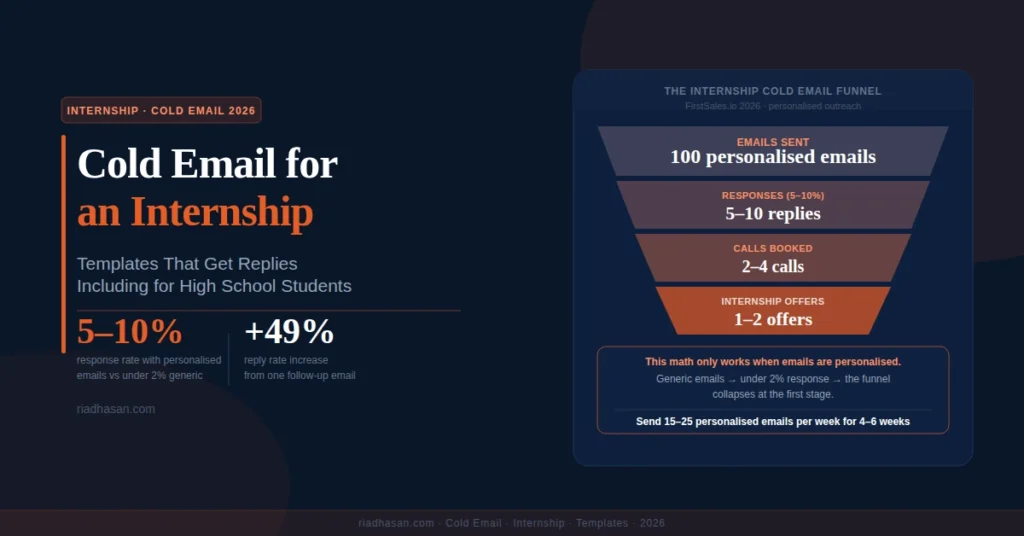
Doing Cold email for an internship works. The way most students do it doesn’t. A well-personalised cold email to the right person at a target company produces a 5–10% response rate. A generic copy-paste email to anyone on the company website produces under 2%. The difference is not talent or experience. It’s research, specificity and structure.
Most internships are never publicly listed. The students who find them are the ones reaching out before a role appears on a job board. This guide covers everything you need to do it right: the research process, the five-part email structure, subject lines that get opened, templates for every situation (including high school students) and how to follow up without being annoying.
Does Cold Emailing for Internships Actually Work?
Yes, more reliably than most students expect. The math, from FirstSales.io’s 2026 analysis: send 100 personalised cold emails, receive 5–10 responses, convert 2–4 of those into calls, land 1–2 internship offers. That’s a better conversion rate than most formal application processes, and most of those internships would never have appeared on a job board.
Cold outreach works for internship seekers specifically because hiring managers appreciate the initiative. For an entry-level candidate with limited experience, showing that you identified a specific person, researched their work and wrote a tailored email demonstrates exactly the kind of proactivity that makes someone worth a phone call. Your credentials might not set you apart. The approach you take can.
Two things kill this approach: generic templates that could be sent to anyone and contacting the wrong people. Both are fixable before you send a single email.
Who to Email and How to Find Them
The right person is not HR. HR processes formal applications. Cold outreach to HR produces the lowest response rates because they’re not the decision-maker. They’re the gatekeeper for a process you’re trying to sidestep.
Target one of three people:
- The hiring manager for the team you want to join — the person whose team the intern would work on. For a marketing internship, this is the head of marketing or a senior marketing manager, not a recruiter.
- A mid-level team member in the relevant function — someone two to four years into their career at the company who can refer you internally or reply informally in a way HR won’t.
- A mutual connection at the company — if anyone in your network works there or went to your school, a warm introduction through them multiplies your response rate significantly.
To find them: search LinkedIn for “[Company] + [function]” and filter by seniority. For email addresses, use Hunter.io (enter the company domain to find email formats), LinkedIn’s contact section (many people list emails directly) or guess the format (firstname@company.com, firstname.lastname@company.com) and verify with a free tool like NeverBounce before sending.
Research First: What You Need to Know Before Writing a Word
Spend 10–15 minutes researching each person before writing their email. This is not optional. It is the thing that separates a 5–10% response rate from under 2%. The research produces the opening line that makes the email feel personal rather than automated.
What to look for:
- Something they’ve published or said publicly: a LinkedIn post, a company blog article, a conference talk, a podcast appearance. That becomes your opening hook.
- Specific work at the company: — a project they’re leading, a campaign they ran, a product feature they launched.
- Something about the company that is genuinely interesting to you — a recent product launch, a market expansion, a press mention about work you find relevant to your studies.
- Their career path — did they go through a similar degree program? Did they intern before joining full-time? This creates natural points of connection.
If you can’t find something specific after 10 minutes of research, move to the next person on your list. A generic opening line is worse than no opening line.
The Five-Part Structure of a Cold Internship Email
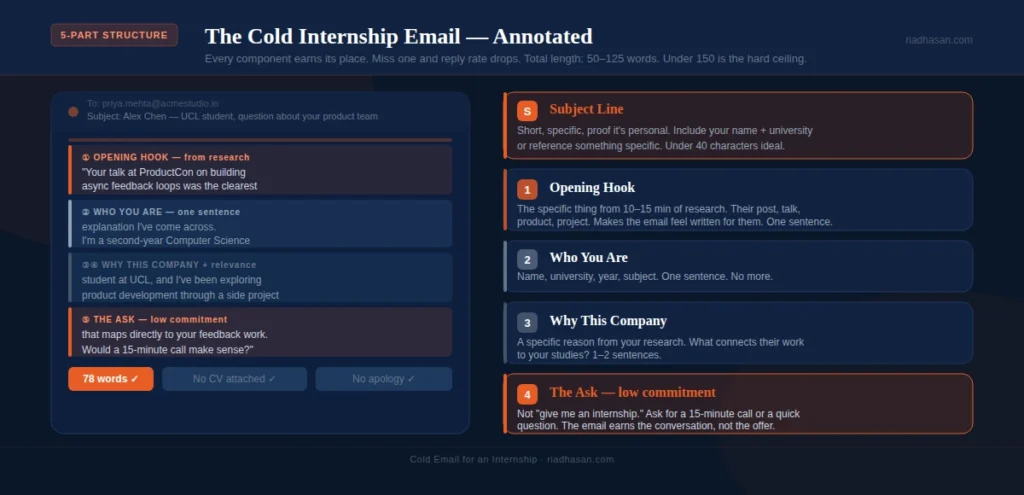
Every effective cold email for an internship uses the same five-part structure. Miss any one of them and reply rate drops.
- Subject line: specific, short and proof that the email is for this person, not blasted to a list.
- Opening hook (1 sentence): reference the specific thing you found in research — their article, a project they led, a company announcement. This is the entire personalisation.
- Who you are (1 sentence): your name, university, year and what you study. No more than this. Keep it factual.
- Why this company (1–2 sentences): a specific reason tied to your research. What aspect of their work connects to what you’re studying or interested in?
- The ask (1 sentence): a clear, low-commitment request. Not “give me an internship.” Ask for a 15-minute call, a quick question about the team or whether they’d be open to hearing more about your background.
Total length: 50–125 words. That’s five to seven sentences. An email longer than 150 words costs you response rate every time you go over. The goal is not to tell them everything about you. It’s to earn a reply.
Two things to leave out entirely: an attached CV (offer to share it if they’re interested) and an apology for reaching out (“sorry to bother you” signals low confidence before you’ve said anything about yourself).
Subject Lines for Internship Cold Emails
Personalised subject lines produce a 35.7% open rate vs 16.7% for generic ones. Subject lines between 21 and 40 characters hit the highest open rates at 49.1%, according to Whali’s 2026 analysis of internship outreach data. Including the company name in your subject line adds a 21.9% open rate lift.
Subject line formulas that work
- [Your Name] — [University] student, quick question about [their team]
- Loved your piece on [specific topic] — [University] [Year] student here
- [Mutual connection] suggested I reach out
- [University] [Major] student — interested in [Company]’s [specific area]
- Question about your work on [specific project/initiative]
- [Your Name] — interested in [Company Name] internship opportunity
Subject lines to avoid
- “Internship Inquiry” — generic, looks like a mass send
- “Seeking internship opportunities” — impersonal and common
- “Resume attached” — creates friction before you’ve earned it
- Subject lines over 10 words — get cut off on mobile, where most email gets read first
Cold Internship Email Templates
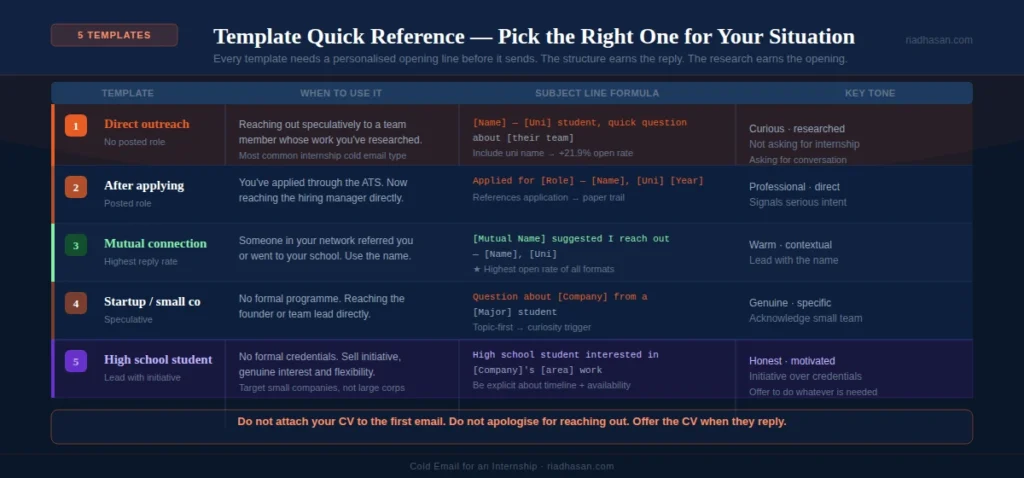
Every template below needs a personalised opening line before it sends. The structure earns the reply; the research earns the opening.
Template 1: Direct outreach to a team member (no posted role)
Subject: [Your Name] — [University] student, quick question about [their team]

Hi [First Name],

[One specific thing from your research — their LinkedIn post, a company announcement, a project you found in your research. One sentence.]

I'm a [year] [major] student at [University], and I'm particularly drawn to [Company]'s work on [specific area you researched]. [One sentence about what connects their work to your studies or interests.]

I'd love to ask you a few questions about the team. Would you be open to a 15-minute call, or happy to answer briefly here?

[Your Name]
[LinkedIn URL]
Template 2: Response to a posted internship role
Subject: Applied for [Role] — [Your Name], [University] [Year]

Hi [First Name],

I submitted an application for the [Role] internship last week and wanted to reach out directly.

I'm a [year] [major] student at [University]. I've been following [Company]'s [specific work or initiative] for [timeframe] and [one sentence about why this role specifically connects to your academic or project work].

I'd welcome the chance to share more about my background. Happy to send my CV if useful.

[Your Name]
[LinkedIn URL]
Template 3: Via a mutual connection or referral
Subject: [Mutual Name] suggested I reach out — [Your Name], [University]

Hi [First Name],

[Mutual connection] mentioned you'd be a good person to speak with about internship possibilities at [Company].

I'm a [year] [major] student at [University]. [One sentence about relevant coursework, project or skill that connects to the team's work.] I'm looking for a [summer/autumn/spring] internship and [Company] is at the top of my list because [specific reason].

Would a brief call make sense?

[Your Name]
[LinkedIn URL]
Template 4: Speculative outreach to a small company or startup
Subject: Question about [Company] from a [Major] student

Hi [First Name],

[One specific thing from research — a product feature, a company blog post, recent press coverage.] It's exactly the kind of work I want to understand better.

I'm a [year] [major] student at [University]. [One sentence about a relevant skill, project or tool relevant to their work.]

I know [Company] is a small team — if there's any capacity for a [paid/unpaid] intern this [timeframe], I'd be a motivated addition. Worth a quick call?

[Your Name]
[LinkedIn URL]
Cold Email for Internship: High School Students
High school students cold emailing for internships face a different set of expectations. You have fewer credentials to point to, and that’s fine. The approach that works at this stage is different from a university student’s outreach.
What to lead with instead of credentials
At high school level, what you’re selling is not your experience. It’s your initiative, your genuine interest and your willingness to do whatever the team needs done. Hiring managers who bring on high school interns are doing it because they want to invest in someone motivated, not because they need someone with a CS degree. Your email should make clear you understand that dynamic.
Specific considerations for high school students
- Be explicit about your timeline and availability. Mention whether you’re looking for a summer placement, a school holiday slot or a part-time arrangement during term. Ambiguity about your availability is the biggest conversion killer at this stage.
- Target smaller companies and startups. Large corporations typically have formal internship programmes with set entry criteria. Small companies and startups are far more likely to take a motivated high school student on an informal basis.
- Reference a genuine interest, not just the company. The most effective high school cold emails explain why you’re interested in the specific industry or type of work — not just “I want work experience at a good company.”
- Lower your volume expectations and raise your research standard. At high school level, 10 highly personalised emails to 10 relevant companies will produce better results than 50 generic ones.
Template 5: High school student cold email
Subject: High school student interested in [Company]'s [area] work

Hi [First Name],

[One specific thing from research — a product, a project, a piece of company news you genuinely found interesting. One sentence.]

I'm a [year] high school student at [School Name], and I've been interested in [relevant field] since [brief genuine reason — a project, a course, something you built or made].

I'm looking for a [summer/holiday] placement and would be willing to help with whatever the team needs. I know this is an unusual request — I just wanted to reach out directly rather than wait for a formal programme.

Is there any chance of a short call to explore whether there's a fit?

[Your Name]
[Email / LinkedIn if you have one]
How to Follow Up on an Internship Cold Email
The first follow-up can increase reply rates by up to 49%. Most responses to internship cold emails come from follow-ups, not the initial email. Send one follow-up three to four business days after the initial email if you haven’t heard back.
The follow-up has one job: remind them gently that you exist. Keep it shorter than the original email. Reference your first message, add one new piece of context if you have it and ask the same question again.
Follow-up template
Subject: [same thread]

Hi [First Name],

Just following up on my message from [day]. Wanted to make sure it didn't get buried.

[Optional: one new sentence — something you read from the company, a relevant course you just completed, or a specific project you're working on that connects to their work.]

Happy to answer any questions or share my CV. Would a quick call work?

[Your Name]
After two unanswered emails, stop. A third email without a response crosses into intrusion. Move on to the next person on your list and come back to this contact in 60–90 days.
How Many Cold Emails to Send
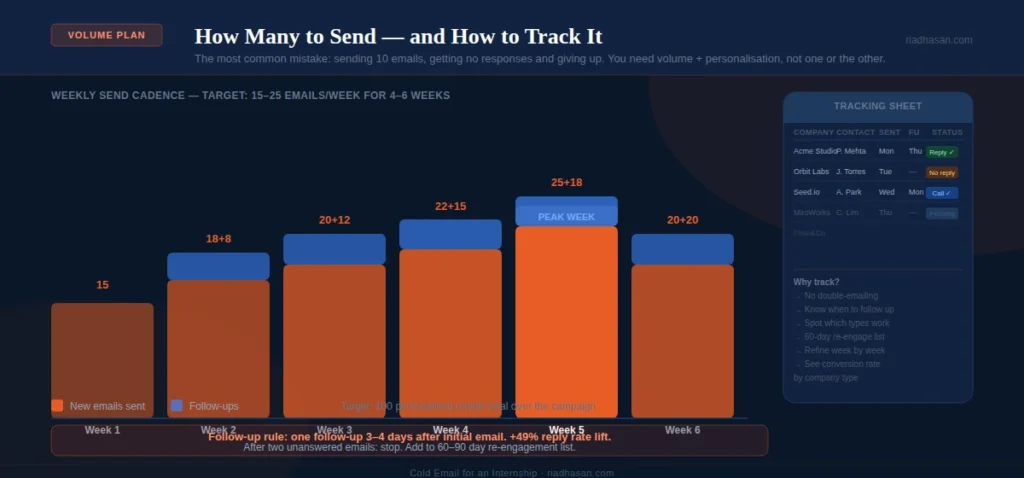
Send 15–25 personalised emails per week over four to six weeks. A common benchmark: 100 well-personalised cold emails produce 5–10 responses, which convert to 2–4 calls, which produce 1–2 internship offers. That math only works if the emails are personalised. Generic campaigns run under 2% response rate regardless of volume.
The most common mistake is sending 10–15 emails, receiving no responses and concluding that cold email doesn’t work. At that volume, the sample size is too small to draw conclusions. Cold email for internships is a numbers game with a research requirement: each email needs genuine personalisation, but you need enough of them to generate a meaningful number of conversations.
Build a simple tracking spreadsheet: company, contact name, contact email, date sent, date followed up, response (yes/no/later). This prevents double-emailing and tells you which types of outreach are producing responses so you can refine the approach week by week.
Frequently Asked Questions
How do I cold email for an internship?
Research the person you’re emailing for 10–15 minutes before writing. Find something specific they’ve written, said or worked on. Write a five-part email: a specific opening hook (from your research), one sentence about who you are, one to two sentences about why this company specifically and a single low-commitment ask (a 15-minute call, not a job offer). Keep the whole email under 125 words. Don’t attach your CV. Follow up once after three to four days if you don’t hear back.
What is a good response rate for internship cold emails?
Well-personalised cold emails to the right person produce a 5–10% response rate, according to FirstSales.io’s 2026 analysis of internship outreach. Generic template emails produce under 2%. At 5–10%, sending 100 personalised emails generates 5–10 responses, which typically convert to 2–4 calls and 1–2 internship offers. Most students don’t send enough volume to see results — 15–25 emails per week over four to six weeks is the practical target.
Should I attach my CV to a cold internship email?
No. Don’t attach your CV to the first cold email. An unsolicited attachment signals mass outreach, can trigger spam filters and makes the email feel transactional before you’ve established any connection. Include your LinkedIn URL in your signature instead and offer to send your CV if they’re interested. Once someone replies positively, you can attach it to the follow-up message.
Is it OK to cold email for an internship as a high school student?
Yes. High school students who cold email for internships have a structural advantage over those who wait for formal programmes. Most small companies and startups don’t run formal schemes, but will take a motivated student on if they make the ask directly. Lead with your initiative and genuine interest rather than credentials, be explicit about your availability and timeline and target smaller companies where the decision is made by one person rather than an HR department.
How do I write a subject line for an internship cold email?
Keep it under 40 characters, include either your university or the company name (or both), and reference something specific rather than using “Internship Inquiry.” Personalised subject lines produce a 35.7% average open rate versus 16.7% for generic ones. Strong formats: “[Your Name] — [University] student, quick question about [their team]” or “Question about your work on [specific project].” Avoid attaching a CV mention in the subject line — save that friction for after you’ve made a connection.
When should I send cold emails for an internship?
Send Tuesday to Thursday, 8–10 AM in the recipient’s local timezone. This window consistently produces the strongest open and reply rates for professional email. Start your outreach three to six months before your desired internship start date. By the time you’ve exchanged a few emails, done a call and negotiated the details, that lead time will feel short. Most internship seats are filled informally well before any public listing appears.
Start With the Research, Not the Template
The students who land internships through cold email all do one thing the others don’t: they research before they write. The template is the frame. The research is what makes the email feel like it was written for the specific person reading it. Because it was.
Pick five target companies. Find one person at each. Spend 10 minutes on each before writing a single word. Send five genuine emails. Follow up on the ones that don’t reply. Then do it again next week.
- Cold Email Subject Lines — 60+ subject line formulas and examples across industries
- Cold Email Personalization — how to write opening lines that prove research happened
- Cold Email for a Job — the same approach applied to full-time roles after graduation
- Cold Email Follow-Up Guide — what to say in each touch and when to stop