Link building is the process of getting other websites to link back to yours. Each link acts as a vote of confidence: a signal to Google that someone else found your content valuable enough to reference. Now you got the answer of the question “what is link building”. Backlinks remain one of the strongest ranking signals in Google’s algorithm, and sites ranking on page one almost always have a meaningfully larger, more relevant backlink profile than the sites below them.
That’s the one-sentence version. The rest of this guide covers what is link building, what it actually involves day to day, why it still works in 2026 after years of “link building is dead” predictions, how many backlinks you actually need, and what separates link building that compounds your rankings from link building that gets you penalized.
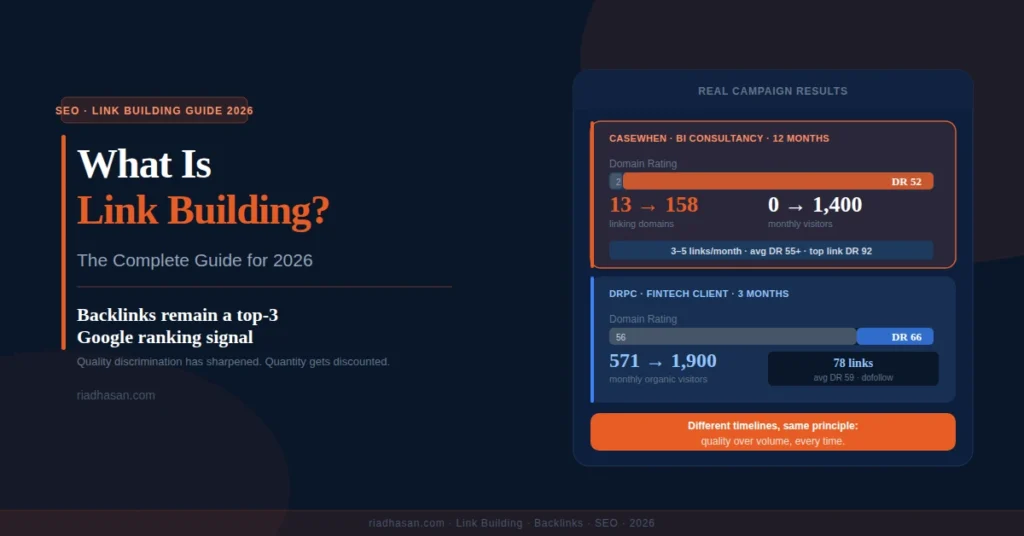
I’ve grown a brand-new domain from DR 2 to DR 52 in 12 months using only 3–5 links a month. I also grew a fintech client from DR 56 to DR 66 in 3 months with 78 links. Both used the same underlying process. It’s the one described below.
What Is Link Building, Exactly?
Link building is the deliberate, ongoing process of earning hyperlinks (“backlinks”) from other websites that point to pages on your own site. It is distinct from backlinks themselves: a backlink is the result, link building is the activity that produces it. You don’t “have” link building the way you have a backlink — you do link building, continuously, as a discipline.
Three terms get used interchangeably in casual conversation but mean slightly different things:
- Link building — the activity: outreach, content creation, relationship building, all aimed at earning links
- Backlinks — the result: an individual link from another domain pointing to yours
- Backlink profile — the aggregate: the total collection of every backlink your site has, including their quality, diversity and growth pattern over time
Search engines treat each backlink as evidence that your content is useful enough for someone else to vouch for. The more relevant, authoritative sites that vouch for you, the more Google trusts your domain, and the higher your pages tend to rank for related search terms.
Is Link Building Still a Google Ranking Factor in 2026?
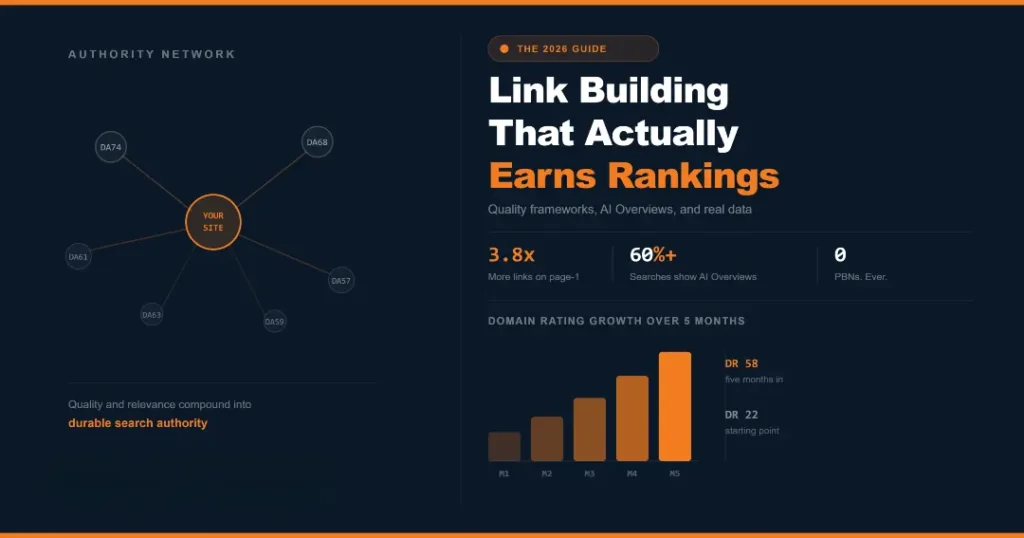
Yes. Backlinks remain one of Google’s top two or three ranking signals according to virtually every independent analysis of the algorithm, and Google’s own ranking systems documentation confirms that PageRank-style link evaluation is still active. What changed isn’t whether links matter. It’s which links matter and how heavily quantity gets discounted relative to quality.
A site ranking in position one typically has several times more referring domains than sites in positions two through ten for the same query. That gap is not coincidental. It reflects a real, measurable correlation between backlink strength and visibility that has held since the original PageRank algorithm and continues to hold today.
What has genuinely changed by 2026:
- Quality discrimination has sharpened. Google’s systems are far better at distinguishing an editorial link earned through genuine merit from a link placed for manipulation. A single link from a highly relevant, authoritative source now outweighs dozens of marginal ones.
- Engagement signals layer on top of links. When real users click a link, land on your page and engage with the content, that link carries more weight. A link nobody ever clicks contributes far less.
- AI Overview citations have raised the stakes. With AI-generated summaries now appearing across a majority of commercial searches, getting cited as a source inside those summaries has become a second prize on top of traditional rankings — and authoritative backlinks materially increase the odds of being selected as a citation source.
- Anchor text over-optimization gets penalized harder. Exact-match anchor text used repeatedly across a backlink profile is now one of the most common causes of ranking drops, not a growth lever.
How Link Building Actually Works, Step by Step
Stripped down to its mechanics, link building follows a repeatable five-step loop. Every tactic (guest posting, digital PR, broken link building, niche edits) is a variation on this same underlying process.
- Identify link-worthy assets. Before any outreach happens, you need something worth linking to: original research, a genuinely useful tool, a thorough guide that’s better than what currently ranks, or a piece of data journalism others can cite. Links follow value. No amount of outreach skill compensates for nothing worth linking to.
- Find the right targets. Identify websites in your niche (or adjacent niches) that have an audience relevant to your content and the editorial standards to make a link from them meaningful. This is where tools like Ahrefs’ Site Explorer, checking domain rating and referring domains, separate real prospects from low-value ones.
- Reach out. Pitch a specific person at the target site with a specific reason your content (or your data, your tool, your expertise) is relevant to something they’ve already published or are planning to publish. Generic, mass-blasted pitches get ignored; specific, researched pitches get replies.
- Earn or place the link. Depending on the tactic, this might mean writing a guest post, having an existing page updated to include your link (a niche edit), being quoted as a source for a journalist’s article, or simply being discovered and linked to organically because the content is good enough.
- Track and maintain. Monitor which links you’ve earned, whether they stay live, what referring domains and DR they carry, and how your overall profile is trending. Link building is not a one-time project — it’s an ongoing function, like content production or paid acquisition.
What Good Link Building Looks Like vs. What Gets You Penalized
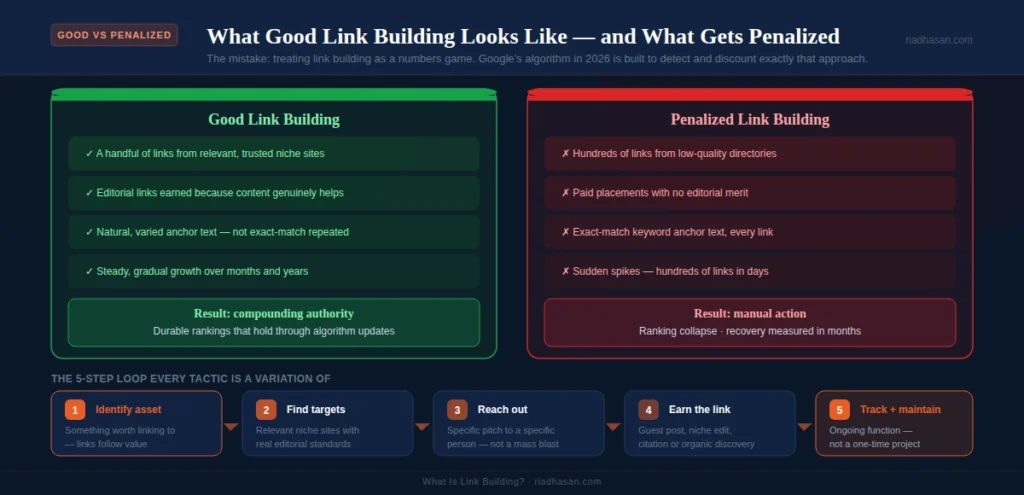
The biggest mistake in link building is treating it as a numbers game rather than a relevance and trust game. Google’s algorithm in 2026 is built specifically to detect and discount the numbers-game approach.
| Good link building | Penalized link building |
|---|---|
| A handful of links from relevant, trusted sites in your niche | Hundreds of links from unrelated, low-quality directories |
| Editorial links earned because the content genuinely helps the linking site’s audience | Paid placements designed to manipulate rankings with no editorial merit |
| Natural, varied anchor text reflecting how people actually reference your content | Exact-match keyword anchor text repeated across every link |
| Steady, gradual link growth over months and years | Sudden spikes of hundreds of links appearing in days |
| Result: compounding authority, durable rankings | Result: manual action, ranking collapse, recovery measured in months |
Google actively penalizes manipulative schemes: private blog networks (PBNs), bulk paid link packages, automated link injection and reciprocal link exchanges run at scale. These tactics can produce a short-term DR bump, but they carry real risk of a manual action that erases years of legitimate progress in days.
How Many Backlinks Do You Actually Need to Rank?
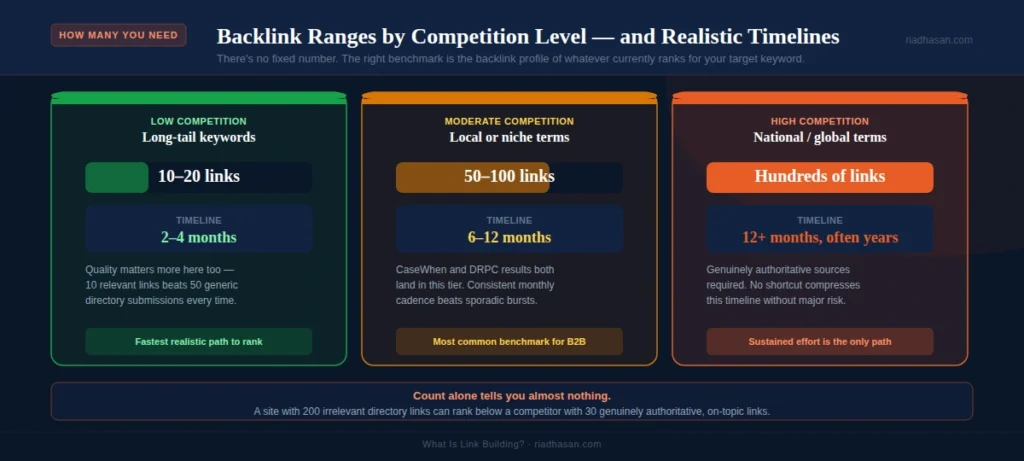
There is no fixed number. A page can outrank competitors with ten relevant, high-authority backlinks if those competitors only have low-quality ones. The right benchmark is never an absolute count. It’s the backlink profile of whatever is currently ranking for your specific target keyword.
Rough, context-dependent ranges that hold across most industries:
- Low-competition, long-tail keywords: often rankable with 10–20 quality backlinks pointing to the page or domain
- Moderately competitive local or niche terms: 50–100 quality, relevant backlinks built over 6–12 months is a common benchmark for local businesses
- Highly competitive national or global terms: hundreds of backlinks from genuinely authoritative sources, often built over years, not months
It’s worth naming the failure mode this guards against: chasing a target backlink count without checking what that count actually needs to look like for your specific keyword. A site with 200 backlinks from irrelevant directories can rank below a competitor with 30 backlinks from genuinely authoritative, on-topic sources. Count alone tells you almost nothing.
The CaseWhen project I ran is the clearest illustration of “quality over quantity” in practice: a brand-new BI consultancy domain went from DR 2 to DR 52 in 12 months: growing from 13 to 158 linking domains and 0 to 1,400 monthly organic visitors, using only 3–5 carefully chosen links per month. No volume play, no shortcuts. Every link had an average DR of 55+, with the highest-authority referring site at DR 92.
Compare that to a tighter timeline: a fintech client (DRPC) moved from DR 56 to DR 66 in just 3 months, tripling organic traffic from 571 to 1,900 monthly visitors, with 78 dofollow backlinks averaging DR 59. Different starting points, different timelines, same underlying principle: a small number of genuinely relevant, high-authority links outperforms a large number of mediocre ones, every time.
| Competition level | Typical backlink range | Realistic timeline |
|---|---|---|
| Low competition / long-tail | 10–20 quality backlinks | 2–4 months |
| Local or niche moderate competition | 50–100 quality backlinks | 6–12 months |
| National or global high competition | Hundreds of authoritative backlinks | 12+ months, often years |
How Long Does Link Building Take to Work?
Google typically takes four to twelve weeks just to discover, crawl and process a new backlink. Ranking improvements on top of that usually take an additional two to six months, depending on competition level and the quality of the links earned. Most meaningful results compound over six to twelve months of consistent effort — link building rewards patience and punishes the expectation of overnight results.
Patience compounds. A domain that earns five relevant links a month for two years ends up with a fundamentally different competitive position than one that bursts for a quarter and stops. The CaseWhen result above wasn’t a sprint. It was twelve consecutive months of the same disciplined process, repeated.
This is also why link building should never run in isolation. A backlink pointing to thin or outdated content does far less work than the same link pointing to a genuinely strong page. Pair link building with content quality and on-page optimization, or the links you earn will underperform their potential.
The Main Types of Link Building (Overview)
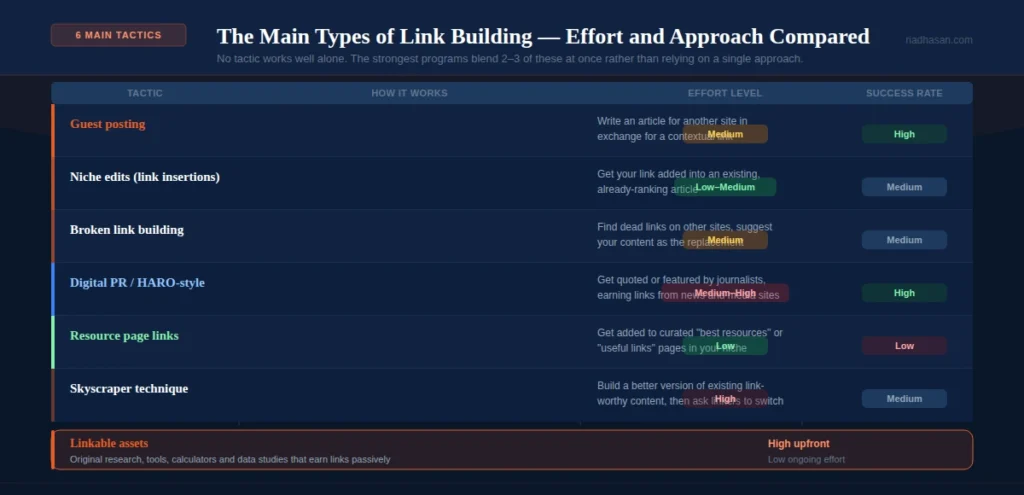
Link building isn’t one tactic. It’s a category covering several distinct approaches, each with different effort levels, success rates and risk profiles. This article covers the category; each tactic gets its own dedicated breakdown elsewhere on this site.
| Tactic | How it works | Effort |
|---|---|---|
| Guest posting | Write an article for another site in exchange for a contextual link | Medium |
| Niche edits (link insertions) | Get your link added into an existing, already-ranking article | Low–Medium |
| Broken link building | Find dead links on other sites and suggest your content as the replacement | Medium |
| Digital PR / HARO-style | Get quoted or featured by journalists, earning links from news and media sites | Medium–High |
| Resource page links | Get added to curated “best resources” or “useful links” pages in your niche | Low |
| Skyscraper technique | Build a better version of existing link-worthy content, then ask linkers to switch | High |
| Linkable assets | Original research, free tools, calculators and data studies that earn links passively | High upfront, low ongoing |
None of these tactics work in isolation either. The strongest link building programs typically combine two or three approaches at once: a steady stream of niche edits for quick wins, an ongoing guest posting relationship with two or three publications, and a digital PR push tied to a specific data release or industry event. Relying on a single tactic exclusively tends to plateau faster than a blended approach.
White hat tactics (the table above) build durable, compounding authority. Grey hat and black hat tactics (PBNs, link exchanges run at scale, automated link schemes) trade short-term speed for long-term risk. The strategy and risk profile of each approach deserves its own dedicated coverage.
Link Building and Topical Authority
Backlinks don’t just lift the specific page they point to. They contribute to your domain’s overall topical authority, the measure of how credible Google considers your site to be on a given subject. Topical authority is best understood as a function of two things: how comprehensively you cover a topic, and how your domain has responded to algorithm updates over time. A domain that earns relevant, consistent links within a clear subject area builds reputation faster than one earning scattered, off-topic links across unrelated industries.
This is why relevance consistently beats raw authority in link building decisions. A DR 40 backlink from a site genuinely in your industry typically does more for your rankings than a DR 70 backlink from a completely unrelated site. The link needs to make contextual sense, both to a human reader and to the algorithm evaluating it.
Frequently Asked Questions
What is link building in SEO?
Link building in SEO is the deliberate process of earning hyperlinks from other websites that point back to your own site. Each backlink functions as a trust signal: evidence to search engines that another credible source found your content valuable enough to reference. Backlinks remain one of Google’s top ranking factors in 2026, working alongside content quality and technical SEO rather than as a standalone tactic.
Is link building still effective in 2026?
Yes. Despite years of predictions that link building was dying, it remains one of the strongest ranking signals in Google’s algorithm. What changed is the quality bar: Google’s systems now distinguish manipulative links from genuinely earned ones far more accurately than in previous years. A handful of relevant, authoritative links consistently outperforms hundreds of low-quality ones, and engagement signals (clicks, time on page) from a link now factor into how much weight that link carries.
What is the difference between link building and backlinks?
Link building is the activity: outreach, content creation, relationship building, all aimed at earning links. A backlink is the individual result: one specific link from another domain pointing to yours. Your backlink profile is the aggregate of every backlink you have, including their quality, diversity and growth pattern. People often use the terms interchangeably, but link building describes the ongoing process; backlinks are what that process produces.
How many backlinks do I need to rank on Google?
There’s no fixed number. The right benchmark is always the backlink profile of whatever is currently ranking for your target keyword, not an absolute count. Low-competition long-tail terms can rank with 10–20 quality backlinks. Competitive local or niche terms typically need 50–100 built over 6–12 months. Highly competitive national terms can require hundreds of links from genuinely authoritative sources, often built over years. Quality and relevance matter far more than raw count.
How long does link building take to show results?
Google typically takes 4–12 weeks just to discover and process a new backlink. Ranking improvements beyond that usually take an additional 2–6 months depending on competition and link quality. Most substantial results compound over 6–12 months of consistent, ongoing link building. It is a long-term strategy: expect gradual improvement rather than a sudden jump, and treat sustained effort as the baseline expectation rather than the exception.
What types of link building are there?
The main categories are guest posting (writing content for other sites in exchange for a link), niche edits or link insertions (getting added into already-published, ranking content), broken link building (replacing dead links with your own content), digital PR (earning links through journalist outreach and media coverage), resource page links (getting listed on curated link pages) and linkable assets (original research, tools or data that earn links passively over time). Each has a different effort level, success rate and risk profile.
Link Building Is a Discipline, Not a One-Time Project
The sites that dominate competitive search results in 2026 aren’t the ones that found a clever shortcut. They’re the ones treating link building as an ongoing function, the same way they treat content production or product development, rather than a campaign with a start and end date.
Start with a tight ICP for who you want links from, build something genuinely worth linking to, and earn a handful of relevant links consistently rather than chasing volume. The compounding effect is real: every relevant link makes the next one easier to earn, because your growing authority makes you a more credible source to link to in the first place.
- What Are Backlinks? — the foundational definitions: dofollow, nofollow, anchor text, referring domains and more
- Link Building Strategies That Work in 2026 — the tactical playbook for executing what’s outlined here
- Link Building Services & Agency Pricing — what it costs to outsource this and what to look for
- White Hat vs Black Hat Link Building — the risk spectrum across every major tactic
If you want a link building system built around real outreach and genuine relevance rather than volume (the same approach that took one client from DR 2 to DR 52), you can work with me directly at riadhasan.com.